

Data Faces · Episode 31 · February 10, 2026 · 38 min
AI governance is moving faster than most companies can control. Gene Arnold on closing the gap.

Listen: YouTube · Spotify · Apple Podcasts · Amazon Music
About Gene Arnold
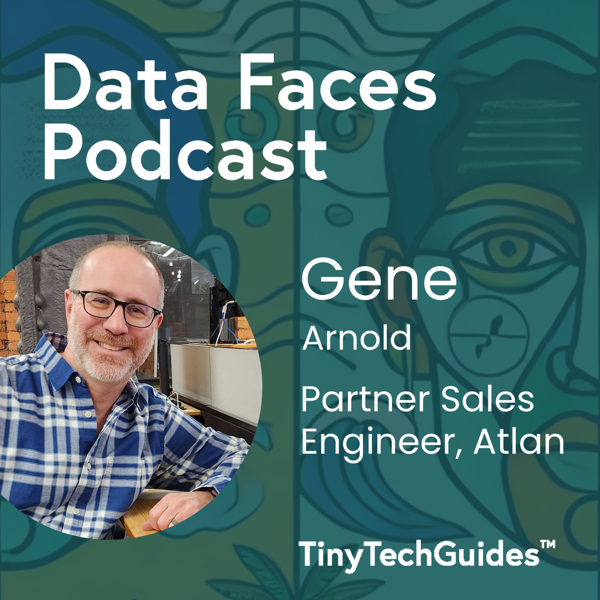
Gene Arnold is a Partner Sales Engineer at Atlan, where he came to AI through the data-catalog world and found that models living on top of data make governance unavoidable. Beyond enterprise software he runs a GitHub AI-agent engineering course, builds with 3D printers and stepper motors, and hosts the “Regular Guy Mountain Biking” YouTube channel.
In this episode
- Why the people most excited about AI often care most about governance
- How pressure from leadership and individual contributors creates governance gaps
- Why models persist bias rather than create it
- The role metadata and semantic layers play in AI accuracy
- How to pick your first AI project — and what to watch for
→ Read the full article: Why the biggest AI enthusiasts care most about governance
Full transcript
David Sweenor 0:06 Hello everyone, and welcome to the data faces Podcast. I’m David Sweenor, founder of TinyTechGuides, and your host for today’s show, this show I talk with the people are actually making data analytics and AI work in the real world. What’s exciting, what’s messy, what’s coming next. Today, I’m thrilled to have gene Arnold on the show. Gene’s a partner Sales Engineer at Atlan. He works closely with data and AI teams, navigating governance in the real world, modern data stacks, partner ecosystems, and the plethora of growing AI use cases. So today we’re going to talk about AI governance, what’s working, what’s broken, how it relates to data governance and how to get started. So gene, welcome to the databases podcast. Yes.
Gene Arnold 0:44 Thank you, my friend. I really appreciate you having me on your podcast today. I’ve been looking forward to it. Honestly, I’ve been looking forward to just kind of hanging out and talking to you again. We’ve got some great history, and it’s always nice to just kind of see and talk tech. We’ve always had a great time together. So yeah, thanks so much for having me on your on your podcast today.
David Sweenor 1:00 Yeah, absolutely. Thanks for joining. So can you just for people who may not know you, tell us a little about yourself and what you’re doing over at Atlan, certainly.
Gene Arnold 1:10 So yeah. Gene Arnold, right now I’m currently the partner I see here in Atlan. Atlan is a data quality, not data quality, a data cataloging system. And currently, really what I do is I spend a lot of time connecting Atlan with various partners like snowflake, Databricks, si ISVs, and just talk about how Atlan can help their organization. What it has done for me, though, is really gotten me into the AI space, and I’m sure we’ll talk more about it today. But considering the fact that models pretty much live on top of data, and you need to find the data, all of a sudden, the catalog has become a new importance in this whole fun world. So I’m pretty excited about it. I’ve learned a ton about AI because of it. In fact, it’s become my new love and passion. I can’t get enough of AI, so that’s what I do. Yes, I’m a partner I see, but I would say I’m more of a AI advocate. And I just, wow, I’m telling you, man, I just can’t get enough of this new, new AI thing going on.
David Sweenor 2:16 It’s awesome. Well, I hope, I hope our audience has heard of the term AI, so we’re good, we’re good there. But maybe, before we jump into that, the some of the things on governance, you have a YouTube channel, hugely popular. That’s not a fake background, but it’s called regular guy mountain biking. Tell us how that all got, got started there?
Gene Arnold 2:35 Yeah, yeah. No, those are, those are real bikes I can Yeah. It’s not like, hey, let’s let’s pretend I’m athletic. We’ll put some bikes behind actually, let’s take the athletic back. I’m not that. So let me answer your question, my friend, I’ve always had a massive passion for mountain biking, but I’m old enough that there was no social media or YouTube when I first started getting into biking. I always wanted to do more with the industry, but at that time, the only way you could do more is to be a pro like you had to be really good, right? And I’m really bad. I had no way to get into the industry unless I opened a bike shop. And from all my friends that own bike shops, they basically said, Gene if you open up a bike shop, just don’t ever expect to ride again, because all you do is work in you do is work in the bike shop, right? So fast forward to regular guy mountain biking. The world of social media allows you to get into industries in a different way, right? So I started talking about mountain biking, recording my rides with my friends, doing product reviews, and all of a sudden I found myself in the industry, right? I was still just as bad as I was before. I didn’t get any better, you know, but it was a way for me to embrace the sport I love even more. So that’s where regular guy mountain biking came from. Still exists right now. Wish I was spending more time on it, but that’s okay. It’s it’ll still be around there for me. That’s right.
David Sweenor 4:04 Well, it’s a little cold with the snow on the ground. Jean, so it’s okay to take some time off. I know you got the bad tires. I hear you. I know. The other interesting thing about you is, Gene you’re like a regular old renaissance man. You’re a maker. You’ve got a 3d printer. I saw a YouTube series you’re doing on AI creating AI with some stepper motor. And you got a GitHub AI engineering course, AI agent engineering course. How like when you were young? What did you want to be when you grew up?
Gene Arnold 4:40 That is such a wonderful question, because I really didn’t know, honestly, I That’s why you do everything. That’s why I do everything. I mean, honestly, I don’t want to take a lot of time on this, but I only became a sales engineer by accident. It was a complete fluke, my friend, okay, I was a D. DJ, you know, the wiki kind of guy for for a long time, like probably
David Sweenor 5:05 about 15 we’ve had on the show, not the first all. Right, here
Gene Arnold 5:09 we go spinning the wheels of steel over here. So anyway, that was when I was bringing milk crates or records into catering halls. God, I love the babble. Anyway, not that you’re having a tough time figuring this out, but I’m not too shy in front of the camera and the microphone. I like this, and that’s why I enjoy DJing. Now, a buddy of mine, I’ll spin this a little faster, asked me if I wanted to become a sales engineer. I was already a kind of a techie, nerdy guy, right? So I didn’t even know. I said. I said. I said, Look, dude, I don’t even know what that even means. Gene, you’ll be fine. Just come on. Do you want it or not? I’m like, Okay, let’s Oh. And what I found out that sales engineering was a nerds stage to basically present and have fun, like I was a techie guy doing presentations. I’m like, Wait, this is like me. So how I got here was basically by accident. I never really knew what I wanted to do, and I just kind of kind of fell into my lap, and now all I want to do is AI. So there’s no way I would have been able to say when I was a kid I wanted to learn more about AI and become an AI advocate and help with this amazing topic, because it didn’t exist back then. Because, right, okay, old, yeah, so, yeah. All wonderful, wonderful relationships and some, some pretty good fortune.
David Sweenor 6:43 And that’s super cool. James, super cool. So let’s, let’s shift gears a little bit and talk about data and AI governance. And I guess the first question I have for you is, we, everybody’s probably familiar with data governance, yeah. Is AI governance related? Are they the same or are they different? Great question.
Gene Arnold 7:05 They’re certainly related. Okay, I would definitely say they rely on each other. And let me get into some details over here, AI, artificial intelligence, all your models, everything that’s out there today, all these things, right? They’ve been trained on data, sure. Okay, so in order for these tools to be accurate, right, in order for them to work well, they need to have been trained on on good data, right? Okay, well, there’s your data governance part, is your data clean? Is your data accurate? Is your data bias? Okay, so there’s your data, your data governance part, right? Okay, and then you’ve got your AI, your AI governance, which is more around decision making and how the system is going to work. I’m sure you’ve heard of the world. Heard of the word agentic, right? Ai, agentic workflows, where you’re having models make decisions and do things. So if you think of data governance as around, how are we going to handle PII data? Okay? AI, governance is, how are we going to react when we’re asked a specific question, all right, agents can have tools, right? Which tools should we use under what situation? And then when I use that tool, let’s go back to data governance. What data should I expose? Right? So all of a sudden they start to become very, very close, right? It’s an agent. Let’s govern what it’s allowed to do and how, and then when it does it, what data governance, what’s it actually going to respond back when you ask that question into the chat bot, is it? Is it exposing what you want it to? Exposure? Whoops, did you add the wrong database to to your model? And all of a sudden the company’s Secret, secret sauce is coming out the window, so you see how they both work. One’s helping you with the decision, how to govern it and properly work in a more of a functional decision making world and data governance is more around properly controlling. I won’t say the word controlling, but keeping the data in a state that will work well with your systems now.
David Sweenor 9:26 Gene that makes perfect sense to me. If we were just double click on that a bit for what I’m from, what I’ve seen. And I’m not an expert in the data governance space. Most companies, I want to say it’s my perception. They’re stuck in the past. They’re focused on rows and columns traditional databases. What about the 80% of unstructured data that’s out there that we tend to forget? Are they focused on that? Or how do people think about that?
Gene Arnold 9:56 The Wow, that’s a really good question. And the reason why I say that. Really so good a question is because that’s where most of your answers are. Right? If you think about your unstructured data, your emails, your manuals, whatever you know, okay, images, music, but really I’m gonna say things like emails, documents, things like that, that’s where your answers are right. That’s where your conversations are. So your smarter companies are using tools to properly extract that information out of that whether they’re pushing that into vector databases or however they want to manage that information, you’ll see a lot of work with just people dumping that information in s3 buckets, just because it’s just terabytes of information, right? But it’s the best information, because, other than that, what you’re really getting metrics and dimensions, right? A date and a value. Okay? Well, it’s not what I want. What I really want is give me the the general topic of this 15 email chain, like, what was discussed? Okay, right? What was the temperature of the conversation? How did it go? I didn’t need to know what my quarterly sales are. That’s a SQL query, yep, right? That’s a number. That’s a value. So I think larger organizations are realizing, holy cow, we’ve got a gold mine just with what we’ve recorded in our customer support chat conversations, sure, right? If you think about how much information is in there, you’re literally understanding what products are having problems, what are working, what ones are working? Well, who’s answering your questions correctly? I mean, you could just go on and on the unstructured data. That’s where it’s at. Dude, that is. That’s the goal line, right there.
David Sweenor 11:56 Do you think, though? Gene, so take your take a simple example of like you mentioned, like a manual, and so I’m sure you talked about, you mentioned, I mentioned that you have a 3d printer, and I’m sure there’s some sort of instructions on how to print whatever you want to do. Yeah, you might have multiple versions of that, but you could, one could envision, in a corporate ecosystem, all 10 copies of those instructions are out there. Do you think companies have a have a handle on how to know which one to pick or to feed their their AI system?
Gene Arnold 12:28 I don’t really think so, to be honest with you, unless they properly have spent the time to curate that information, honestly, I’m going to come back and kind of say what, what I do, right? I help with the data catalog, not trying to promote Atlan for that specific use case. But if you think about it, one of the things that a data catalog does is it helps you organize and understand everything you have in your data estate. Do you have duplicate data? Do you have siloed data? How do you find information on that. That’s just why a catalog so nicely couples to this whole AI.
David Sweenor 13:06 Yeah, nobody can find anything. Can’t find
Gene Arnold 13:08 everything, right? So the only thing I would say, though, in a response to your question, is that what I can do now with AI is feed all 10 of those versions into a model, and now ask it questions I’d like to do X, please return to me what you think is the most correct way of handling X, and it’ll respond well, based on the knowledge that I have. These are the three different methods that I feel would be appropriate, and that’s where the human in the loop comes in, right? But without that, I’m not going to read all 10 models. I’m certainly not going to comprehend and remember all of them, right? So even if an organization does not keep up with pruning, you know, short old information, at least you have a method of burning through it quickly, right then finding out what you need from it, and then you bring in the human in the loop to make sure you go the right way.
David Sweenor 14:10 All right, that makes sense to me. So let’s talk a little bit about then, AI governance. And you said, I think you meant to summarize your sort of like it’s, it’s how you understand the decision that’s being made and why it’s being made and things like that. I’m sure all companies are pro AI governance. Is it working? Are the things broken? Or, you know, what are you seeing out there in the world?
Gene Arnold 14:34 Probably the, I would have to say, the biggest area where I feel is is is broken right now, is the fact that this whole world of AI is moving so quickly that everybody wants to make the new cool way to save the company, right? I mean, remember, I’m not picking on more business focused folks, but you. Your your general sales rep can literally create AI tools to help do things sure you don’t have to be a super techy nerd. You don’t have to know how to code. So where I think companies are failing is, oh, that looks really cool. Real fast we can use that well, whoa, whoa, whoa, whoa, who owns it, who’s responsible for it, who trained it right traceability on where the data is coming from. And that’s why I think, I think the stat is, I could be wrong, but it’s going to prove a point. 80% of AI projects generally do not go to production, because it’s just so easy to make something. But then when you really put it down into the real world and run it well, did you really properly QA this new cool, cool thing. So I think where they’re failing is not having a proper governance workflow to make sure. Okay, cool. Look. We don’t want to stop innovation. That’s a bad thing. We don’t want to stop it. In fact, it’s great now that more people can innovate. But here’s the box. Let’s try to stay somewhere in the box. Okay, it’s okay to be outside of the box because that gets us. But in general, I need you to stay here so that we can then evaluate it, because it could be a winner. It really could be a winner, but we need to make sure that it’s
David Sweenor 16:31 safe, right? And you met, you mentioned that, you know, everybody in a company can be an innovator now. And are you seeing so governance is certainly important. Are companies picking the right transformative use cases? Is it more? Do you see more of a tops down, like the leadership says we’re going to focus on this, these core things, or do you see more on sort of a bottoms up where individual individuals are sort of doing like, I’ll say, productivity improvement type, type use cases to make their own lives easier and better and faster and smarter.
Gene Arnold 17:10 I think another really good yes, good, some good question. The reason why I like this question is I think this is probably one of those times in the industry that’s kind of coming from both sides. And I truly, truly believe that because the top down AI in general, is not that hard a concept to understand. I mean, look, we could get into the nuts and bolts, don’t get me wrong. But in general, everybody’s talking to chat GBT right now to help them create an email. It’s not that hard. I mean, everybody I can talk to my phone. Now, people have been talking to Alexa for years. Ai the concept. So from the top down, these these individuals are, why aren’t we doing it? Because this company is doing it, and they’re moving faster than us. So it’s a me too. We have to be in the in the AI race. Why will because we’re supposed to be sure. Top down, what are we doing? What are we doing, but bottom up, I can go and build something right now, I’m thinking, before we actually click the record button, you and I were talking about any then wonderful tool, boom, I can knock out a workflow in a couple minutes. And again, we were also talking about how many templates there are, there’s so many things already done. So that’s why I feel it’s it’s both right? Because bottom up, I don’t have to be a rocket scientist to build something. Top down, I don’t have to be a rocket scientist to understand we need it, right? So we’re both racing from both ends, and that’s where I feel the governance factor has to kick in, because if we don’t agree, right, if we don’t agree, how to do this, that’s not good, right? Make it. Make it. Make it. Hey, look what I made. Look what I made. Okay, hey, whoa, they made it. Send it out. Whoa, stop. No one’s saying it’s not cool. I love it. I haven’t been more happy about a technology in my life, and that’s why I’m such an advocate for AI governance, because I don’t want to see it fail.
David Sweenor 19:06 Okay, so what are the implications of maybe a lack of good governance? Are there any real world failures that you could totally you could cite, and I think I’ve seen some LinkedIn posts from you on this, so
Gene Arnold 19:18 yeah, definitely. I mean, if you, if you’re really bored and have absolutely nothing to do, certainly follow me on LinkedIn and I’ll help you fall asleep at night. You can read some of my posts, but one, and I did fact check, this is the last thing you ever want to do is say the wrong thing about an organization. But if you do do a Google search on AWS, is little, little issue they had with their hiring process. What they were doing was they were using models to help feed through resumes to figure out, I mean, Ada, how many possible candidates do they get right? 1000s of them Sure. So they tried to, well, unfortunately, here’s the thing. It, as I mentioned earlier, models are trained on data. Okay, I can’t train a model on the future. I don’t know what the future. I have no data on the future. We could try to predict the future. But how are we predicting the future? We’re predicting the future with what we know about the past and what we kind of know currently, and even what we know currently, technically is the past, right? The minute I say something, it’s already old, it’s already history. So I’m training a model on what was once. And guess what? History’s got some good, good points, and it’s got some black marks too, as well, right? I mean, we’ve got some things in history that could have gone a little better. Well, unfortunately, women in the technical industry, probably not, probably at all. Definitely didn’t get a really fair shake when it came down to being a candidate for a job. And I’ve worked with some incredibly intelligent women, so I think that’s what. It’s a horrible number because it’s completely incorrect. It’s just totally wrong. But that is
David Sweenor 21:00 history, okay? Because it’s just what they were in the training set, right? That just that.
Gene Arnold 21:04 That’s it. That’s just how it was trained. Okay? That’s just history. I can’t change it, and I can’t change it. So a model doesn’t create bias. A model simply persists bias, right, right? The model was trained on x. If x was biased, then guess what? The model is bias. So unfortunately, when when resumes came in and had anything like head of the woman’s check chess club or any it woman, any more feminine type wording was actually
David Sweenor 21:38 a negative right? Yeah, I give a negative
Gene Arnold 21:40 score there. Yeah, negative score. And where does that come back? Well, there you go. Ai, governance, okay, accountability, traceability. Who designed the model? What did you train the model on? Did you run it past 10,000 20,000 resumes? I mean, now you can spin up synthetic data like that. Were you properly QA, ing the model for various criteria to see if it’s okay? So that’s just one of the example. Another example was organization. Guess what? Didn’t actually get proper authority to use the faces that they were using in the models. So basically, what was happening is facial recognition and how it was returning information. They didn’t actually have the rights to do that. Traceability, accountability, one of the areas where organizations are failing is they’re just they’re moving too fast. They’re not taking the time to make sure that the block and tackle is being done in the beginning. And, you know, those are just a couple areas where organizations just figured, you know, they hit the mark. You didn’t spend the time to really properly make sure that it should be released.
David Sweenor 22:57 Yeah, that’s interesting. And so there what like the second one, the faces. That’s sort of a illegal issue that I think would have been caught, caught in a lot of these checks you mentioned. You know, do we have the right to do this? And should we be doing it? All that stuff, the Amazon example, with the resumes, you can envision a scenario where they did all their due diligence. Let’s give them the benefit of the doubt. Sure, smart companies, smart engineers, to do all their due diligence. And the model, everything is working perfectly with what they had right was history predicting perfectly what they historically had. So I guess that maybe that’s one of the big differences between data and AI governance that you mentioned, is that you have to monitor the output. Yeah, yes, of AI and then, like, how would you even detect that, you know, it’s biased against, you know, a certain demographic, in this case, you know, female candidates, because that’s historically what they’ve done. So I think sometimes that’s that’s, like, pretty nuanced and hard to understand if you’re detecting that.
Gene Arnold 23:56 I recently wrote a paper on AI bias, and let me give you here. Let me give you an example, so I could have group A and group B. These are two different groups of people. And if this, this was based on loan approval, all realistic, synthetic data, but based on accurate history. And I could run a loan approval test and say if a candidate had a PhD or not, the PhD group okay would get approved more than not having a PhD, okay, that makes sense, fine. But then what would happen would be you would expect, well, then if the PhD group was no longer a PhD, give them a bachelor’s degree, right? And make them even now this. Was bachelor’s. This was PhD. PhD wins, okay, PhD, bachelor’s, no PhD, PhD, now they’re the same, and this one still won. Well, all of a sudden, PhD was covering up a another feature. Maybe it had to do with zip code, right, maybe it had to do with maybe it had to do with race. It could be anything like that. So the problem is, sometimes one feature in the model that’s using to calculate its accuracy can outweigh something else, and all of a sudden, when that one’s turned off, like you said earlier, we were testing it. We were practicing. We were testing it, we would expect Sure. PhD, okay, well, all of a sudden, guess what we found out? PhD, people didn’t pay their loans back, right? They’re really smart, but they don’t care about paying their loans back. This bachelor guy, the one that worked really, really hard, and it’s just kind of middle class making things happen, responsible, all of a sudden. But these guys won. You had the PhD. We picked the right person. Actually, this. The PhD covered the fact that down here, loan payment wasn’t always paid in full. Okay, so again, how do you figure this out? Constant testing, tweaking the levers to make sure that you properly, at least make it as unbiased as you can, and then bring in specific filters and tweaks, handicaps, if you will, to even out things the best. You will never get it perfect, but you can see where the human in the loop comes into play over here. Sure can’t just flip the switch and say, best of luck, and let this thing go all day long and hope that you get it right. That’s scary. All right, that’s
David Sweenor 26:45 that’s super interesting. So I think the importance of testing is definitely something that we should be aware of and tweaking the leverage. I like that, that phrase. So for people who want to get started with AI governance, yeah, you’re a builder. Give us some practical advice. What can they do?
Gene Arnold 27:02 Yes, you need to pick one process at a time. Obviously, you’ve always heard that, you know, don’t eat the elephant one, you know, one, one process at a time. But here’s the important part, you need to pick a process that you know is working well, but you want to automate, because unless you know what good looks like, how do you know if the model is doing well? Okay, so I need to take a process that I know should be always doing this, the output in the input, I need to know what they are. Okay? If I input this, it should come out like that. Okay? So the model needs to know and be trained on what good looks like. How is it supposed to be trained on what good looks like? If you don’t know what goods looks like, pick something that works. It’s very scary to build a model to fix a problem you’re having. If you don’t know what would have fixed the problem without the model, take the model out of the equation first.
David Sweenor 28:11 Right? How we got to know what to do AI, is not a bad right?
Gene Arnold 28:15 I always, I always say, automation can either make things really good really fast, or make things really bad, really quick, right? You have to make sure that you know what good looks like. So you pick something that you believe in. You can say, Look, I need a win. I need to trust this thing. Because what’s that going to do? It’s also going to help you now learn around the infrastructure is that working well like you’re not. You’re going to learn more than just how to fix that one problem. You’re going to learn if your team works well together, is your AI governance workflow proper, right? So you’re going to learn a ton by just picking that one project that you already know how it’s supposed to end, and that’ll help you work on other areas of the system as well.
David Sweenor 28:57 You mentioned something very interesting. We you know how it’s supposed to end so, you know, with this, this project or this process, if you think of things as a workflow, you see companies innovating like an entirely new way of doing things with AI. Or are they just, you know, to your point earlier, are they just automating, putting more automation into an existing flow so it it goes either better, faster or crappier, faster.
Gene Arnold 29:23 Well, you know what? I like the idea that they’re innovating it and doing it a different way. Because you Ever hear the saying, you can’t throw more people at a problem, right? You can’t just,
David Sweenor 29:32 I’ve seen it my whole career. Yeah. Riot work. The team size gets bigger and bigger and bigger, and
Gene Arnold 29:40 it’s not, it’s not a scalable approach, right? It’s your point. You can’t bring any more people in. So I think this is a good time to be able to sit back and rework poor tooling, right? Okay, look, it’s got us here. Let me, let me give you again. I’ll give you another example. There are still extremely large. Large organizations running these organizations on Excel spreadsheets.
David Sweenor 30:05 I’m always amazed by that, right? I’ll
Gene Arnold 30:07 go in there and we’ll be like, Hey, what are you using? No, you’ve got, okay, so I can’t
David Sweenor 30:14 it’s not even a Google Sheet. It’s an Excel sheet. I know, I know,
Gene Arnold 30:17 on a green screen of the day. That’s not something you’re looking to like make faster. We got to retool this one. So I’m just going to use that as an example, right? There are there times where, well, you know what? We can just we needed someone to read all these files. We still think they need to be read, but I’m going to have a model run them now. The process is fine, but the model can read it faster than a human. Okay, right? Sure. Totally cool. But there are other times, like the expel Excel spreadsheet, where we’re going to say, Well, now’s a good time to bring in a new system, right? And retool and if we’re going to do this, what can AI offer us, and where does it fit in?
David Sweenor 31:06 Sure, okay, I like that. Maybe one more question here before we start to start to wrap. But let’s talk about a little bit about accountability that’s come up a couple of times in this discussion. How do you think about that? What do you need for accountability? What kinds of data or metadata do you need to make that work?
Gene Arnold 31:29 Well, there’s a couple of ways I can go with that. One, as far as accountability goes, I think that really comes down to just, we’re just kind of kind of loop back around and start from the beginning with AI governance, right? I’m going to say, when you have a project, one of the things that Atlan does is you can catalog all your models. So I can catalog models, I can look at models, and I can see what data it was trained on. I’ve got lineage to understand where everything’s coming from, right? So one thing that I feel is very important is that when it comes to accountability, how did you build the thing? Who built it? Who owns it? But now you, you said the magic word, metadata. Now, dude, you open up a whole nother door. We can talk about another podcast. It’s a whole nother podcast, right? Hey, Gene part two, no, but at the end of the day, metadata is, is literally, I feel, the deciding factor on how a model answers correctly. Okay, you need something called the semantic layer, right, a semantic view of how to properly answer a question. So what I’m saying is, if I ask a model a question, it might not know how to answer it without semantic knowledge, extra information to know how to properly answer the question, okay. Gene, what the heck does that mean?
David Sweenor 32:49 Yeah, I was gonna ask you. JJ, semantic model. Tell me say
Gene Arnold 32:54 something that makes sense to me, buddy. Okay, here we go. I’d like to ask the model, please give me a summary of the East Coast. Q1 sales. Okay, just give me a summary. Okay. Model is going to say, what does q1 mean? What is q1 are you on a physical calendar? Does your physical year, your financial year, start in January? Does this? Does it end like, I don’t know what. Give me some semantic information. What are your time frames? What are your what makes up a quarter to you? Model doesn’t know you said quarter. It can assume, since without any other information, it’ll take a guess. But usually models don’t do that, right? I mean, even even their guesses. Remember, it’s not a human, their guesses are still based on fact. Okay, so what it would do, I can tell you this, is, if you train the model on what SQL queries look like that are good. And that’s a very important thing to do when you’re training model, especially things like text to SQL, you need to train a model on what good SQL looks like. It could look at SQL and it can say user asked q1 did not give me a date range, looking at past history and what good SQL looks like. They used January, February and March. I will use January and February March, okay, but that is giving it semantic information. You’re helping the model along. If you don’t, it doesn’t know how to answer some of these questions, and it goes on and on. If I want to ask it for a specific metric, well, how does the company calculate that metric? Oh, you got to give it that semantic knowledge. Okay, so is that it
David Sweenor 34:46 right there? Gene is, is metadata, the metric, say, quarter in this case, right semantics is how it’s calculated. Is that how I should think about it?
Gene Arnold 34:59 Certainly. Look, yeah, the I would say that the metadata, the semantic information, is literally the ingredients in the recipe. To really figure out how to how to make that cake, how to return that answer. It’s helping you understand how to do it, what to say without it. The model just, just doesn’t know, she doesn’t know how to properly do things and well, that’s why you can do any research you want. Everyone’s coming out with semantic model generators, semantic layers. You just do a little search on semantic it’s, it’s all over the place. I’ve got a semantic generator I built. I have to get that video done. Man, it’s a really good example. Actually, I put you together on what, what, what a question looks like with and without semantic knowledge, and when you see that, you’ll be like, Oh, that makes a lot of sense. We’re gonna put on the show notes.
David Sweenor 35:47 We’ll put that in the show notes. We’ll put that link in the show notes. You got some time? We got some time on that. Very good, cool. Well, I guess with that gene, we’re coming up, really to the end of the time. But you know what are some sort of a parting thoughts for people just getting started here, you know, what do they really need to think about and think very carefully about, sure?
Gene Arnold 36:10 Well, first of all, AI is not going away, okay, so I think you need to think about how to use it properly and wisely, okay, AI is just like any other tool, like I can take a hammer and I can build something beautiful with it, or I could take that hammer and I could, I could smash something that was beautiful. Okay, so I think this is the time where you’ve got the chance, because AI is still pretty new, to embrace it, understand what it can do and build something beautiful with it. I love AI. I want to see nothing more than it to succeed, because it’s allowing me to do things that I’ve never been able to do before. So it can make things available to you that you never thought was available to you. So now is the time to just step back, check it out, open up a chat GPT instance and start there and ask it some questions. You’ll get hooked real quick, and all of a sudden you realize, wait a minute, what else can I do with this thing? It’s not that hard, but that’s what that’s what people need to be doing right now, is just start understanding its power and its weaknesses and understand its weaknesses so it’s used correctly.
David Sweenor 37:26 All right. Well. Gene, with that, this has been a fascinating discussion. We could go all day, but I appreciate it so gene, Arnold partner se at Atlan. If you want to learn about mountain biking, go to his channel, threed printing, ai na stepper motor, and his GitHub, AI engineering, AI agent engineering course. Check it out. Gene, thanks for joining the data phases podcast.
Gene Arnold 37:47 Thank you so much, my friend. I had a great time. And yeah, guess we’ll get together some other time, right? Cheers. Bye. Bye. You.