

Data Faces · Episode 11 · May 6, 2025 · 38 min
Tired of B2B messaging that sounds like everyone else’s? Gabriela Contreras on making the customer the hero.

Listen: YouTube · Spotify · Apple Podcasts · Amazon Music
About Gabriela Contreras
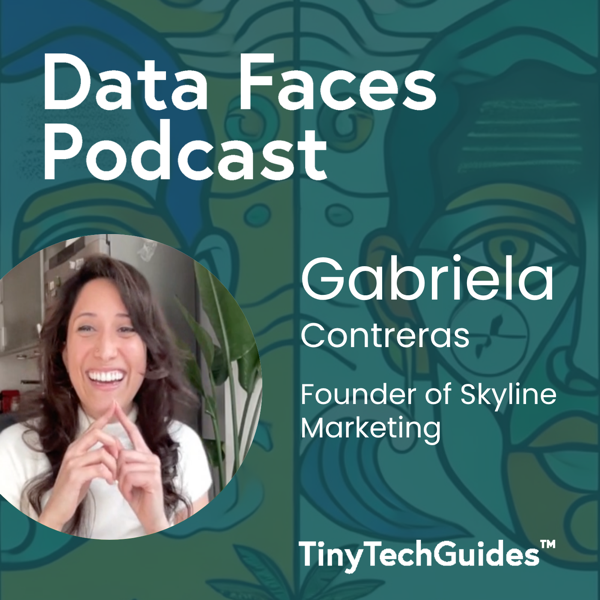
Gabriela Contreras is the founder of Skyline Marketing, where she helps startups position themselves and tell product stories that resonate with buyers. With 8–10 years in B2B SaaS marketing communications, she specializes in helping companies escape “jargon land” and speak about their products in simple, human terms. She also partners with Emma Stratton to help marketing teams write better messaging.
In this episode
- The #1 messaging mistake B2B companies make
- How to navigate messaging for multiple stakeholders
- Techniques for differentiating in saturated markets
- Translating technical features into customer benefits
- How to gain alignment across teams with conflicting needs
→ Read the full article: The customer hero principle: why your B2B messaging falls flat
Full transcript
Gabriela Contreras 0:00 Music.
David Sweenor 0:05 Hello everyone, and welcome to data faces, the podcast that brings the human stories behind data analytics, marketing and AI David Sweenor, founder of TinyTechGuides, your host for today’s conversation, today, we’re going to talk into a topic that every product marketer faces, and it’s going to hit home to every B to B product marketer you know why your messaging isn’t working, and, more importantly, how to fix it. So today, we’re lucky to have Gabby Contreras of Skyline marketing. She is an expert Product Marketing Consultant. She’s got deep experience in B to B SaaS marketing. She helps companies sharpen and refine their messaging and communicate real value with customers. So if your messaging is not punchy enough, if you’re struggling in alignment across teams, or you’re just trying to cut through the noise, this podcast is fused. Let’s dive into it. Gabby, welcome to the databases podcast.
Gabriela Contreras 0:56 Thanks so much for having me, Dave. I’m super excited to be here with you today. Excellent.
David Sweenor 1:00 So Gabby, can you just tell us a little bit about bit about your background and your company? What you
Gabriela Contreras 1:05 do? Absolutely. So I’m founder of Skyline marketing, and really we’re focused on helping startups better position themselves, you know, helping them cut through the noise, tell better product stories that really resonate with buyers, and helping them get away from the jargon land and the buzzword land and really speak to things that they’re doing in a really simple and humanistic way. And, yeah, I’ve been in the B to B soft space for, you know, the last eight years, 10 years in marketing communications. And I just love being in product marketing and working with early stage founders and GTM teams, helping them with their messaging and their positioning. And I also partner with Emma Stratton helping marketing teams, you know, develop new techniques to write better messaging. Excellent.
David Sweenor 1:53 Well, that’s a great intro and background. And, you know, Gabby, it seems so simple to me, there’s three, typically three, core value props and three, you know, core differentiators, or points of distinction. And you’ve worked with a ton of marketing teams and companies, you know, what’s the number one messaging mistake you see at companies make, you know, over and over, what are they where are they going wrong?
Gabriela Contreras 2:16 Absolutely. So I would say that the messaging mistake is usually, almost always a reflection of the GTM strategy. But really, the biggest mistake that I keep seeing over and over again is just positioning to everyone. You can’t be everything to everyone. And unfortunately, I see a lot of startups, especially once they hit like that series B stage, you know, they got a new round of funding. They’re looking to keep growing, and they’ve already found a niche that really loves the product. They get great value from it. And then there is that, that desire to move up market, to branch into other markets. And so that leaves the marketing team figuring out how to speak to all these different pain points and speaking to all these different personas in a similar way, and unfortunately, that doesn’t really help to shape a very clear story or clear narrative. So for instance, segment is an example of a company that felt, you know, not, wouldn’t say victim, but culprit of doing this, right? So they were, they’re, you know, a customer data routing platform, and they were trying to speak to the devs, to the product managers, to the Eco managers, to the marketers. And because they were trying to talk to too many people, they ended up, you know, losing to amplitude and mix panel, which these companies had a narrower, you know, messaging and the audiences that they were speaking to. And, you know, unfortunately, it’s something that we see a little bit of everywhere. So I would say the best way for product marketers that are working on this messaging to really tackle this problem is to really answer the question, which audiences are most urgently going to be raising their hands for this particular product, and how can we speak more directly to that audience, instead of trying to tackle three to four different people that we’re speaking to, and trying to kind of cram all these different value and benefit statements into one ruthless narrowing and prioritization and segmentation at the end of the day, is what can really help to combat that?
David Sweenor 4:19 You know, I love that. I love that concept. Let’s maybe dig down a little bit on this. So we have buyer personas, we have user personas, and then oftentimes, you know, maybe you gotta cater to an IT personas in the mix. So, you know, when you say, narrow your personas, like, Who do you focus on? Is it it or the CFO writing? The big check is, is it the CMO, if you’re making marketing software, or the users of it like, like, what do you recommend to companies?
Gabriela Contreras 4:51 I mean, it all depends on what are the types of materials that you’re working on, right? So obviously, if you know that your buyers. Are going to be like the customer experience leader, then, of course, you need to speak to the person that is going to be signing off on this. But if there are other influencers involved in this deal, like, say, the E commerce manager or maybe the analyst, it’s important to include messaging for how you’re speaking to them in maybe some of the more targeted blogs or the email campaigns that you’re sending out that are kind of used to, you know, encourage people to understand what it is that you’re doing. So really, it’s about understanding where you’re speaking to these different people, and that can kind of also help you narrow down the formats and and who to focus your messaging on. We know that, especially in for like these larger deals, you’re speaking to a lot of different people who are involved in that sales conversation. So you know also doing a little bit of of customer journey mapping can help you understand, like, Okay, we know that these people are coming up the most at this stage of the conversation, then that means that I probably need to help my sales team have better top tracks for this persona, maybe a one pager or a landing page that they can share with them to specifically speak to what it is that they care about. So it requires just taking a little bit more time to pick up on these patterns of who you’re speaking to at these different stages in these conversations, so that way you’re not using too general of too broad of a message, and you can really start to like, resonate with the people that are most brought into these conversations at these different stages. Okay,
David Sweenor 6:36 well, that’s great advice. And so I think your B to B software, especially, I think a lot of the software capabilities will save becoming a little bit commoditized so they roughly do the same sort of stuff. Maybe some buttons are shinier in this software versus that software, but I think that leads us to a lot of the B to B messages, they all sound the same. Hey, we’re open, we’re flexible, we can, we can lower risk. So what can companies do, or product marketing managers do? What can they do to stand out without losing credibility?
Gabriela Contreras 7:13 Yeah, so this is so true, and it’s interesting because I was doing a little bit of research, and there are over 30,000 software companies globally right now, 30,000 so imagine, like, the scale. It’s such a saturated space, like we all know this, and we feel it as marketers, as you know, like the next day you see, and especially, oh my gosh, my product marketers and competitive Intel, my heart goes out to you, because you create all this collateral, and then all of a sudden this new competitor comes in, and you’re like, Oh my God, I didn’t even hear about this company. And here they are putting together all of the same messaging that we have. And it’s a whole freak out situation. It’s really hard because, like you say, the reality is that nowadays, differentiation is pretty narrow depending on which markets you’re in, right? But I’d say that the best way to combat that is staying close to your customer and having a voice of customer program. And when I say a voc program, it doesn’t have to be like a huge, you know, customer intelligence analysis, unless your team has the capacity for that, then that’s great, but if not, it can be something where you’re just regularly collecting insights from customers through interviews, through win loss interviews. These kind of programs can give you some of those sound bites and those tidbits that you can use as a foundation for your messaging. Because the reality is, if you’re not letting customers do the talking, that’s when your messaging starts to go into jargon land, because you’re losing that connection into what customers are really saying. And look, I know a lot of times you can’t use the customer logo or the customer name, and that can suck. I worked with a cyber security client who they couldn’t say anything. They couldn’t use their their customers, you know, information, but you can get creative with it. You can take an anonymous interview style, like in the documentaries, where it’s like someone with, like the the distorted voice and, oh yeah,
David Sweenor 9:17 with the crazy lighting, you don’t really know who they are
Gabriela Contreras 9:20 exactly, with the crazy lighting. Or you can do like a confessions of campaign series, which can also be really fun, but in the end, you can also just use the actual words and the sound bites from what customers are saying, and pick up on these patterns like you’ll start to find the more that you do this, the more you’ll find patterns in what people are saying they really love about your product and how they’re using it, and that, I would say that that’s my biggest recommendation, especially as the space continues to get more and more saturated, I’m
David Sweenor 9:53 wondering, I’m curious about something. I totally agree with you, and I always say you can’t do marketing from from an ivory tower, so you have to get down there. And understand what the customers are saying. I see in a lot of organizations that product marketing managers, particularly, are being pulled in all these directions, and the teams are shrinking. And so what I see happening is most of the conversations with customers are either through the product management team or through the customer success team, typically in a lot of organizations. I wonder if you’re seeing that like, What can a PMM do to insert themselves in those conversations because they’re happening, but usually they’re not included because they got to go create decks for an event or work on messaging or fix the website, or do do stuff, and they’re missing on the gold that informs the messaging that would help help the company overall. I wonder if you’re seeing something similar. Yeah. I mean,
Gabriela Contreras 10:44 it’s hard, especially at bigger organizations, where everyone is working in a pretty siloed manner, something that I’ve seen work really well, again, earlier stage, right? So things are a little bit more connected, but if you’re able to create good partnership with the customer success team, where maybe there are certain points in the customer journey where you know if a customer meets certain requirements, you can be invited to shadow a call, to shadow a QBR, to join in the last 10 minutes, right? I think there are, like small things like that, where it’s not eating up a ton of your time or a ton of the product marketers time, but if you’re able to align on very specific milestones in the customer’s journey, and especially if it’s maybe a customer in a particular vertical that you know that you’re wanting to learn more about, having this sort of alignment can help to create more of like, a systematic way to participate, or at the very least listen in on some of these conversations. But you know, of course, outside of this, I think that’s where the value of conversation intelligence tools really comes in. Yeah,
David Sweenor 11:58 see some organizations using phone calls, those are always full of the issue is, you get so many of them find out what’s in all these things, you know,
Gabriela Contreras 12:08 right then that’s the overwhelm of having too much data to parse through. Yeah, that’s, that’s the flip side. And, I mean, that’s the ideal stage, but that’s just something that I’ve seen maybe an on a more, you know, if you’re stuck in maybe a more manual stage of of your of your organization, if you’re the marketing program is still growing and you’re still building out some of the those initial phases that can be something that can help of just embedding yourself into the the process a little bit more and building trust with the relationship managers first.
David Sweenor 12:39 Because I like that. And so find a way for PMMs out there, find a way to insert yourself in that conversation, either listen to gom calls or or, you know, come up with these. I like that milestone process idea. So Gabby, we’ve both done a lot of messaging in our careers, and what I see is, you know, let’s talk about teams different, the different teams that are involved in having to approve or inform and agree with the messaging. So we got, typically, what I’ve seen is marketing, and I’m guilty of this, I have too much gobbledy gook in there, so too many buzz words product teams want to be, you know, just too technical. Always want every feature function that’s in there, and especially for larger product teams. And then, you know, sales they want. They want something, just an easy talk track that they can remember that’s differentiating. So like, how do you? How do you gain alignment across these teams who have really just sort of sometimes conflicting needs and wants? How do you? How do you how do you rein this in?
Gabriela Contreras 13:42 Yeah, so I have two parts of the answer to this question. Um, first, trying to get them in the room when these initial conversations are happening is really important. Not bringing people in at the end, when you’re already, like, presenting what the positioning is going to be and what the you know the core messages are, because at that point you’ve already lost them. And I’ll give you an example of where I’ve seen that go really wrong and in my experience. So I remember one time we had just rolled out all the positioning and the messaging, and then one of the new Hot Shot, AES, decided to go rogue, and he hired his own designer, and I guess marketing person, to create his own sales. I mean, it was to be fair, was just a slide, but still, to create a slide and his own talk track for it. And I remember, at the time I was, I was so shocked. I was like, wow, the audacity. But at the same time, looking back on that experience, it’s because there was no buy in in the first place, right? Like he hadn’t been brought into the conversation, you know, like, if you don’t have people involved in the initial in the initial conversations, then there’s no way you’ll have that alignment across the board. You have to. Have at least like one champion from every department that’s that’s going to be involved in these, these discussions. Otherwise, that’s how you get to this place where sales is making their own slides. They’re not talking about things with the right messaging, like they’re just doing their own thing. And then the second piece of that, I will say is, before you get into the messaging. Really align on what you’re saying, and ultimately, what is that positioning, right? So really, really get aligned on what is the main value that you’re talking about, and what are the benefits supporting that value, and why this matters. And it’s important to align on the what that you’re saying, so that you’re not arguing over the words. Because I think that’s where there’s often that disconnect, where you’ll have an exit come in like, well, it’s not quite that we do that. It’s actually more that we do this, and really it’s that customers like this and not that. So then you get into back and forth on the what, and then you end up going in circles and circles and circles. So first align on the structure and the value that you’re really going to be talking about. So that way the messaging conversation becomes more of like, oh, well, maybe we can, you know, use this word to inspire more curiosity, or this word to better match our brand voice, you know. So starting from from really aligning on the strategy is super important to make sure you’re getting that cross functional alignment. Okay, that’s,
David Sweenor 16:25 I think that’s great advice. And I think it really just comes back to what you said in the beginning. Is, you know, you really gotta understand the persona that you’re talking to, you know, sort of like Jeffrey Moore, like, what’s your beach head start there? And, you know, have that, you know, maniacal and ruthless prioritization on that one question that came to mind as you’re describing this is so you get your messaging and your positioning done, and now we need a new sales deck, right? You always need a sales deck to go with us. And I’ve seen like nobody can really agree on what the ideal sales deck is like. Sometimes the, say, the senior leaders or executives, they want, like an EBC or like an event type deck, which is very different than, I think, a deck you would use for, you know, maybe a one to one sales engagement. How do you how do you rein them in? Like, they just, they just don’t agree on what they want, you know, and who would, I don’t know if you’ve you’ve seen this, but I’ve seen it. Just curious, your your perspective on that,
Gabriela Contreras 17:24 you know, I think there’s only so much you can do at that stage right,
Gabriela Contreras 17:31 honestly, is just giving them, you know, giving them the colors that we want them to use, giving them the canvas that we would like them to use, you know, encouraging a certain direction in terms of the technique. But at the end of the day, like a salesperson is going to want to create his artwork the way that he wants to create it. So sure a certain degree, it’s like, sometimes, I think it’s less about enforcing for the sake of enforcing and just really explaining the why, of you know, why we’re heading this direction, or why we’re using this format and making sure that it’s something that they can also agree with, and finding a balance there, because also, it’s like, I’m not trying to kill anyone’s, you know, their mojo, or the way that they like go in and and, you know, do what they do best. And I think sometimes as product marketers, we kind of try to get a little bit too micromarging in that way. Um, so, you know, not a direct answer to your question, which I think is just, you know, offering them some templates that they can work with, maybe joining some conversations to see what are some similar ways that they’re framing some of these ideas so that you can then create some better visuals to support what the way that they are saying this, that might be my only other addition
David Sweenor 18:53 to that sure, as a PMM, you know, I think there’s also, you know, these different levels of decks, you know, there’s the very high level, almost like a Corporate deck, and then there’s like, a 101 a 201 and 301 depending on the technical details. Alright, so how about this? Let’s, let’s move on to another question I was thinking about is, you know, you you talked a lot of companies, and I was checking out your web page earlier. But can you walk us through a time when a client had to really unlearn everything they knew about messaging and why and what changed.
Gabriela Contreras 19:24 Oh my gosh, yeah, yeah, I’ll, I’ll share this story of a client that I worked with. First off, one of my favorite founders that I’ve ever worked with in my life. She’s so amazing. Her name is thong Chang. She just such a brilliant mind. PhD in bioinformatics, then went on to create this at the time, you know, like a very, very new way to use AI to automate chat conversations, which now we know chat automation. But when she first started and started building out her her initial solution and her platform. From the way that she was approaching the problem was really new in the sense that she created these patented vertical AI models to basically deeply understand common and nuanced retail and E commerce needs and be able to quickly train the AI on these on these common questions, concerns, issues, escalations, so that the chat bot could very easily and quickly reach resolution with these customers. Obviously, when she and I first sat down, she gave me her whole pitch, and it was so technical,
David Sweenor 20:37 right? What
Gabriela Contreras 20:38 do you mean by your NLU models. Like, what do you mean by this? And it was, it was great, because I actually learned a lot in in those initial conversations about NLU models. But at the same time, it was like, Okay, we’ve got to find a better way to translate the way that you’re, you’re talking about your technology, which is great, obviously, it’s, it’s, it’s doing some awesome things for your customers. And she they were working with great brands, being a really early stage startup, but you know that I and she would go into these conversations with CX leaders, and they would be super inspired by the energy that she brought into the conversation, right? But it wasn’t like they were like fully. They were just like, okay, yeah, I can kind of but it took a lot of explaining to get them to really understand what it is that they were talking about, that Fang was talking about. And so in the end, you know, what we did was we shifted the messaging to be less focused on these proprietary, verticalized AI models, and more on the fact that they were trained on E commerce and retail, and because of that, they were able to understand very nuanced issues and quickly resolve customer issues faster than your average chat bot, which, at the time, and I would say still today, generally speaking, is just gives you the run around and doesn’t really give you what you need. And it also, you know, did consultative selling. Selling, there were so many aspects to it that were so much more sophisticated than what the rest of the market was doing. And so with, you know, we updated their their sales messaging. We also created a new, you know, how it works, technology page, which is also where messaging goes hand in hand with good visual storytelling, right? Like, how are you telling a good before and after picture that is sometimes what’s needed in order to have the aha moment. The words need to be simple and concise so that somebody can can easily get the gist. But the visuals are really what can complement what it is that you’re saying on the messaging standpoint, and then bring the whole thing home. And, you know, Luckily for them, the company link got acquired by capacity, they were able to successfully exit with a clear story. And, you know, in the end, it it helped to simplify their story and to simplify their narrative. But I think that’s just an example of where knowing getting deep enough to be able to translate that technical jargon into something that a business buyer is going to understand is, is super important in order to be able to have these conversations with potential buyers, as well as potential, you know, acquires, you know, yeah,
David Sweenor 23:18 sure. And I’ve definitely seen that a lot of founders, you know, they they bring this energy and this aura, and they’re the only ones that can give the pitch they’re giving, because they have this, you know, gravitas about them. So it doesn’t really work for the rest of the organization. It only works for that unique individual. So, you know this, so this notion, let’s maybe double click down on this, this translation notion. So is there a process you follow to take these, you know, very can be technical SAS solutions into something that you know, someone like me, he went centered message. I can understand it, but you don’t want to make it like so basic. You don’t want to dumb it down, right? So how do you what is that balancing act? Act that. Why are you need to? You need to walk on there? Yeah,
Gabriela Contreras 24:04 absolutely. So I use Emma Stratton’s methodology, you know, shameless plug for Emma Stratton and her punching methodology for how she approaches messaging. I really like the way that she’s, you know, created this framework of basically applying what’s called the vbf rule to whatever it is that you’re trying to message so it stands for value, first, benefit, second and feature last. So a lot of times, you know, as product marketers, we get really excited about the features. We get really excited about the technology, the how, right? And so we lead with, you know, like with this intuitive dashboard, you can achieve X, Y and Z. You can do this one efficiently, faster. But the problem with that is that you’re using Inside Out messaging. So from me, the product the company out, instead of outside in, which is taking into account what. Audience, what your buyer really cares about? What is the superpower that they’re gaining? So what you’re doing is you’re basically, you know, figuring out the how, so you already know the how. Okay, right? What is it that the how enables you to do? So what are those benefits like? Now you can work faster, work smarter, be able to have all of your data in one place, and then from there, the work is moving from benefits into the big win or the value. So what is the big thing that your customer, your user, gains from whatever it is that your your product is doing. And so by using that framework, you can, you know, easily translate the how into the what and then into the big when. Now I say easily, we
David Sweenor 25:47 could say it’s hard work, for sure,
Gabriela Contreras 25:50 that’s where the finesse comes in, because it can be really hard to figure out what’s the benefit, what’s the value, right? Because sometimes you can flip them, you know, and it’s like, well, this is really important, but, you know, maybe it’s this, or maybe it’s that, and, and that’s really where the messaging work is, is taking the time to really marinate and and see where it is that you can understand whether something is truly a big win for for your customer, or whether it’s just, you know, like something that helps them in a in a, like, smaller or less important way. And then the second piece on this is also altitude. So I think that’s where the what you’re talking about, of translating something really technical into more simplified messaging. That’s also part of the work, which is figuring out, you know, who are you talking to? Are they going to care more about the foundational technology? So maybe, if you’re speaking to a developer, obviously, like they’re going to not want the marketing, Bs, they’re like, No, I don’t want any of that fluff. Give it to me straight. Like, yeah, sure. What is this really the value that I’m going to be getting? And that’s where having a lower altitude, where you’re more deeper in the weeds, will kind of be a more valuable way to speak to this person, versus, if it’s a CFO high level, they’re like, Okay, I don’t care so much about that, but how is this going to help me do my job better, and how am I going to make sure that this is not going to be interfering with any of The systems that we already have in place, etc. So that would be the other component is altitude, knowing where, where to keep your your message on that spectrum, and how to translate that into something that makes sense for the audience that you’re talking to.
David Sweenor 27:35 So Gabby that that’s, I love that answer, maybe just one on this value benefit feature framework. You know, I love that concept, and I’ve written plenty of messaging documents over a number of companies. Hey, maybe one of them is, we’re going to increase productivity. Like, I’ve never felt like I need to have more productivity personally,
Gabriela Contreras 27:59 right? Like, it sounds good.
David Sweenor 28:02 It’s unproductive enough. It sounds good. Like, like, for a business, oh yeah, the business wants to be more productive. In the end, there are users or people using so the business is going to be more productive. But like, what’s that balance of this you speak to, like, the the value I’m personally going to get, like, maybe I don’t have to work 25 hours a day, you know? I know there’s only 24 hours a day, but you sort of get the idea like, what’s the or the emotional attachment, or, like, you know, personal value. How much of that do you do? You see companies bringing out or or not, there’s a still, hey, reduce risk, more productivity, optimize, blah, blah, blah. I don’t need to be optimized,
Gabriela Contreras 28:39 right? I don’t need to be optimized. I want to put that on the t shirt. There we go. Please don’t optimize me. I’m good, exactly, but you’re so right. And I think that’s where, you know, we have to be less robotic in the way that we’re speaking, because obviously, you’re talking to another human. They’re the ones that are going to be using this product. It can be kind of scary to just say, like, 10x your productivity, like, what does that really mean? And that’s where tapping into the human emotion comes in, like, it’s it’s less so 10x your productivity and more about freeing yourself from these annoying, tedious tasks that are slowing you down, and, you know, making you spend a million hours jumping from spreadsheet to spreadsheet, right? So that’s where it’s like, you have to be able to tap into that human emotion. And I think there are some, there’s some really good techniques out there where you can take the increased productivity and then, or I can explain it. So you take the something like increased productivity, and you ask yourself, Okay, like, so what? So I can, you know, do my workouts, so what, so that I’m less stressed about having to report into my my next meeting. And, and you keep on digging into that, and then you get more and more into some of the more emotional components of of what it is that you’re that you’re saying. And. Um, once again, that’s another technique that Emma Stratton, you know, teaches in in her workshops, is, how do you double click into that the like, generalized word that we all use and make it mean something
David Sweenor 30:16 I like that, don’t be annoyed. Reduce your annoyance factor. But it’s very similar to, like, the five, the five whys and like six sigma lean, you know, just keep asking, Why, why, why? And take it down to the cause Exactly. All right, so probably have time for two more questions here. So let’s talk about, you know, you said you work a lot with early stage startups and I’m sure many other clients, but how do you see their message evolve? You know, as they, you know, find their product market at fit, you know, I think these, you have an idea, and sometime in the future, it’s a little bit different. Some of the core elements are there. But how does their messaging evolve? And what have you seen there? Yeah, things become more competitive too, probably, as as other people are saying, Yeah, opportunity here. So I’d love to hear your perspective
Gabriela Contreras 31:01 on that exactly. So really, it’s about whether or not you’re evolving with the market. And I think that’s where having a market intelligence effort is important, where you’re really understanding, okay, what new players are in this market. How is the technology advancing? You know, how are the buying decisions happening in different ways? What is the spend that’s being invested into these types of technologies right now versus a year ago versus three years ago? You have to have a pulse on these things, otherwise the messaging doesn’t evolve with the market. So I can give you an example of that. When I was initially developing, you know, marketing strategies for contact center. Ai, I would say, like, six, seven years ago, sure, it was the hot new thing, right? So at the time, there weren’t a lot of vendors that were, they were, they were really expensive. They were just crappy, you know, like, they Right, right? Like, let’s keep it real. They the there was, like, super inaccurate and undependable outputs. They couldn’t really use this and use these insights in any way that made any sense. And when I say insights, it’s like being able to understand what customers are saying in, like, customer service conversations, and doing something with that, right? So at that time, you know, as contact center AI was coming into the scene. What we were doing was really new, because the technology was much more advanced. It was more accurate, you know, the speech recognition and detection was just more evolved than what a lot of these other players were doing. So because of that, we were able to apply a really fresh messaging, a fresh approach into, you know, actually being able to get analysis and insights on customer intent, on sentiment, all of these things were, I wouldn’t say that they were new, but actually being able to use them and for them to detect more nuanced aspects of the conversations was new. So at the time, I was like, Oh my gosh, we got to focus on this. This is our messaging. This is our positioning. But then, you know, now the market has evolved a lot since then. Sure, there are so many players. You have zoom came out with the contact center. You have Amazon contacts, like you have all of these other players, vendors that have entered the market, which you know now we know it is this conversation intelligence that’s used for the contact center in seacast Right. And with that shift, the messaging has to change, and it has to be more about how what you’re doing is solving the problem in a different way. And again, once again, that goes back into positioning right, which is really being able to understand what problem you’re solving for who your competitors are, how what you’re doing is different, and understanding the market context of what you’re doing. And all four of those pieces have to be taken into account. And as companies evolve, sometimes the it’s the messaging stays in how we’re solving the market problem, and it doesn’t shift as much into okay, this is how we’re solving the market problem, differently from everyone else, right? That is a harder because it’s a moving target, right? Because technology is evolving so fast these days, so, so so fast. I have a theory that I think that’s why time is feels like it’s moving faster, too, but that’s topic for another day,
David Sweenor 34:24 another podcast on that one like, truly,
Gabriela Contreras 34:27 but because of that, you know, it’s like you’re it’s really hard to actually evolve your messaging at the speed that it needs to evolve, because the competitive nature of what you’re doing changes weekly. So, you know, keeping a pulse on that is important, and doing the best that you can to tell real, differentiated customer stories, I think, is, is the best approach to that, and being able to really deeply explain, like, how is it that this company actually used to. The technology to improve these specific areas in their business, and how they did it actually deeper level than just, you know, again, improved productivity, increased efficiency, actually optimized
David Sweenor 35:15 for sure. Alright, yeah, alright. So maybe the last question before we wrap is, you know, if you can give one piece of, let’s call it maybe unpopular advice to B, to B marketers about messaging, what is that piece of advice? Yeah,
Gabriela Contreras 35:33 so less of an unpopular opinion and more of a reminder your product is not the hero. Your customer is sometimes we accidentally get really caught up, especially when we lower our product and we’re super excited. We’re like, Oh man, this new add on, this new feature, I get it like I fangirl over the products that I’m working on too. But you gotta translate it again. You gotta translate it into what it is that is, how is that helping your customer be the hero in their organization? How is that helping them get their next promotion? How is that helping them look good in front of their boss? So as much as you can really think and bring that attitude and angle into the marketing and the messaging that you’re working on, the more successful you’re going to be in, the more you’re really going to be able to stand out.
David Sweenor 36:22 I love that advice, and I think I have it in a book here. Nancy Duarte, resonate, yes, yes, you’re not a hero, it’s your audience. I I put that in a couple of the books I’ve written, so I wholeheartedly agree with you. So you know, so with that, Gabby, how can people find you if they want to know more, if they want to, how can they get hold of you and just, you know, any last pieces of advice for our listeners? I mean, this has been an amazing discussion. We can go on and on, but, you know, I think we’re coming toward to a close. So any last minute piece of advice, and how can people find you? Yeah,
Gabriela Contreras 36:59 absolutely. So you can totally reach out to me on LinkedIn, send me a DM. I’d love to chat and and talk through some of the challenges that you’re facing, if you have a team of marketers that you think could really benefit from, maybe getting all into the same room and having some fun with some messaging. I would love to get you set up with punchy and I can help you guys through a messaging workshop, and kind of help you learn some new techniques, so you can reach out to me for that as well. And you got this, you got this, you can do this. Last words of encouragement. The most important thing, I think, as marketers sometimes, is we can tend to get a little bit lost in the data, especially as product marketers. Sometimes we think that everything needs to be, you know, backed by data. Usually it does, but sometimes you just have to trust your gut. Sure, trust your gut,
David Sweenor 37:54 alright? Words of wisdom, right there. Very sage advice. Well. Gabby, thank you so much. This has been an amazing conversation. Lots of pack full real world advice for people. So I think our listeners are going to enjoy it. And I want to say thank you for being on the databases podcast. Absolutely
Gabriela Contreras 38:10 thanks so much for having me. Dave. All right. Cheers. Thanks. Bye. You.