

Data Faces · Episode 18 · August 12, 2025 · 36 min
The curse of knowledge is costing you deals. Emma Stratton on writing B2B messaging that actually converts.

Listen: YouTube · Spotify · Apple Podcasts · Amazon Music
About Emma Stratton
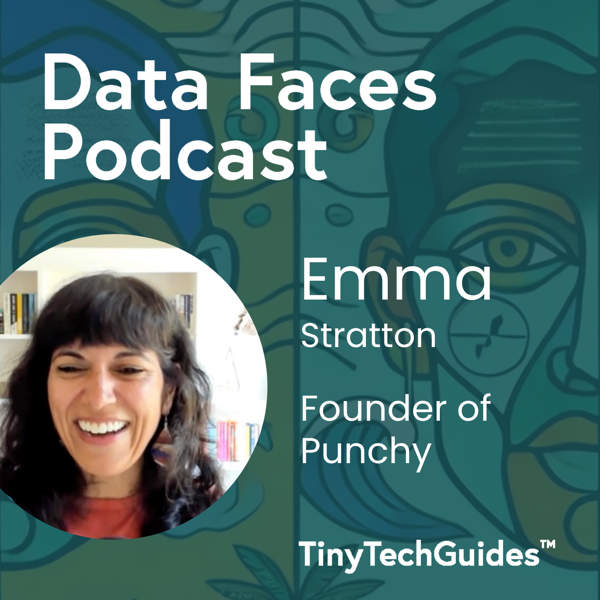
Emma Stratton is the founder of Punchy, a training and consulting firm focused on positioning and messaging for B2B SaaS companies. She has spent nearly 10 years helping technical teams and software founders communicate the value of their products, and is the author of Make It Punchy, which lays out her process for writing simple messaging that resonates with buyers.
In this episode
- Why technical teams naturally overcomplicate their messaging
- How to find the right “altitude” for your audience
- Why even technical buyers are driven by emotion
- The biggest differentiation challenges facing B2B companies
- Her framework for testing messaging with sales teams
→ Read the full article: How to write punchy B2B messaging that actually converts
Full transcript
David Sweenor 0:00 Foreign Hello everyone, and welcome to the data faces podcast that brings the human stories moving between behind marketing, data analytics and AI to the forefront. I’m David Sweenor, founder of TinyTechGuides, and your host for today’s discussion. Today, I am super excited to be joined by Emma Stratton. She is the founder of punchy and a leading voice in B to B SAS messaging. She helps companies find their voice and tell clear, compelling stories that actually resonate. So let’s jump into it. Emma, welcome to the data faces podcast.
Emma Stratton 0:34 Thank you for having me. David, I love the music in the beginning of your podcast. Very fun.
David Sweenor 0:39 It matches my shirt. So thank you. Can you so for people who aren’t familiar, can you just tell us a little bit about yourself and punchy? What’s it all about?
Emma Stratton 0:48 Yeah. So punchy is a training and consulting firm that focuses on positioning and messaging, largely messaging. I’ve been doing it for about almost 10 years now, and it really started with my obsession with helping technical teams, tech companies, software founders, get better at communicating the value of their software, like helping people understand what it is that they’re building. Because I’m sure, you know, a lot of technical folks really struggle with simply explaining what they’re building or what it is. I saw that problem, and so I developed messaging for tech companies. I also teach marketing teams at tech companies how to write simple messaging, and I wrote a book make it punchy, which really lays out my whole process, start to finish, on how you can write more simple messaging that really resonates with buyers.
David Sweenor 1:41 I love that, and I have a copy of the book. Unfortunately, it’s not as cool on the Kindle, but I’d encourage everybody to read it, because it’s a great book. I love that. And I got a quote from your book, Emma. It says, messaging is how you convey the awesomeness of your product in a succinct way, and that is the foundation for consistent sales and marketing activities. It’s as simple as that. And then I saw a recent LinkedIn post that said, wishy washy, lukewarm headlines usually come from messaging where too many people get in a crowded room and had their say. So tell me. I have a question for you. The first question is, why do BB companies over complicate their messaging and what, what does it cost them?
Emma Stratton 2:22 I do think that it’s almost default human nature to over complicate things, especially when you know a lot about it. So maybe you’ve heard about the curse of knowledge, that cognitive bias, that if you know tons about something, you naturally assume that everyone else understands as much as you do, and so you end up talking about it or writing messaging about it. That’s way too advanced for your reader. And so I think a lot of times, teams make it too complicated. They can’t simply explain what their product is. And does they make it complicated. They want to tell you everything about it. They want to get into the details and and the feature is in the tech, and they love so much of it that they don’t want to leave any of it out. And I think that’s what naturally happens. I think that is how we all feel when we’re trying to talk about something we love and what we’ve built, and that’s really deep and complex. And so I think it’s just natural. And if you don’t go at it with the goal of, hey, we need to make this simple. We need to stand for one thing, not a million things. We need to make this easy for buyers to understand what we’re selling. If you don’t go in with that, then it’s just going to be complicated. So it’s almost it’s not our fault, it’s not your fault. You know, this is natural, and that’s why it happens. And it doesn’t help that you also have other people in the industry kind of doing the same thing. So it’s like, well, everyone else is making it sound complicated, and have all these words, I guess we should too. So I think also we see other people doing in the industry, and that just reinforces that it’s the right thing to do, and I think that’s why we can get in this mess. You know, I
David Sweenor 4:03 see this a lot with different product managers and larger companies that I work for. And, you know, maybe there’s different product areas they’re responsible for, like, oh, this button is really shiny here, and it’s the shiniest of all the buttons in the software. And then this little weird thing over here does this. And this is super cool as the PMM, you got to sort of harmonize all of that so with this complexity, and I like that term, the curse of knowledge, what does it cost companies if they do over, you know, overload their messaging with jargon and things that I guess a normal human doesn’t even understand?
Emma Stratton 4:36 Yeah, you miss out on connecting with customers, potential customers, or getting their attention. You risk, kind of, you know that that whole, the metaphor of, like, drinking from the fire hose, right? Yeah, it’s, it’s like that, you know, someone’s like, maybe interested, and you blast them in the face with a full powered hose of information, and they’re, they’re gone. It’s too much. So it takes work to kind of figure out, well, let me wade through all this jargon and all these words and try and figure out what this thing is, and if I need it, no one’s going to do that right. Especially people are getting less and less patient by the day. So when we over complicate it, you just lose people. And these could potentially be people that you help. And the thing that I always say to folks is you can have the best products in the world. That is actually the answer to this person’s dreams, but if you just spit a bunch of jargon and technical gobbledygook at them, they’re not going to see it, and they’re going to go so that’s what it costs. I mean, it costs customers, you know, and you can also lose to a competitor, that just makes it simpler. I mean, I have this story. It’s kind of from back in the day, was when it was a sales tech company and they were the best, and everyone new analysts were like, yeah, they’re the best. They have the most robust platform. It’s great. But they sounded like scientists in their messaging. They were just very technical, and they made it sound hard. So a competitor came in with a not as good product, I mean, a decent, but nowhere near as good as theirs, and their messaging was super simple and human. So everyone was like, Oh yeah, I want to use that one. It looks easier. I think it’s more what we need. So also, when you’re complicated, you give off the aura of a complicated product to like, hard to use products like that also comes into it as well. So there’s a lot of reasons why I recommend people don’t go super complicated and jargony if possible. Okay,
David Sweenor 6:37 so what you know I love the name at the title of your book. It’s way cooler than the name of my marketing, but mine’s like B to B marketing, so that’s not very cool. It does when it says something. It is descriptive naming. I am a fan of that. But what does you know this term punchy, you know? What does that mean in the context of B to B marketing? And how did you, how did you maybe arrive at that name, you know, yeah, work as well.
Emma Stratton 7:02 You know, punches is the name of my company, and the name came to me, and it’s probably because I used to work in the UK in branding as a writer, and punchy was a phrase that people use a lot in the UK. And that idea of, like, something with oomph, you know, something with pop. And I really just love that idea of writing that was punchy, and I to me, Well, what I actually loved was I was like, let me actually get the official definition when I was writing my book, because I never actually looked for it. I sort of had my own definition. It’s really about saying something forcefully or effectively with as few words as possible. And that’s, to me, what it’s all about. It’s, How can you convey something powerful with as few words as possible? Now it doesn’t mean that everything you write can only be three words or five words. It’s not about restricting a word count, but it’s, how can you say something in a sentence rather than a paragraph. How can you get this idea across in a memorable way, quickly? And that’s because, like I said before, people don’t have a lot of time. They’re not wanting to sit around and, you know, read this big tome about your product. You want to get in there quick to kind of stand out with all the competition. So punchy is a way that you can do that. And of course, as you probably know, in B to B marketing, there’s a lot of writing out there. That’s the opposite of punchy, right? And so if you can make your point in a few words and let it pop, you’re going to hopefully stand out from a lot of other voices and noise in this space.
David Sweenor 8:38 Well, that’s certainly the hope. But do you think there’s like a risk to people you know that your clients that that you work with that when you maybe use simpler language, and it’s not so technical or or filled with jargon, they feel like they’re dumbing it down, you know this and trying to make it simple is there? Do they feel like that number one and two. How do you get them over that? Well, you know, this is actually better in the long run for your for your prospects.
Emma Stratton 9:06 Yeah, I think that is, for sure, a fear. And I’ve written posts on this saying that sim making something simple isn’t about dumbing it down. So it’s not about making it something your great grandmother can understand. Because that’s that’s not quite right, especially, say if you’re writing for a technical audience, sure, but making it simple is about making it quickly and easily understood by your reader. That’s what simplicity is about. So it’s almost like accessibility for your reader. And I say, hey, sure, you can use all the big words your your buyer is smart. They know what these words mean, but processing this sentence with all these big words that is like wading through mud, and it takes a long time. Compare that to this message, which is written with shorter words, simpler language, maybe a more conversational style, and you can kind of see which one is easy. Just read it. You just get it, whereas the other one take. A lot of work. So that’s what I say. It’s not about dumbing it down. It’s about making it really quickly and easily understood. It’s also about talking about one main idea rather than 12. So it’s like a two part thing. So I like to think it’s about making it super easy for your buyer to understand what we’re trying to say.
David Sweenor 10:20 Okay, super interesting. And there’s, there’s different altitudes, right? Like, I mean, like, there’s this, there’s gotta be some balance between being too high level and then being too I’ll say meh, would be my technical term for it. But, like, reduce risk. I mean, like, everybody says that. I guess I could say that about my refrigerator, yeah. Like, go about finding the right set of words at the right altitude for what you’re trying to accomplish. Like, yeah, process you have to go through with teams that are and what’s the unlock for them?
Emma Stratton 10:52 Yeah, altitude is one of my favorite things to talk about. I have, and I think it’s in the book I have, like, a scale of altitude. So we’ve got super high altitude, which is, grow your business, increase revenue, like, make the world a better place, right? That’s like, sure, as high as you can go, just very broad, often vague, value at the very bottom, the lowest altitude you have is like the Tech Talk, like, real time, AI, digestible, self serve, analytics or something, right? Just so technical, and really usually where we want to be is somewhere in the middle. So it can help to put a message down and think, Is this too high altitude, too low, and then go up or lower. So for example, if you put down, like reduced risk, and you’re like, Yes, that’s true. But also my refrigerator could say that, right, you want to go lower and that’s too high altitude, too vague, too broad, so you want to go lower in altitude. So that’s like, what could that look like? It could be like, well, we’re talking about a made up product here. Maybe it’s about fraud detection. And it’s like, you know, pick out fraudulent documents two times faster than before, which leads to risk reduction, but that would be an example of going lower in altitude. So it’s almost getting more specific, a little bit more detailed, around what your product can do. That’s how you go lower in altitude another time, if you’re too techie, like, you’re like, real time communication, and you’re like, Well, what is that you want to go higher in altitude? So you want to get more into the value. Why would someone care about this? So that’s, I think, kind of taking your first shot and then thinking, Is this too broad and vague, like, Could everyone say this that lets you know it’s too high altitude, or is this too technical? Is this too in the weeds? Is this too much detail for my audience? Then you want to go higher in altitude. And it really all comes down to who you’re talking to. So if you’re talking to a technical, technical practitioner, engineers, you naturally want to be lower in altitude in your message, right? You still want to show the value, the why, but you want to show more detail, more specifics. Whereas a CEO, a business buyer, would naturally be higher altitude. Why do I care about this thing? I don’t need to know all about what’s in it, but I need to know, you know, what will I be able to do with it, and why should I care? So that’s kind of how I think about altitude.
David Sweenor 13:26 Okay, that’s super interesting. And you know, the one question that that comes to mind, you know, you mentioned, you know, it depends on who you’re talking to. And so there’s a lot of different buyer personas for some of these products. And I’m curious, where do you start? Because, for example, maybe an IT type persona, an IT leader persona, is a very different set of language than I don’t know, a healthcare person. Oh, yes. And so the words you choose and how you describe your product are different. Where do you advise companies? Where do they start? Do they write sort of generic, I don’t know if I want to use that with generic messaging and then adapt it to like an IT persona or healthcare persona or finance or whatever. Or you start with, Hey, pick one persona. Start there, and you know, then move to the other, once you figure that out.
Emma Stratton 14:19 Well, so I first think of like, what is the core message, which sort of sits on top of all the audiences and all of that. I like to go there to really understand, well, how are we positioning this product, and in that process, you are still sort of thinking, who is my audience? Like, how narrow can we get on our audience? It might not be as simple as company size. It might be like a mindset or an attitude that that kind of makes our A plus customer. It’s what I call that in my book, kind of our best customer. But first I like to do top level message, like, what is our core value proposition? That’s. Tied to our positioning, right? What are we going to stand for? What are our top key benefits that are kind of top reasons to choose us? Then, you kind of know, this is the core of our story, and then you can translate that story for the different audiences. So, for example, say you had three benefits, you know, one’s an efficiency story, like, one is about, I don’t know, automation. Another is about great customer service. I’m just making this up, but conceptually, that’s what those three are about. Then you know you’re talking about those for each audience. But what great customer service looks like for healthcare versus it would be really different. Same with efficiency or productivity would be really different. So it grounds you to kind of think at the core, how are we positioning this product in the market? What is its core value? What are its benefits? And then how do we tell that story to different audiences? I think if you just go straight with a different audience, you’re just going to come up with, like, wildly different stories. And then, yeah, there always has to be something that sits at the top when you present your, you know, product to the world. And I think it just gets hard to do, because you can get lost in the differences between all the audiences when really you’re trying to find the commonalities between them that tie back to your products positioning and core value.
David Sweenor 16:22 I love that. So it sounds like, you know, what is, what is the core, you know, value, you’re trying to relate your product and you’re going to adapt it to different different audiences and personas. So maybe the follow on to this is, you know, in the age of AI, you know, there’s these tools that can spit out endless amounts of of content at a large scale. And you know, you talk a lot about sounding human, yeah. And so my question to you is, how does this translate into writing, copy or messaging that that really converge? Because I don’t think AI, it does an okay job, like brainstorming things, but getting down to that, that street level language, or whatever term you want to use, that that someone, your target persona, would understand that it doesn’t do a great job at that yet.
Emma Stratton 17:11 No, I mean, it’s, it’s funny, like, I, like I told you earlier, I don’t use AI tons for my writing because I don’t have to do large volumes of content each week. If I did, I probably would be leaning on it more than I am now. But when I do, and I’m asking you to do something simple, because I’m too lazy to edit down this thing, and I’m like, All right, can you just make this more concise? And it just spits out this, like, you know, everything’s like a big ad headline, and it’s got all this, like, you know, I’m like, can you just calm down and just be straightforward and just, you know? And it just, it doesn’t work. It wants to be all jazzy with its end dashes, and it’s kind of pithy lines, and it’s like, stop. I just need you to functionally make this shorter. So, yeah, I think when it’s about becoming like sounding human, to me, it’s it’s casual phrasing, casual turns of phrases where possible. So there’s one I like. I think it was a long time ago hot jars. Value proposition was like, understand user behavior without drowning in the numbers, talking about their analytics. And that’s a really nice human, casual conversational way to say, hey, we’re analytics with, like, a simple UI, like simple dashboard, right? But that’s a nice way of talking about the value that’s really easy to grasp. And so when I say make it casual, I’m not talking about like putting slang in or sounding unprofessional, you know, right? Whiskey, because some are cursing. I mean, people have asked me these things like, I don’t know if we can do that. I’m like, I’m not saying you dropped the F bomb, but you can say something casually. So like, get everyone on the same page, right, turns of phrases, rather than, like, align teams and departments. Yeah, right. Get everyone on the same page, right? It’s like, can we just make it more how you would actually talk in conversation, rather than how you think you should be writing it to sound professional or smart or something?
David Sweenor 19:13 You know, I love that because, you know, productivity is a common, you know, value prop that people talk about. And I’m like, I don’t know if I need to be more productive. That doesn’t resonate with me personally at all. Right? I think I’m productive enough,
Emma Stratton 19:27 right? Yes, yeah, yeah, exactly. I think, you know, the other thing that I’ve always done in my process is speak to customers, ask them how they describe the benefits, how do they describe the challenges they’re trying to solve. How do they describe how their life changed after the product? How was life before the product? You ask these questions, and you get really nice language, like they will say it really nicely. I also look at reviews, and when I’m feeling stuck, I’m like, Well, how are they saying it? And sometimes you can pick up on a repeated phrase that’s. Is probably a good thing to put in your messaging like, I’m currently working with a company, and they’re kind of in the conversational intelligent. Conversational intelligence. Sorry, you know all these all these categories sound the same. Conversational intelligence, these listening tools. And I interviewed about 14 customers, and four of them talked about how it let them have eyes and ears on all of these kind of customer interactions, right? And it’s so interesting because four of them described it that way, and so that’s something we might put into the messaging, because we heard it, and I thought it was a really interesting way to talk about it. I never would have really come up with myself, but it comes from the customer, so it’s a huge cheat code to talk to customers and really just use the phrases that they use, even if it’s not. See, here’s the thing, often they’ll say it in a simpler way, and it’s not how you would describe it, right, right? And it’s like, does that dumb it down, or does it make it accessible and understandable for customers? Right? That’s, that’s,
David Sweenor 21:02 yeah, I don’t know, yeah, dude, like Product Marketing Manager, they need to be fancier, yeah? Like they send out to your are they afraid of sending something with that casual language to the boss? You know, I don’t know. But, you know, you’re always forced to, like, you get into this or corporate mode now, and corporate mode speaks completely different than personal mode, yeah, nobody likes.
Emma Stratton 21:28 Show me the person who wants corporate
David Sweenor 21:30 mode. Yeah, exactly, exactly. So, you know, that brings in, you know, another question I had, and you know, I opened up with your LinkedIn post. You know that this wishy washy messaging. So messaging by, uh, committee or other words. And I think we’ve all been there. I’ve been through many, many messaging projects where everybody has an opinion, and you get some generic something out of this that nobody really likes. I sort of equate it like, you know, politics and making laws, like you got two sides. You get some crappy law that nobody really likes because you have to have consensus. So, like, how do you test, you know, in messaging, you know, how do you test that it resonates before, you know, it’s too late before you change all the stuff you got to change as a marketing person,
Emma Stratton 22:17 yeah. I mean, I’m a big fan of leaning on the sales team and using sales throughout the process of messaging. So when I work with clients, I always have sessions with the sales team where I ask them questions, because they have such a finger on the pulse of prospects, and also they’re basically message testing their their own stuff all the time, so they kind of know what doesn’t work, what does work. So they’re really great in that sense, when you’re starting to get do the discovery point and prepare to develop messaging. But then afterwards, I like to run it by sales. Have them start running it in conversation and just seeing how it lands, whether they can do in some outbound emails or even just in their sales conversations, and is it landing? Like, do they get it? Are their eyes lighting up? And that is often, like, the quickest way you can get some feedback and feel pretty good about it. I mean, we are in an industry that loves data, and also we all want, like, the data to make us feel like safe, like, this is going to work and right? But really it’s hard to get pure data really quickly before you launch messaging. There’s always some point where you have to kind of take the leap and just see how it works in the wild. But having sales kind of their thoughts, running it through in prospect calls, is a way that I really like. Another way is if you have relationships with customers, if you have user groups, people who would be willing to kind of just give their thoughts on value propositions, that’s another thing that you could do as well. But I would say sales is my favorite, and I’ve had a lot of early validation come from that process.
David Sweenor 24:02 Yeah, sales and, you know, you mentioned, you know, the customer interviews and talks and years, oh, sub super like a trade show. You know, you try to pitch something on a trade show or I’m like, oh, that didn’t work at all, flat on its face, so it looked good on the on the paper, but terrible trying to verbalize it. So, yeah, you had to get that direct feedback for sure. Yes. All right, so when you’re engaging, you know customers, your customers, you know, what’s the biggest sort of blind spot that you see companies have about, you know, their own, their own product messaging.
Emma Stratton 24:36 You know, there’s a there’s a few, I think I don’t know if it’s a, well, let’s see. I don’t know if it’s a blind spot, per se, but I think differentiation is really one of the biggest things that people come to me and are kind of struggling with. You know, how do we differentiate? How do we sound different? There’s so many competitors that is a. Really tough one. I think it gets harder every day. Is more and more entrants are in the market, and categories are really so confusing. So that’s a big one that comes up. But in terms of blind spot, I think there’s often blinds. There can be blind spots in kind of what customers are really looking for, like, what they want. Sometimes you can think or assume they’re more advanced than they actually are, right? This is when it happens a lot, like you’re wanting to push, like the big future vision. And really they just need to start with the simple thing for the big, big vision. That’s something I come across a lot, like, they’re so excited about the future, but their their customers aren’t, aren’t ready, right? It’s like, you’ll get there. That’s not the first reason that you’re going to draw them in to to buy your product. So that. And then, of course, the thing that we discussed already, just thinking that if we talk about how great the features are, that’s going to differentiate us, or that’s going to make us stand out, when really it just doesn’t resonate. So those are kind of the top things I see. Yeah, I see
David Sweenor 26:11 a lot of that as well. And you know, one thing you mentioned category I was, wasn’t in our prep list, but I’ve talked to a number of customers, late prospects lately, and they’re like, hey, need help with messaging. Like, great. You know, they’re all kind of, it starts the same, you know, for what I’m working on. And they’re like, oh, but we’re going to create a new category. I sort of just like, oh no. Like, I sort of like, what, what? What do you like? What do you think when you hear that we’re going to create our own category? I just remember, I worked at Dell for a little bit Dell Software, and the brand people at Dell Software said some about category. They said $50 million minimum, minimum to start a category. Dell could probably do that if they wanted to. But like a categories, like something that’s out there, I don’t see some of these smaller startups going to create a category. Do they not have product market fit or, like, what do you think when you hear this? It’s just, it befuddles me that all these companies I talked to, we’re going to create our own category, a category of one. It’s
Emma Stratton 27:11 gonna be great, that’s right. I mean, thankfully, I actually don’t get a lot of that anymore. I did a couple years ago. I feel really hot a few years ago. I’m hoping now people kind of get it that that’s not really feasible for most people, and that there’s too many categories. So thankfully I don’t get that a lot. But if I did what I would say, like you said, you know, it takes a lot of marketing spend, takes a lot of things to build a category, and to not only do people have to explain, like, what your category is like, what is that category? And then what is our software? And then Who are all these layers of mystery, and so it’s like, it’s a lot easier to just, you know, win in an existing category. I will say that people often mix up new category with, like, a jazzy marketing term of what we’re going to call our thing, you know, like, Oh God, I can’t think of one. And I don’t want to say one that I’ve come
David Sweenor 28:12 across Right, right? I don’t want to throw anybody under the bus here. Composable content
Emma Stratton 28:17 orchestration, like they just make up this exciting name for their platform to make it seem like it’s something new. And they kind of call that a category, but really it’s just like a marketing term, yep, to call your platform that is also confusing people, right? That’s, that’s not helping people like it’s, we want to make this platform sound exciting. Let’s give it this fancy name. But again, people are like, what is that? Then you have to explain. What it is. And then they’re like, Oh, they’re trying to, they’re trying to think, like, okay, in relation to the categories I understand, what is this thing, right? And so it just doesn’t work. And I can’t tell you how many companies I have worked with who had recently abandoned something like that, like they had tried to call it this thing and and it just never worked, kind of like how I think it was drift did, like conversational marketing that was, like, their some marketing term. It’s not a category, it’s like a cool name for what they’re doing. And it worked for them. You know, inbound that that was HubSpot that worked for them. They came up with inbound, great that worked. But these are only a few. There’s been millions that haven’t worked, five that worked. So I say clarity. It’s like, does this make it easier for someone to understand, like, why they would want your thing? If the answer is no, then, you know, make it something simple, like, call it what it is, so that someone knows what your product is like. Stop trying to like, dress it up in fancy clothes and titles when it’s just a screen recorder, you know, right,
David Sweenor 29:51 all right. So no fancy pants. Dress up for these, these things. So, so Emma, I think can, we can declare to everybody listening to this no category creation that. A that’s a big that’s a hard stop, emergency stop, right there. That’s the, I think that’s the airplane
Emma Stratton 30:04 symbol for Yeah, I think so. I think so. David,
David Sweenor 30:07 all right, awesome. So we talked a little bit earlier about corporate mode and how nobody likes that. And so maybe the last question you were getting near the end of time is, is emotion in B to B marketing, and I know throughout my career, sort of resisted using emotion in messaging, because it’s not corporate. Yeah. So how do you convince, you know, companies that you work with that, you know, logic alone doesn’t win deals,
Emma Stratton 30:37 yeah? So I had a client a while back, and their product is in the IT space so very technical buyers, and it’s a very functional technical platform. And I interviewed a whole bunch of them, and they it was amazing how much emotion was in these interviews. They’re talking about how stressful their jobs are. You know, how hard it is to maintain these clunky solutions, the dread and fear they have that something is going to go wrong and it’s going to go back on them getting calls in the weekends and how that interacts their family life. And I remember after this call, just thinking, wow, it’s almost like the technical people are even more emotional than you would think, because their jobs are so critical with the infrastructure of a business. And I always bring those findings back to the customers and say, like, hey, they’re, you know, they’re concerned, they’re, they’re working nights and weekends. They don’t feel confident, that type of thing. And I always highlight it and then, and they’re, they’re always like, Oh yeah, we should get some emotion. And it’s almost like we forget, in our B to B marketing lens, we just sort of forget about emotion. We’re so rational we think about ROI numbers, all that. But the emotion is how you connect to how someone’s feeling. So it’s not trying to make people cry, but it’s connecting to, connecting to like how they may feel confident, you know, going to their boss with a report that comes from this awesome technology, or how they might not be feeling confident in the numbers, or how they might be worrying about things going wrong. So it’s like worry and confidence frustration. These are all very relatable, real emotions that people are probably feeling in their current state. And if you can connect with them and then show them how that emotion could shift with the help of your product, you’re just going to be more relatable. People are going to care more about that. They’re going to connect with it because it’s human, so it’s it’s not as much of a 360 or 180 sorry as people might think it is. It’s, you know, tap into those frustrations, those worries, and show how you can, you know, allay them. And that is, I don’t know, a really good thing in messaging. I think I’ve, I have a story in my book about when I was really bad with personal finance. This is when I was in my early 20s. I just sucked at it. I didn’t make any money. I I was afraid to check my account balance, and I would never do it. And then I saw this headline a couple years later, and it was like, take the fear out of checking your account balance. And it stopped me in my tracks, because I was like, oh my god, that is me. So I kept reading, and I ended up signing up, and I became a loyal customer for many years. And I wasn’t looking for a bank, but I saw that headline, and it drew me in, because I was like, That’s me. They understand me, so maybe they have a solution for me. And that’s really the point of emotion, connecting to how people are feeling and where they’re at, and showing that you understand and that you can help them.
David Sweenor 33:47 Wow. So this is a shock. So people actually use the soft humans, and they buy the softwares we need to connect with humans. Be human. I think that’s right. That’s a great message. I guess. You know, before I forget, you mentioned earlier about AI, don’t, you know, can’t get it to summarize things. I’ll give a tip to everybody listening. I have a new prompt that I use, and I say, make it punchy, yeah, and it works fantastically. I thank you for that. Maybe you should. You definitely should that that is fantastic. So this has been a delightful conversation. Emma, I want to thank you for joining. But you know, before we conclude, is there anything you’d like to leave people who are struggling and have too much jargon or having messaging by committee? You know what? What sort of advice would you want to leave to them?
Emma Stratton 34:43 Yeah, I would say, get my book. Make it punchy, because it really covers everything I put everything I know in that book, and it not only shows you how to go from complexity to that simple messaging framework. The last chapter talks about implementation. And getting alignment and buy it and working with others, because that’s part of messaging as well. So make it punchy is the book. It’s available anywhere that you get books that would be the place to go, because I’ve got you, I’ve got you with that book.
David Sweenor 35:17 All right. Fantastic. Well, Emma Stratton, founder of punchy thank you for joining the data faces podcast. This has been a wonderful conversation, so I appreciate you joining and sharing your experience with with our listeners. Thanks.
Emma Stratton 35:31 Thanks for having me. David. Cheers. That
Emma Stratton 35:33 was.