

Data Faces · Episode 42 · June 30, 2026 · 35 min
Volition, visibility, and viscosity — the coiner of big data’s “three V’s” names the next three for the agentic era.

Listen: YouTube · Spotify · Apple Podcasts · Amazon Music
About Douglas Laney
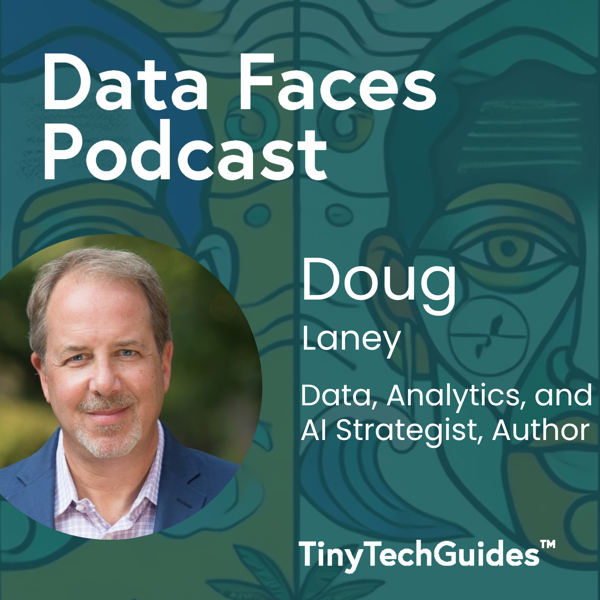
Douglas Laney is best known for coining the “three V’s” of big data — volume, variety, and velocity — and for his book Infonomics, which makes the case for treating information as a measurable economic asset. A former Gartner Distinguished Analyst, he now writes, teaches, and advises on data monetization and the emerging idea of the autonomous, “self-driving” business.
In this episode
- The next three V’s for the agentic era — volition, visibility, and viscosity
- The seven levels of agentic autonomy, from a basic chatbot to a business that runs itself
- Why labor savings are the least imaginative way to value an AI agent
- Who really owns your data — and why that question is about to matter more
- What it would take for a billion-dollar company to run on a handful of people
→ Read the full article: The three V’s of agentic AI
Full transcript
David Sweenor 0:05 Hello, everyone, and welcome to the Data Faces podcast. I’m David Sweenor, founder of TinyTechGuides and your host for today’s show. In this show, I talk with people who are actually making data analytics, AI work in the real world. What’s exciting, what’s messy, and what’s coming next. Today, we have Doug Laney, who named the three Vs of big data and turned information into an economic asset with Infonomics. Now he’s making the case. That a fully autonomous, self-driving business is closer than we think. So, Doug, welcome to the Data Faces podcast. It’s great to have you here.
Douglas Laney 0:38 Right. Even though I got a face for radio, good to be here. Thank you.
David Sweenor 0:42 Right. And for those who have maybe not come across your work, can you just tell us a little brief intro of yourself and kind of what you’ve been up to lately?
Douglas Laney 0:52 Yeah, I guess the most interesting thing is we moved to Portugal a couple of years ago, a little less than a couple of years ago, to enjoy a little bit of tranquility. You talked about the three Vs, so I’m trying to achieve the three R’s now, retirement, relaxation, reading or something. So, yeah, we’re just enjoying it, enjoying it here and access to Europe. Our son lives in Amsterdam, so we’re a bit closer, but not too close to him. So, yeah.
David Sweenor 1:21 Well, I love that. And you certainly have the shirt for it. So I appreciate it. You’re like there’s only a handful of people have been bold enough to wear the nice, fun shirt. So I appreciate that.
Douglas Laney 1:33 I heard about the show. So, yeah.
David Sweenor 1:36 There we go. There we go. You’re certainly on brand. So part of the show is named Data Faces. And so part of the idea is to get behind the people in their professional career. So I always like to start off with an icebreaker. And could maybe you just tell us something funny, a story that people may not know about you?
Douglas Laney 1:55 Some people know this. Let’s see. So I like to claim that Tom Cruise played me in the film Risky Business. I was in a program in high school called Junior Achievement. um and uh we had trouble selling we were selling travel kits um in the business that we formed um and it’s something where you’re sponsored by a local business and then the high school kids get together and set up a company and then shut it down after a semester um and so the the product we were making were travel kits and we had a hard time selling them um at shopping malls at the pop-up trade fairs and shopping malls because in the 80s there were kids in shopping malls. Why would they want to buy a travel kit? Unless, as my friend said, let’s put something in the travel kits that… teens would want and so we’re thinking nash we put weed in them no we can’t do that and my friend goes condoms so let’s put condoms in them they started selling like crazy we ended up becoming the company of the year in the midwest and and a street writer in in the next town over heard about our little hijinks extrapolated on the idea and wrote the screenplay for Risky Business based on what we had done. And since I was president of that junior achievement company, I claim that Tom Cruise played me in Risky Business.
David Sweenor 3:15 You know, I love that. Hopefully some of the residuals will start to roll in soon. Maybe they forgot to send the journey.
Douglas Laney 3:21 That would be nice.
David Sweenor 3:24 All right. So we have a bunch of questions, but the first one is… The three V’s. You know, you’ve coined this term in volume, variety, velocity, and the big data error for people who don’t know. Some people wanted to add more V’s, nine V’s, 25 V’s. I couldn’t keep track of it. Yeah, we call those people one V’s. There we go. So I don’t know if you’ve heard of the term agentic AI or AI. It’s out there in the world today. But do you think we need a new vocab for what makes it hard? Or do you still see the three Vs that you originally coined? Are they still relevant?
Douglas Laney 4:05 Yeah. I think they still matter. And perhaps even more so as AI models become more commoditized. Yeah. I think data will continue to be the competitive differentiator. Initially, the 3Vs spoke about the challenges of data management. but um today the more i think about the opportunities to use data to train and enable ai agents and to enable these agents to communicate with each other but i was thinking about that and um maybe we should have another set of these for you know for for ai so um how about um well one is is i think about volition What does the agent have permission to do? What kind of rights does it have? What kind of autonomy should we give it? Should it gain more authority over time as it proves itself? Then we’ve got… Another one might be visibility, like whether management can inspect the influence, the logic or actions, what’s going on inside the black box, their auditability, repeatability, consistency. And then do agents have visibility to what other agents are doing? I think the combination of the volition, the permissions and the visibility really enable these forms of agents, which we’re going to start seeing more of. And then the last one, which we talked about in terms of data, but I think applies here, is viscosity. That’s the amount of friction between its recommendation and its actual business action. So friction could include things like change management, corporate culture, FUD, overall resistance to AI because of the fear of job loss. So… The thing is, if we have too much viscosity, the agent becomes just a glorified assistant. And if we had too little viscosity, then you’ve got software making big decisions or taking actions faster than the organization can absorb them. So I think the first three Vs were about big data, and the next three Vs are probably about big autonomy, if you will.
David Sweenor 6:22 I like that. So three V’s, volition, visibility, and viscosity. You heard it here on the Data Faces podcast. We have a stoop. You heard it here first. I love it. I love it. Well, I appreciate that. That’s amazing. You’ve done a lot of work and written some books and things on infonomics and talk about how to monetize data. And with AI agents today, you see these headlines like, hey, we’re going to have entire workforces of agents running the business with very little oversight in a lot of cases. How do you measure the economic value of an agent?
Douglas Laney 7:06 Yeah, that’s a great question and something I think organizations ultimately are going to be struggling with. I’ve seen some people talking about it. They haven’t seen the actual data that shows that the amount of token that organizations are using are more expensive than the people that are using. So, you know, I think that’ll go away because the models are getting much more efficient. I think most companies start measuring agents in the most basic pedestrian way possible, like what kinds of hours were saved or how many tickets were resolved or how many emails were drafted. Those measurements maybe are useful, but I think they understate the point that… Labor savings are probably the least imaginative measure of value of an agent. I think what’s more interesting is, are we creating new capacity to sense and act and coordinate and test and personalize and scale? So I might ask, what are we substituting? Okay, so how can we measure what the agent is substituting or absorbing from people or systems? The second thing is, what are we amplifying? What work did the agent make better, faster, more consistent, or less? that are dependent on managerial glue. And the third is the upside, right? The numerator side of the equation. What new products or services markets pricing models business models customer experiences are becoming possible because of the agents um i think it’s that third category where the accounting gets yeah kind of really difficult um you know a procurement agent may save three percent on on supplier spend and that you know that’s useful um but then it may be discovered new supply structures run autonomous sourcing you know things like that and those might be a little bit more difficult to measure um so you know i would say that um don’t don’t just measure an agent based on what it’s replacing but the value that the economic the surface area that, that, that economic expands. So yeah, I, I leave it there. I mean, thinking about this, I’m working with a hospital system and I have some, some thoughts kind of on applying these three to the hospital system. You know, if you want to kind of give an example.
David Sweenor 9:38 Yeah, I’d love an example. And then I had a follow up question of that. Let’s hear it. Let’s dig down. Yeah.
Douglas Laney 9:43 So I’m working with the hospital system, and so the first layer substitution, right? So how could it absorb work like authorizations or denials or scheduling or documentation? The second layer being amplification. How could a discharge planning agent coordinate? the pharmacy, the transportation, the home health, the follow-up care, you know, things like that. And then the third layer would be invention, where the agent begins enabling the care and business models that the hospital previously couldn’t organize at scale, like, I don’t know, chronic care management between visits or continuous trial matching, which is a big, big thing, or precision outreach for patients. One of the things we’re working on are governed dynamic data products. We’re actually using an AI tool that I’ve built to generate ideas and test the feasibility and economic value of various data products.
David Sweenor 10:48 Okay. That’s a great example. And what you’re sort of saying, what I’m hearing is, and this came up in another podcast episode with a different guest, but everybody’s talking about all the businesses are talking about the cost side of it. You’re saying, hey, there’s a revenue side of it. How can we get more revenue? And we see all these layoffs. So are the businesses, are they purely focused on costs or do they think they can… Can everybody, for lack of a better word, and grow revenue? Or is it only on the cost? Because that’s the easiest thing to try to measure.
Douglas Laney 11:23 Costs have always been the easiest thing to measure, but the numerator side of the equation is unlimited, right? How far can you actually squeeze cost in anything that you’re doing versus what is the upside for introducing new business models, new products, new markets? It’s infinite, but it’s difficult to measure, and the investments become speculative. You asked the initial question about measuring the value of an agent. Like I advise with data, you shouldn’t try to value any given piece of data, but rather a collection of data. The same thing with agents. We need to measure the value of individual agentic functions, not the agents themselves.
David Sweenor 12:07 Yeah, it’s super interesting. You know, it’s just the story like, you know, I think there’s some companies that my clients that I’m working with are moving from a time and materials model to sort of an output, you know, outcome driven business model. And it’s like that old story about the factory breaks down, the guy comes in, he looks at it for a few hours, you know, turns the one screw that needs to be turned. And the factory, he spends up a $60,000 bill for, you know, two minutes of work because he’s the only guy that knew that. Do you think people need that? Are the business models going to change from time and materials? Because, I mean, it’s so ingrained in our society, but it’s really the output and the outcome that matters.
Douglas Laney 12:47 It’s a bit of an aside, perhaps for another conversation, but something that I’m working on is a concept called economic process modeling. We’re looking at the various economics of processes and process components themselves to help organizations redesign their processes for digitalization, for AI. So, probably another topic for another time, but the concept is called economic process modeling. That’s kind of an offshoot of intronomics that I’m working on.
David Sweenor 13:17 Okay. So, we’ll pick that up a different time. So, you teach a lot of MBAs, right? And… What do they get about AI that maybe executives don’t, you know, because MBAs are sort of, a lot of them are younger and have fresh eyes on things and look at things in a different way versus someone who’s, you know, been there, done that. I’m not going to try that again. What do they get that executives don’t?
Douglas Laney 13:44 You know, we’re really focused on data in the class. I mean, we use AI. I’ve created the higher education’s purportedly, the higher education’s first AI use case chatbot that my students use for their assignments. So that’s kind of fun. Then I’ve embraced AI in some of the assignments. I’ve asked them to create AI-generated essays, but include the dialogue where they tested the assumptions and conclusions that the AI tool came up with. They’re becoming comfortable with that, and I think that’s important as they enter the business world or continue in the business world to be able to challenge what the AI is telling them. More so for data. I think something that the students are grasping that executives still don’t quite get is that data has these unique economic qualities. It’s non-deplating when you use it. It doesn’t get used up. It’s non-rivalrous. You can use it multiple ways simultaneously. and that it’s progenitive, when you use data, it typically creates more data of value. It’s also easier to transport and store. And although it’s increasingly more difficult to secure than physical assets, it’s also more difficult to clean up if you spill it, as we’ve seen. So I think my students are recognizing that data doesn’t behave economically like physical plant or equipment or inventory or cash. um or even labor it it doesn’t you know deplete when it’s used it can be used by multiple parties simultaneously and generates more more data so we discuss how companies that embrace these economic qualities of data and and bake them into their business models are the ones that are really thriving today and in fact have if you look at the fortune 500 these are the kind of the companies that have replaced the automakers and the oil companies at the top of the the fortune 500 so from a mba standpoint this really changes the management problem you know like we were talking about if you treat data as a cost center you minimize it if you treat it like a compliance artifact you restrict it if you treat it like exhaust from systems you’re ignoring most of it but um you know there are bigger questions like who owns it how is it maintained how does it depreciate or decay how can we ensure it how can we commercialize it how can we bake data into our products and services to make them that much more valuable so um Yeah. So I think, you know, the exercises that we do, including an assignment where I actually ask them to apply any economic model to data like supply and demand or productivity frontiers or, you know, you name it. One of my students, even a couple of my students even applied Sharia law to data, which I thought was pretty cool. And so these exercises are when they stop thinking about or repeating the tired slogans like data is the new oil and start really seeing it as a unique asset class with true economic differentiators that can power AI applications.
David Sweenor 16:44 Yeah, I was going to comment on that. You have a great graphic, and I can’t remember, it’s probably in a lot of your materials, but what you were saying essentially is, I thought of data as a renewable resource. Because what you’re saying is every time you transform that, the value of that can increase, and it’s really in perpetuity, and you can keep transforming it any number of times. Yeah. Um, the ownership piece is, is, is actually quite interesting to me is that are, you know, you mentioned you’re dealing with a hospital network now that do they own all their data or do the equipment providers that make some of the machines that the hospital uses, do they own it? Like how to, how to, how are execs, how should they think about this?
Douglas Laney 17:27 Also, it’s contractual, right? And there are some, you know, HIPAA regulations about data, um, usage, which can imply that a individual’s an individual’s data is their own but in reality there are acceptable use cases for uh for data that the hospital collects on you so the notion of ownership really is a function of of regulations within an industry and contractual obligations. The courts have not determined that data qualifies as property, and therefore property laws don’t regularly apply to data. This actually goes back to 9-11 when companies started contacting us while I was at Gartner. um lamenting not only the tragic loss of life but also the loss of their data and they wanted to submit claims for the value of the value of the data they lost um so we helped them value data because the valuation experts and the accounting firms wouldn’t wouldn’t touch that so we helped some of them value their data they submitted claims to the insurance companies and the insurance companies gave them the old fu sorry we don’t think data’s uh property therefore it’s not covered by your pnc contracts, which made my head explode. Then, a month after 9-11, the insurance industry updated the commercial general liability policy template to explicitly exclude data from PNC policies to add further insult to injury. And that set me down this whole road of thinking about data as an asset and the infonomics concept.
David Sweenor 19:09 Super interesting, you know, an aside here. Our family got a new car recently. I was just looking in the manual. These things track everything. And essentially in the back of the manual, it says they own all the data. They can use it for whatever the heck they want. And if you don’t want it, don’t drive the car. Essentially, I don’t really think there’s a way to turn it off. Yeah.
Douglas Laney 19:33 Most teams for any kind of software you subscribe to will say pretty much the same thing. They don’t want to own it because they don’t want the legal obligation for owning that content. But they say, you own it, but we have the rights to use it in any way that we want.
David Sweenor 19:52 Right.
Douglas Laney 19:52 Because they don’t want to, they don’t want to own it. They don’t want the obligation of owning.
David Sweenor 19:55 Right. A liability to own it, but they got a license in perpetuity to do whatever the heck they want.
Douglas Laney 20:01 Perpetual rights.
David Sweenor 20:02 Okay. All right. Well, so speaking of cars, you’ve, you’ve actually mapped the agent at AI into an autonomy level or maturity model from a chat bot to a business that’s running itself. Can you tell us a little bit about that?
Douglas Laney 20:18 yeah i i think you the this the self-driving analogy works um kind of we take it more seriously a self-driving car doesn’t become autonomous because somebody bolts a chatbot onto a dashboard. It needs sensors and maps and perceptions and prediction, planning, controls, actuation, feedback loop, and fail-safe mechanisms. A self-driving business is one that needs the same basic architecture, but translated into enterprise terms. Unfortunately, most companies have installed automated dashboards and call it autonomy um that’s more like you know cruise control not not self-driving so i think it’s important for for organizations to you know executives to realize that automation is not the same thing as economy right and so where would you put companies in general on this so where on that scale of you know seven levels kind of where where would you yeah let’s talk about the seven levels first one’s chatbot answers questions summarizing the drafts you know the next thing we’ve got a co-pilot that helps the person complete work inside a function or an application. Then we’ve got task agents that perform work on their own in a bounded way. Then we’ve got workflow agents that plan and execute multi-step processes. Functional agents that manage, this is level five, functional agents that manage a defined business function or sub-function. against particular goals and constraints. Think something like revenue cycle or capacity management or procurement function independently. Then at level six, we’ve got cross-functional agents, which are networks of agents or swarms of agents that coordinate across functions like finance and operations or supply chain and HR. And then the seventh is the fully autonomous self-driving business where the agents or swarm of agents, collection of agents, sense the business conditions, reallocate resources, redesigns processes, innovates, manages partnerships, adapts the strategy, all with limited or eventually no human intervention. So I think most… companies are probably still between level two and three where they they’re co-piloting stuff um where they’re helping an individual person work inside an application or a function or or more kind of task agents um i am working with a consultancy i can’t name them that’s creating actually an agentic operating model for the entire consulting function where it will advise on and learn from previous proposals and project work, and then use that to generate new winning proposals and accelerate project work. So they’re still probably, you know, they’re getting close to that, probably level four in doing that. Okay. I think one of the problems is that companies are trying to pilot their way to this, and I don’t think you can pilot your way to level six. At some point, somebody’s got to redesign the business model or at least the operating model, and maybe your AI will help you do that too.
David Sweenor 23:30 Okay. Maybe I want to step back and just a quick question. So we have this maturity model. We talked about MBAs and how you’re helping them think about data and AI. What’s sort of their mood with all the layoffs, their demeanor? Do they feel like there’s a place? There’s two camps, right? There’s like, hey, people say, and I think we say this because we’ve got to feel good, we’re going to create more jobs than it destroys. I’m curious, what’s the mood of the students? I know for me, it’s a tough job market out there. That’s why I do my own thing. It’s tough.
Douglas Laney 24:08 Yeah, they’re very concerned about layoffs and deferments. We’ve seen companies, individuals in my class who got offers from big consulting firms and they’re now getting deferred. Yeah, it’s really challenging. If you’re not doing some kind of physical work or coordinating human activities, a lot of those jobs, I think, are at risk and probably another topic for another time. But I’ve done some research into what kinds of jobs are most at risk. I know other folks like McKinsey and Gartner published that as well. But there are definitely certain jobs that are at risk. But one would hope, and we’ve seen this cycle before, Dating back to the days of the, you know, where did the buggy whip manufacturers go when people stopped riding horses, right? To, you know, the internet and radio and television and, you know, it’s a cycle, right? It is. It’s just hard to kind of predict right now what those are.
David Sweenor 25:14 I think the one promising thing that I see is that AI is enabled. If you have an idea, you can use the AI to really help. Make it real. And you can innovate at a scale that’s unprecedented. And, you know, I want to jump to the, you know, we talked about, you had predicted there was going to be a billion dollar company run by agents and a couple of people. And you shared a Wall Street Journal article. It’s happened a bit sooner than you predicted. Yeah.
Douglas Laney 25:47 you know i kind of look into that i’m still you know i’m still kind of comfortable with the prediction that in the next few years um you know we’ll see a a billion dollar company run by just you know one or a handful of people um but i’d be careful about what you kind of what that counts so the company you’re talking about is called medvy um kind of a cautionary example the company was framed as a nearly a two billion dollar company with two employees a couple of brothers in a garage powered by ai um they’re a kind of a more of a thin core company a tiny payroll sitting on top of a telehealth infrastructure with clinicians and pharmacies and payment systems and marketing platforms so i think it proves that a company can use software and outsource infrastructure um like external conditions and pharmacies and logistics and marketing channels to keep a formal head count remarkably low but At the core, you’re still outsourcing a lot of that work to other people. So I’m at least confident about the denominator. Are we counting employees? Are we counting human effort? embedded in the operating model, as we were talking about before. Those are kind of different claims. So I think for this kind of prediction to slip into the next decade, agents would have to keep failing in a few places. One, in more dependable execution, probably in regulated accountability and their ability to coordinate cross-functionally. Because right now they can draft and summarize and transact. The harder problem is getting them to coordinate work across systems. If anybody’s tried to use any co-pilot or co-work solution today, they’re still kind of funky to try to use. I’m doing some minimal things with it. But like you said, there’s an entrepreneurial opportunity for everybody today. My coding days are… 30 years behind me, right? But I had this idea for an app based on the data product and data monetization workshops that I do where I sent all of that material that I have to Google’s AI Studio and I said, generate an app that does all this. And it basically now can do in… matter of minutes what usually takes me a month or more with a client to to do from generating ideas to testing their feasibility to doing an economic analysis to um to creating an implementation plan yeah
David Sweenor 28:19 Yeah, super fast to prototype these things, and I think it’s great. I still think there’s a role for professional software engineers. There’s a lot of things we don’t know, but you could say, here’s how this thing should work, and then you can go get somebody that knows what they’re doing to operationalize it.
Douglas Laney 28:35 You look at them, it’s fairly imminent. I think the Frontier AI models are achieving this new form of Moore’s Law. They’re doubling the amount of human replacement work they could do every seven months. That’s great for white-collar, but I think robotics is another issue, you know, altogether. How do we match up the white-collar work that AI agents can do with the blue-collar work that, you know, perhaps robotics can do? Robotics, you know, will take quite a bit longer, I think.
David Sweenor 29:05 Sure, sure. Okay, so, you know, we’re talking about agentic AI, and I did want to ask you a question about the, we talk about the certain decisions that, You need a human in the loop. Okay? Yeah. And, you know, hey, if you’re sending a coupon, you probably don’t need that. If you’re making a credit health decision, all that stuff, maybe you should. But with decisions at scale… How do companies think about this? It’s sort of like, yes, yes, you get bored. When Quan tells me you want the thing to run, I don’t know what that Python code is. It just keeps asking me. I don’t inspect every piece of code. I just hit go, go, go, go. Is that the same thing with this notion of human in the loop? Is this a false dream of ours?
Douglas Laney 29:58 Yeah, going back to our three Ds of agentic AI, right? The volition, visibility, and viscosity. I don’t know if the real barrier, back to the self-driving metaphor, I don’t think the real barrier is letting go of the wheel in abstract. I think trust is probably not the right or the wrong unit of analysis. The better issue is delegation or warranted delegation. Leaders won’t and shouldn’t hand, like you say, meaningful business authority to agents until the agents operate in clear boundaries with permissions and provenance and governance and observability and escalation rules and economic targets and audit trails and kill switches. Remember the old adage that the… What was it? The accelerator in the car isn’t what allows the car to go fast, right? It’s the brakes. Right. Right. So, you know, autonomy without controls… it is an innovation it’s it’s um negligence with with better software right so i don’t think we leap from human approval to full autonomy we’ve got to move through um recommendations to bounded actions to supervise workflow ownership to more functional autonomy and then more levels of enterprise autonomy so i don’t think the organizations that move fastest are going to be the ones with the Most trusting leaders are going to be the ones with the more governance or delegation architecture for AI.
David Sweenor 31:43 So isn’t an interesting question on this idea of the steering wheel and level of autonomy. I think when leaders, I don’t know if this is the case, but my hypothesis is they’re thinking about, hey, let’s do all this stuff. let AI do it, an agent do it. How about the business leaders themselves? Do they see themselves removed from this or should AI replace their decision-making? Maybe it’s less biased. Maybe we’ll think through it more carefully. I don’t know. Any thoughts on that?
Douglas Laney 32:16 Possibly. I think we put ourselves on a pedestal, we humans. That’s a philosophical discussion.
David Sweenor 32:21 It’s only somebody else’s problem. It’s not my, can’t replace me because I’m special, right?
Douglas Laney 32:25 Right. Yeah, I was talking to my students about all variety of kinds of bias from survivorship bias to there’s dozens of different kinds of analytic bias that we as humans are always repeatedly guilty of, right? That I believe that we can program out of AI.
David Sweenor 32:44 Right.
Douglas Laney 32:44 Okay. Yeah.
David Sweenor 32:46 Well, Doug Laney, this has been a fascinating conversation. Any just sort of parting words? What should people think about when they’re thinking about agentic AI or words of wisdom from all this work you’ve done over the years? What’s the one thing you want them to walk away with?
Douglas Laney 33:04 One, recognize that data has these unique economic qualities, and if you’re not embracing them, if you’re not baking them into your business model, you’re not going to thrive, probably not going to survive. And for AI, if you’re continuing to use it just to scan your email, and I actually just saw, I won’t name names, but a major prominent university has some big name people teaching a class, and they advertise how they’re going to use AI to help you scan your email. I’m like, that’s just incredible. I can’t believe that that’s what they’re talking about. So late. Think bigger. AI is increasing in capability at this incredible pace. Companies are… There’s companies like Spotify, so they haven’t even developed the line of code manually since sometime last year. So if you’re not using AI to do things and you’re just using it to do research or write your emails or analyze your emails, you’re just not thinking big enough and probably not preparing yourself for the future or your organization for the future.
David Sweenor 34:14 Yeah.
Douglas Laney 34:14 You know, I had the great pleasure and honor of watching a guest lecture at my university, University of Illinois, by one of the fathers of AI, Marvin Minsky, who founded the MIT AI lab. And I always remember his famous quote, because you can remember, we’re in the thousand years between no technology and all technology. And you can listen to what the experts say, but remember that we are all ignorant savages.
David Sweenor 34:45 Okay. And with that, I want to thank you for joining the Data Faces podcast. You’ve been an amazing guest.
Douglas Laney 34:52 Thanks, David. See you again.