

Data Faces · Episode 16 · July 15, 2025 · 37 min
AI is great at gathering information and terrible at knowing what matters. David Bryson on the “so what?” that makes it intelligence.

Listen: YouTube · Spotify · Apple Podcasts · Amazon Music
About David Bryson
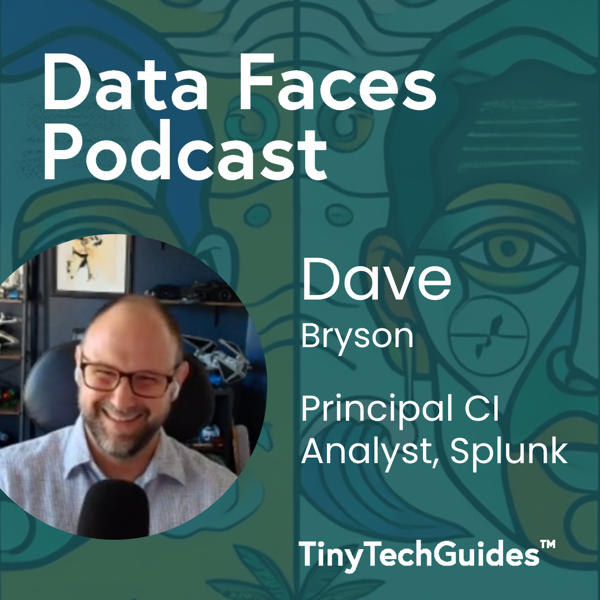
David Bryson is Principal Competitive Intelligence Manager at Splunk. He came to competitive intelligence from a sales-engineering background, mentored by a longtime CI practitioner whose favorite question — “so what?” — reshaped how he thinks about intelligence work. He draws a sharp line between gathering information and producing intelligence.
In this episode
- The difference between information gathering and intelligence gathering
- Where AI helps competitive intelligence — and where it just adds noise
- The “so what?” test that separates data from intelligence
- Moving from information collection to actual intelligence
- What CI teams and marketers should automate (and shouldn’t)
→ Read the full article: How AI killed traditional competitive analysis
Full transcript
David Bryson 0:00 David.
David Sweenor 0:05 Hello and welcome to the data faces podcast that brings the human stories behind data analytics and AI to the forefront. I’m David Sweenor, founder of tiny tech guys, and your host for today’s discussion, I am super excited today we are chatting with David Bryson, so it’s the Dave show. He’s the principal competitive intelligence manager at Splunk. He’s an expert in CI and he knows a thing or two about location intelligence as well. He spent his career helping organizations make smarter strategic decisions by combining his deep market insight with practical tools and advice, and now with the help of AI. So let’s get into it. David, welcome to the data faces podcast.
David Bryson 0:40 It’s great to have you here. Yeah, great to be here, David. Thank you. And
David Sweenor 0:44 so should I be David or do you want to be David or Dave? We got to get this straight before we jump into this.
David Bryson 0:51 How about how about you be David and I’ll be Dave. All right. Well, Dave,
David Sweenor 0:55 bit about yourself and your company.
David Bryson 0:57 Sure. So I’ve been doing CI now for about seven years before that, I was a sales engineer. So I spent, actually most of my career as a sales engineer selling enterprise software. And I got into Ci after I joined a startup that their main competitor was the company I used to work for, so of course, I had to do a little bit of CI on my former company for my current company, and that kind of made me fall in love with the profession and been doing it ever since. So yeah, I worked at Alteryx for a little while. Helped build the CI practice there, and now I work for Splunk, and it’s been an interesting journey. So when I joined Splunk a week after they announced the acquisition by Cisco, so I work for Splunk now, but actually, technically, I work for Cisco, so it’s been a wonderful journey, and being a part of Cisco has been actually really awesome. So yeah, it’s, it’s, it’s great. Well,
David Sweenor 2:02 that’s fantastic, you know. And I started my marketing career doing competitive intelligence, so I have walked in your shoes, but before we jump into their our topic du jour, what did you want to be when you grew up? What if it’s not a competitive intelligence analyst for Splunk? What was
David Bryson 2:19 it? Well, I grew up in North Carolina, so just about every North Carolinian kid wants to be a race car driver. And I think if I, if I had my dream, that would have been it maybe not NASCAR. I probably would have been more Formula One or GT three, or one of those, you know, where you drive Porsches and Ferraris and Corvettes and stuff. But, yeah, I think that that was probably my dream, but that’s a tough sport to get into if you don’t have a lot
David Sweenor 2:50 of money. Yeah, well, I’m glad you chose you want one that you don’t just go in an oval or a circle. So that’s, yeah, we’re on the same page there. But, you know, let’s talk a little bit about AI. So you know, competitive intelligence, historically, is required a lot of research, getting documentation, websites, what have you. So, how has AI changed, how you and your team at Splunk prioritizes, you know, sort of intelligence gathering efforts?
David Bryson 3:15 That’s a good question, you know, I think the gist of this question is really about, you know, that sort of gathering process, right? And you know, AI can easily automate that gathering process or this low value activity. And I think that’s true. But I think, you know, what is intelligence gathering? I think there’s a difference between information gathering and intelligence gathering. So when it comes to information gathering, AI has done a lot to help us automate a lot of that, and I guess not necessarily de prioritize it, but it just sort of it’s in the background. So we have vendors, vendor tools like clue that help us that have, you know, news aggregation tools and things like that. Some of our teammates have built their own using their own AI skills to crawl websites and documentation and bring back things and filter it out and summarize it and stuff like that. So a lot of that information gathering activity we’ve been able to automate, and it doesn’t take up a whole lot of our time, but that’s not intelligence. So information ultimately leads to intelligence. And so what, what I think AI has done is it’s allowed us to get a lot more information, which then allows us to look at that and say, okay, so what? Right? So we’ve got all this information, we got all these news articles, now we can go a level deeper. So it’s that’s really been I think the pattern that we’ve seen is that you. AI just to sort of allows us to get a lot more information in a lot faster, which then allows us to look at it a little bit deeper and get to that intelligence, get to that somewhat,
David Sweenor 5:12 you know, that brings up an interesting question, Dave, you know, so if you can gather all of this information, and, you know, I’ve used deep research and what have you. And you type in, you get some prompt in there, and you get back this 60 page report. And then you got to write some sort of summary function with AI to summarize the report. Do we have access to too much information? Is there like an overload from a CI perspective, like, how do you, you know, separate the the signal from the noise, I guess is my question.
David Bryson 5:45 That’s a good it’s a very good question. Um, what I I’ve thought a lot about, I think, I think we have access now to an incredible amount of information in terms of, like, AI is able to go and search so much more than we can, you know, I’ve used Gemini is the one I kind of like for deep research, right? It gives you hundreds of articles, hundreds of sources that would have taken me months to go through, and it summarizes that. And so I don’t think it’s too much information, but I do think the information that we’re getting back as a CI analyst, you’ve, you’ve, you can trust it. You can say, Okay, I trust that. Google has very good crawlers, and they’ve been doing search for decades, so they kind of know what they’re doing, right? Well, I need to verify. I need to go in and I need to look at that source and see, is that source reputable? Is it, you know, what perspective is it being written from, and is there an agenda behind what it’s what it’s saying, or is it just cherry picking out, like a sentence or two that matches the question that you asked? Those are the things that you’ve got to go through and really look at. So I think it’s not too much information. It’s actually wonderful that we have access to all this information, but you still have to apply that critical eye to what things like deep research gives you back, and in terms of, like, a general response, like, if you go in and just ask a general question, I really, like, I advise a lot of the analysts on our team to really take it with a gigantic boulder of salt, not a grain of salt, a boulder of Salter, all right? Because if you think about it, those the answers you’re getting if you ask about a competitor’s product line, or how do we our company? How does it compare to another company? All of that is trained on the marketing message of the competitor. And on top of that, you’ve got the AI is sort of, I don’t know if you read these articles about the sycophancy problem, right, which is that llms kind of have this need or program to give you this kind of neutral, positive answer about everything. And okay, is that really what an analyst would do is give you this neutral, positive analysis of everything? Probably not. So you’ve got to really critique those generic answers. And I think a lot of that comes down to prompting and how you’re getting the getting those answers. But you know, we’ll get a lot of sales people who will just say, well, AI told me this about this competitor. And you know, they’re just kind of using a generic prompt. And, you know, that’s, that’s, that’s not the right way to really do analysis, in my opinion.
David Sweenor 8:55 Yeah, no, totally agree with you. And like the general ones, like, perplexity is probably the worst data. It comes up with these blogs I want to even bother to read ever. But I’ve seen some where, like, I wanted a review of, you know, like the snowflakes and Databricks shows that, you know, happened a few weeks or months ago. And I asked it, hey, summarize this. It was coming up with other vendor recaps of what these companies may have said, but these companies didn’t say it. It was biased towards whatever that company did, and it was a data governance message, which wasn’t really, you know, the focus of it. So I, you do gotta, I always tell people, you gotta use your eyeballs. So I love, I love that message. So, you know, with all of these tools, you know, people say this about marketing. They say about, you know, competitive intelligence. Hey, it’s going to automate your you. It’s going to automate you away your role, your job. So how do you see it enhancing and and maybe not replacing the human side of of CI to bring that intelligence that you mentioned, mentioned earlier? Yeah, not information, intelligence. Were very specific on that,
David Bryson 10:01 yeah, exactly. And, you know, I think if, if, if you think that AI can automate away an analyst, then you probably don’t have very good analysts. And because, if all you’re doing is just sort of regurgitating what you’re reading out in the world, or, you know, putting it in newsletters. I mean, those are things that, yeah, AI is going to automate, that these, you know, ci platforms like clue or others can automate a lot of those types of things, even, you know, creating battle cards or whatever. But I think that one way that AI is enhancing our work is, is deep research, and so we just talked about that, right? It can unearth these sources that you might not have found on your own, or give you maybe some perspectives that you didn’t see. But what’s really important is the expertise of the prompter, right? You. The way I look at deep research and the way that our team sort of uses it is, my prompt will be a page long, right? Maybe more. And the way I think about it is, okay, I have access to a on, you know, incredibly intelligent, unlimited capacity will work all day and night, research intern, right? That’s, that’s deep research. It will do what you tell it to do better than anything else, but you have to tell it to do the right thing. So the way I think about it is like, what would I tell a intern to do if I wanted to research this problem? What perspectives would I tell it to take? How would I How would I guide it to be critical of what it gets back, to think through what it gets back different sources, not just marketing websites, but, you know, other websites that I might go and try to look for. When you guide it in the right way, it’s super human, right? But if you what I found is the responses from deep research can be amazing or terrible, and really
David Sweenor 12:09 it’s on that spectrum. There’s no in between. There’s no great, good or bad
David Bryson 12:15 and and what I found is that if you’re more generic, if you just say, compare Splunk to CrowdStrike, and that’s it, right? It will go, and it’ll do its 10 minutes of searching, and it’ll, it’ll go through its reasoning and everything else. And what it’ll give you back is very sort of bland responses, right? If you give it a page worth of prompting to really say, here is my problem. This is the sources I want you to use. This is how I want you to think about this. This is the persona I want you to take on. These are the follow up questions I want you to ask when you get the results like you really think about a prompt. Man, it is, it is really good. It is really, really good to give you back some solid information. So that’s one way that we’ve used it, sort of AI’s enhanced our work. The other is learning, and that this has been a, kind of a surprising one to me. I’ve you know, cybersecurity and observability were not areas I was expert in when I joined Splunk and I had to learn about all those different industries, and that is a mass those are two massive industries to really have to learn super technical, too super technical, lots of use cases, everything. So I have found AI to be a wonderful way to learn something I didn’t know before, because it’s like your personal tutor. You can ask it explain this to me in simple terms, or I didn’t understand that. Or, what does this acronym mean when you said this? What does that mean? And it’s infinitely patient with you. It’s not going to say that’s a stupid question, right? And so through either you know, the deep research results I get back or from just like, hey, I don’t know this. What does this mean? I’ve been able to learn a lot about the industries that I support, which then means I can take my CI training and apply it, and I have the background knowledge that I need to be able to do more deep analysis.
David Sweenor 14:18 Very interesting. Yeah, I find it very valuable for that as well. So you know this prompt, this one page prompt you have, sounds like you’ve taken your years of experience, yeah? How you would ask how you do this manually, and you’ve, you’ve written it down, and so now the AI is going to follow your instructions. From an organizational standpoint. Does your team share these things, or does everybody sort of keep them to themselves? I’m just curious. What the state of this prompt? I’ll call it a prompt inventory or library. But how do you distribute that knowledge throughout your company? If you do or maybe you don’t, I don’t know.
David Bryson 14:58 Yeah, it’s an interesting. Interesting question, we each we each focus on a different area of the market. So my prompts won’t always be transferable, because I’ll be asking different questions from a different perspective than maybe one of my peers will be. But one of the things that we we do is we all take the same certification training for CI, which gives us a particular lens that we look through, so we can share the prompts with each other. You might have to modify it significantly in some cases, or just a little bit, depending on what it is you’re asking. But you know, it’s not a secret, right? Like, if we share things with each other, if we found something, some tool or some prompt that really worked well, of course, we do share it with each other, but sometimes it’s, you know, you use it as a reference, but then you write your own, right, because it’s very personal, very specific to the project that you’re working on and the competitors that you’re looking to assess, or maybe the specific capability or use case or outcome that you’re looking to research will be different every time.
David Sweenor 16:09 Okay, so it sounds like I was just to genericize that. It’s sort of ad hoc. You’re sharing if you’re asked. But there’s not a central repository where says here, put your best here. It’s sort of you share it when asked. So, yeah, yeah, okay. I was looking at your, your your last blog post on on LinkedIn, and thought was interesting. You were talking about putting AI, you know, into products, essentially. And you actually started out with this, you know, the dreaded feature function matrix that we’ve all created. And, you know, every company I’ve worked for they, I think they have this, like, what do they call that? The geocentric version of the universe? You give yourself all green check marks, and everybody else gets some, some yellow and reds. And, you know, you’re you’re awesome. But if AI is embedded into every software tool. Now, how do you think about this from a competitive intelligence perspective? Yet, you had a really unique viewpoint in that article?
David Bryson 17:10 Yeah, I think that I really I struggled with this one right because I wrote that article right when I was I had shifted my focus from, you know, kind of looking at data management competitors to now looking at all of our competitors and their AI capabilities. And what I found was that it was, it was difficult to differentiate between one vendors, co pilot versus another. They were both co pilots. They both used open AI, maybe, or, or maybe they use Gemini as an API, right? But from a feature functionality perspective, like when you think about those matrices that we typically make, you know, let’s, let’s go back to Alteryx, for example, right? Alteryx had over 200 tools, so each individual tool is a feature function, and then you could compare that to another one. And now you’ve got a matrix, and you say, well, they have this and they have that, or they don’t have this, and, you know, we do whatever in AI, it’s like, Well, okay, so they have a co pilot. So do we, they use open AI? So do we their cybersecurity platform? So are we, where’s the differentiation, right? And the differentiation is the outcome. So what does the user want to do? What problem do they want to solve? And does the AI help them solve that problem or not, and that, I think, is the new sort of feature matrix is it’s not about What model do they use or not? It’s about what problem does the AI solve for the user that we do or they don’t? Right? That’s the comparison, rather than the future, and it and so that that was kind of what that article was about, was to say that as a CI professional, you have to stop thinking about comparing features. And as a salesperson, specifically, you’re selling this stuff, you’ve really got to stop competing on features. Because, you know, I’ve seen a lot of sales people struggle with this. You know, they want to say, Well, what? What does CrowdStrike aI have with ours? Doesn’t or whatever, and it’s like they’re not thinking about it the right way. You need to ask your customer, what do they want to do with AI? What are they expecting it to do? What are their problems? And every organization is going to be different, by the way. So every organization that you sell to is going to have their different business. They’re in a different industry. They’re gonna have different problems and use cases that they need, they need to solve. So that’s the lens that you look at the AI through and the capability. And that’s what we’ve done on our team, is we’ve flipped it from feature comparison to outcome comparison. Then when it comes to AI, and that’s that’s really helped us find those differentiators of, like, one co pilot versus another.
David Sweenor 20:08 Oh, that’s, that’s really fascinating. So am I hearing this right in that? Let’s just, I know nothing about cyber security, so this will be an easy one for me. Like, there’s probably, you know, a dozen 100 different sub markets. Of that, are you saying each company now you’re saying, hey, this one does this one thing really well, and this one does this other thing really well. And so if you’re going to talk to the customer that has, you know this outcome, that’s that’s our sweet spot, maybe this, this other one does a different is that, how you think about it, versus Hey, do you do, I don’t know, threat detection. Sure. We all do threat detection or something. Is that? Is that? Is that, is that kind of what you’re
David Bryson 20:44 getting at? Yeah, and it’s being specific with each it’s being with specific with each customer, right? So, yeah, the threat detection is a good one, right? Like a lot of cybersecurity vendors, they have AI that supports threat detection in various different ways. You know, algorithms in the background, correlation searches, all these different things that are, you know, AI, right? But you know, let’s say that, okay, you you’ve detected a threat, or you’re getting all these false positives. How is AI going to solve that problem? So I’ve got all these threats that have been detected. How am I going to work through all of those threats and actually figure out is this real or not, and then take it to its conclusion of doing something about it, automating that response to whatever that threat is? How is AI going to help you solve that problem? And and, so that’s where things start to get interesting. Because, yeah, they can all do threat detection, but within what happens after that? So, okay, I’ve detected the threat. Now what that’s getting to that level, deeper and that use case of, well, one company might treat a threat a little bit differently, or they may have a different process, or, you know, one one company may have a team of 50 SOC analysts, and one company may have a team of one sock analyst. The use case of how AI is going to help a team of 50 versus one is going to be very, very different. So that’s, that’s the, the thing I encourage, like our product managers and our sales people to really get into, is get into those niche use cases so that we can really do a proper comparison and analysis of of the AI capability of a competitor. That
David Sweenor 22:35 makes perfect sense to me. I remember what I used to work in. You know, manufacturing and statistical process control. You have all these 1200 processes, and like you have all these alerts, so all these things are red. And if I have 300 engineers, and I each spent 30 seconds on each one, it would take them all, you know, like more than there was time in the week to get through it. So how do you prioritize what you go through? So I think that was a nice way that you explained that. So maybe let’s shift a little bit on the you talked about you’re using AI for deep research, talked about the prompts. What other sort of real, real word, real world use cases are you using AI for that? Maybe help you shift from maybe a reactive approach to Ci to a more proactive approach to competitive intelligence.
David Bryson 23:23 Yeah, I think the thing that that AI has done for us is it’s allowed us to do when, when we’re doing things like research or, you know, Googling things like it’s made all those those processes faster. It’s made the ability to do the things you would expect a CI practice, to do, the battle cards, the newsletters, you know, we have a podcast like all those things can be done faster because we’re using AI tools to get us that get us there, right? What? What’s really made us be more proactive, though, is not necessarily that AI is helping us be more proactive. It’s that AI is helping us be more strategic in the work that we do, in the research that we do, and because we can be more strategic, we can be more proactive. And so there have been several instances where, you know, every CI team, we there’s always a huge challenge in the business that we all recognize. We can see it. And Splunk was no different. And so I can’t tell you
David Bryson 24:33 everything. I don’t. I don’t want to break, no, we don’t want to give any, any secret. Yeah,
David Bryson 24:37 sure. But you know, there was a, there was something that Splunk was missing in the market that they had overlooked. And I think everyone can relate to this, right? That you all, you all, everyone sees it, and you know, for whatever reason, there’s just change is not happening, yep. And one of the things we were able to do, because we have this extra time that’s enabled by AI, is we were able. To go deep on this particular topic, and we were able to look at our competition and look at the market and see what, what they were doing, and more than what they were doing, what that what that product set was the consequence of our customers adopting this competitor, these competitors, what the ultimate outcome for Splunk would be, and articulating that in a way that was really impactful and almost scary, right? Like we don’t want to scare people, but at the same time, like we want to motivate them and say, Hey, if you don’t pay attention to this, this is what’s going to happen in the future, and we were able to get ahead of we were able to be proactive and get ahead of this, this, this product area that we were kind of neglecting, and bring it to the forefront. And that was enabled, I think, a lot, by the fact that we, we we had this actually, we have more time now to be strategic. And every CI practice, and everyone who’s listening, who you know is in CI, everyone wants to be more strategic. The fun part of CI is being strategic. It’s not making battle cards. It’s not doing newsletters like that’s not the fun part. The fun part is when you really get to be proactive and think through what are the next moves of this competitor going to be, and how are we going to respond to that? That’s, that’s where it gets really
David Sweenor 26:27 fun. Oh yeah, we’re gaming it out, and all that sort of, yeah, that’s cool. So we talked a little bit about this. You know, deep research can scan. It takes 20 minutes. It scans 1000 websites or or whatever, gathers information, yeah. When does it become intelligence? Because if it’s searching 500 1000 websites, I don’t know if you have enough time in the day to click through all of those. So at what point does this? How do you make sure it’s not noise? Number one and number two. How do you, how do you, what does it like? What’s what is that tipping point? What does it go from information to intelligence? What does that look like in your mind? I was,
David Bryson 27:12 I was trained in CI and actually at Alteryx, by this wonderful woman who was a longtime CI practitioner, and she sort of mentored me in the practice. And she used to always tell me, I would, I would go and I would get all this information right. I would bring all back all these information. And I would say, Oh, Sophie, look at this. We’ve got this. And this competitor did that, and they did this. She would look at me, and she’d say, David, so what. And and at first I’d be so what I don’t know. And over the years in CI I’ve, I’ve really embraced the wisdom of those words. The way that you get to intelligence is you look at the information that’s presented to you by an LLM or, you know, look even by Google searching right? Let’s go back to the old days right of a year ago.
David Sweenor 28:06 We’re in the olden days now. You
David Bryson 28:09 google search something and click the blue link, what did you ask yourself? So what and what that does? So let’s say, you know, a competitor releases something new, or they have this article that they’ve released. It looks interesting at the end of it, you read it, and you say, okay, so what? And what that does is it, it sort of trivializes the response that you get from the LLM or from the article you read it kind of trivial. Trivializes it a little bit, and says, You take these things at face value. Say, Oh, it’s coming from CrowdStrike. It must be authoritative, but when you say so what, it makes you look a little deeper. Like, okay, why are they writing this? How true is this really? What’s the motivation who wrote it, or who said this? Let me go look them up on LinkedIn. Look at their history. Oh, they announced a new CRO. Okay, let me go look at that person. So what? They have a new CRO? Big deal. Why did they so you see how that question, it starts to make you ask additional questions. And so that’s where you get to intelligence, is that you’ve gone beyond what the LLM presents to you. Oh, this is the differentiator really Okay, so we have better data management than our competitors. So what? What does that mean? Why is that important? And that gets you to the point where you can make a really solid recommendation and get something really valuable about what’s going on behind the announcement, or what’s going on behind the information that you’ve you’re being presented?
David Sweenor 29:45 Oh, I’d love that answer that. So what? And you keep, you know, it’s almost like the five why’s with lean, lean six sigma, you know? So what? I had a science teacher in high school, they would ask that. So what? So by. Ones on your underwear, they would say, I’ve never forgot that. So what is the meaning and and how do you translate that to buyer needs? If you’re focused on sales support or, you know, what do you need to do to your product? Yeah, I love that. So we’re at the we’re at around the 30 minute mark. So let’s talk a little bit about the next generation of competitive intelligence specialists and professionals, what do they need, you know, to thrive in an AI, sort of AI first
David Bryson 30:29 world, you know, I think a lot about this. You know, there’s a lot of stories out there about how AI is making people not think as much. And, you know, kids in college who are using it to write their papers, and they’re not, you know, these critical thinking skills are being, you know, challenged, and that’s a huge part of competitive intelligence, is critical thinking, being able to think through these problems, get to that. So what behind everything? I think that what will happen. And, you know, new CI professionals will have access to all these tools for information gathering, and it’ll be great for them in that way. I think there’s, I think there’s, there’s three things. First is, I think CI professionals of the future will need to be experts in human behavior. Why is that important. Companies are still no matter what industry you’re in, companies are run by humans. Companies are led by humans. Companies are advised by humans, and they have weaknesses. They have personalities. They will make illogical choices, and until such time as AI runs complete companies, which, hey, may happen in the future. Who knows? You’ve got to, if you’re looking at a company in their moves and what they’re going to do in the future, as a CI analyst, you’ve got to understand human behavior, right? You’ve also got to, under have a good understanding of history, you know, have an interest in history and looking at trends over time, because a lot of what history is cyclical, right? And even in business, that’s true. A lot of companies will make the same mistakes over and over and over again, um, but I think the biggest advice I and and skill set that for new for the future CI professionals, and this is going to sound weird, is that I think they should do something else first. Oh, I don’t think that someone has an MBA coming out of college who’s had access to AI tools for most of their education is going to make a particularly good CI analyst. The best CI analysts come from other, I think, other backgrounds, right? They’ve been sales engineers, product managers, product marketers, sales people. I’ve met so many different CI professionals who come from such varied backgrounds, and that’s what makes them good CI analysts, is they have this diversity of thought that is makes them unique, and look at a problem or look at a company or look at a situation in a different way. So I think that is really the future of CI, is that it shouldn’t be the first job you get, it should be the second job you get, or the third job that you get. And that’s gonna, I think, help the profession grow in this age of AI. Because again, AI is an amazing tool for you to use as a CI analyst. But, you know, like I said about prompting, prompting matters, right? You’ve got to have that perspective and that unique perspective to guide it to what you want it to do for you. It’s not a, you know, templated stamp of, you know, I’m a recent MBA graduate, so I’m going to analyze this like an MBA student. You’ve got to really think about it in different ways. So do something else first.
David Sweenor 33:47 I totally agree with that. So critical thinking. Understand history because it’s cyclical, and do something else first. I agree because I never really understood Dilbert until I worked at IBM, like, Oh, now I get it, you know, just the insaneness of some of the processes that we’re going on. So maybe the last wrap up question, Dave is, is for people who have had their first or second job and are interested in the CI profession. You know, what recommendations may you have for them to get in the field, or how should they approach it?
David Bryson 34:29 I think what I love about CI is that I feel like it really is. It’s a meritocracy. It is if you come with a diversity of thought and perspective you can get into it. Don’t be afraid if you don’t have 10 years of CI experience to apply for a CI job. Don’t. Be intimidated that you know you don’t know CI right? All of those things can be taught to you, the techniques and the things that we learn in our certification courses, those are things that can be learned. Again, the best CI analysts are the ones that understand human behavior. Have a curiosity, a natural curiosity, want to learn more about something. Want to explain the world and how it works. And I think my advice would be, don’t let, don’t let the fact that you don’t have that title in your in your job title, don’t let that stop you, because again, some of the best CI people I’ve ever worked with, they never did a c ci a day in their life. And then they come into the job, and they’re magnificent, because they just think differently. And so again, if you’re curious and you it sounds like an interesting job, go for it, and I think you’ll be rewarded, because a lot of people in this profession are looking for people who aren’t necessarily, you know, oh, they’ve got 15 years of CIA experience. It’s, oh, you’ve got experience on the ground as a salesperson for 15 years. I bet you’re going to have a really unique perspective about how we compete.
David Sweenor 36:18 That’s what we’re looking for. That is awesome. That is amazing advice from a true professional. So Dave Bryson, thank you for joining the databases podcast. This has been an amazing discussion. Our listeners and viewers are gonna get a lot out of it, so I appreciate your time, and thanks for the great advice you shared. Dan, thank you, David. All right. Cheers. Bye.