

Data Faces · Episode 12 · May 20, 2025 · 36 min
The biggest reason AI projects struggle isn’t the tech — it’s the people. Danny Stout on team dynamics over technology.

Listen: YouTube · Spotify · Apple Podcasts · Amazon Music
About Danny Stout
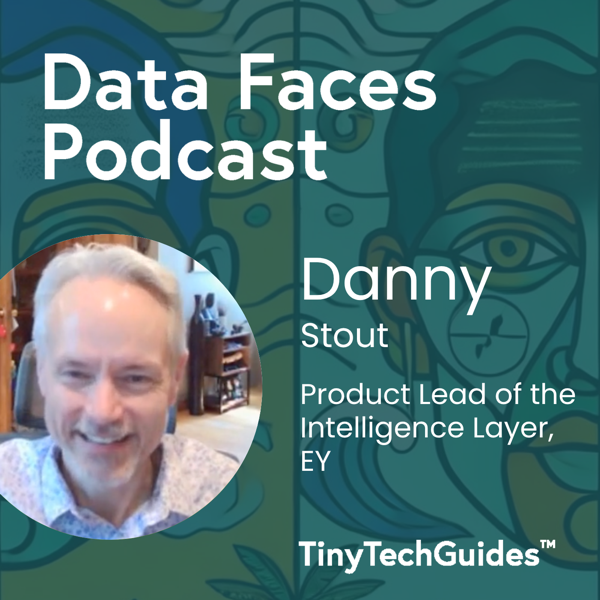
Danny Stout is Product Lead of the Intelligence Layer at EY and a self-described “data scientist by accident.” With a PhD in educational psychology, he brings a human-centered perspective to AI. His career spans STATISTICA, Dell, and TIBCO — building predictive analytics for enterprise customers — and he previously served as global head of forecasting, pricing, and analytics at Takeda.
In this episode
- Why bigger AI models aren’t always better
- The three critical roles needed for AI success
- How team alignment determines project outcomes
- Real-world lessons from a diamond-mine theft-prediction case
- Why communication skills matter more than technical prowess
→ Read the full article: Team dynamics over technology: the human elements that drive AI success
Full transcript
David Sweenor 0:05 Hello everyone, and welcome to data faces, the podcast that brings the human stories behind data analytics, marketing and AI to the forefront. David Sweenor, founder of today’s discussion today, I am super excited to join with Dr Danny snow. He’s the product lead of the intelligence trader at EY. Danny has been in the AI game for quite a while. We worked together in the past, and I’m super excited to talk about the human impact of AI and analytics. When we talk about what really drives successful AI, we’re talking about teams. I think why the human element is more important than ever, so let’s get into it. Annie, welcome to the databases podcast. It’s great to have you
Danny Stout 0:45 here. Thank you very much. David, I’m excited to be here. It’s good to be working with you once again for at least a little while. Yeah,
David Sweenor 0:53 there we go. So I saw on your LinkedIn a part of your profile says, I specialize in harnessing the power of Gen AI and machine learning to drive innovation and transformation. And I noticed in your educational profile, you have a PhD in educational psychology, so tell us a little bit about yourself, how you got to where you are and what you’re doing in your current role. Great.
Danny Stout 1:14 Thank you. David, yeah, I call myself a data scientist by accident. I really thought that I would hate statistics and anything related to the math part of humanity. So it’s whenever I was in my master’s degree, I was going towards human relations. And I had a professor that was really a mentor to me, both in my education and also in my direction in a career. And he really made statistics lively for me. He really showed that statistics really is an interpretation of what we do as a as as a worker and as a person in life. And it made it so attractive to me that I that I had to go, just like a true nerd, go for a PhD, and he had a PhD in educational psychology and that. And that’s what I did, too. They have a rems cognate, which is a focus on research evaluation and measurement. And I actually did my dissertation on measuring medical knowledge and epistemology. So, oh, boy. Really exciting work in science, and it led me to be a data scientist. I got a job in Tulsa, Oklahoma, my hometown where I met you, and started working for a company that developed STATISTICA. Worked at Dell for quite some time, designing predictive analytic systems for enterprise customers, went to Tibco with the STATISTICA product, continued to develop my predictive analytics skills, as well as being able to sell to those large, large customers and being able to convey the human aspect of technology. And that led me to Takeda. I was their global head of forecasting, pricing and analytics for a while, for about three years, actually, and now I’m at Ernst and Young, where I am the director of a product line there. So really excited to be here. Long winded answer to what I do, but the human element is really where I get my focus, and seeing how we can leverage that in any work that we do. That’s
David Sweenor 3:16 great. Danny, you should have a very rich background, and you’ve been with a lot of companies. You’ve talked to a lot of companies, and, you know, today, I think everybody’s, like, tech obsessed, I want to call it, and we see an announcement probably nearly every day or every week. Hey, my model is bigger than your model, and I have a billion parameters, and I have this many billion more parameters, and how long it takes to to change where it got these models and metrics. So what do you think we’re missing when it comes to the team and culture and analytics? And AI,
Danny Stout 3:47 great. So I say, I really think, you know, in this instance, bigger is not better, the bigger model is not better, the bigger application is not better, the bigger LLM is not better. And if you look back at past, we see real evidence of that even if you look at ensemble models, many small ensemble models outperform a larger model. And we’re continuing to find that today, as we start to look at so the llms, we start to see that some of the smaller language models are actually better for some applications. And guess how we’re finding that out by people using those models. So it’s we’re really able to see how we can harness the power of smaller applications within a larger system.
David Sweenor 4:32 Danny, does this imply that for every use case, I need to have a potentially a different model running, that’s a small language model appropriate to the use case, or like, I mean, how does even an organization think about that? I think
Danny Stout 4:45 it’s a lot of exploration, seeing what problem you’re looking at, what the business or the people are trying to get out of it, and what the application really is for. So recently, we were working on an application. Where we actually wanted to develop a large language model for a particular line, and we thought that by having a specialized model, it would actually outperform some of the other models, like the Azure models that are out right now, some of the mistral models, some of the larger models that are very, very popular. And by actually looking at it and using it, we were able to see and we did actually build a model, and it did not outperform. So I think we can have better utility by looking at what’s at our hands and trying that out, and then seeing where the next step is going to lead us,
David Sweenor 5:37 okay, and our past experiences that you know, we’ve seen a lot of, I’ll just say alignment issues and organizations or lack thereof. So you know, what role does the executive team, and a lot and alignment in that executive team, how important is that for analytics and AI?
Danny Stout 6:00 It’s absolutely vital, if the team is not aligned beforehand, there’s no way that whatever model you choose is going to be successful. The team has to be in alignment. And also the team has to understand what is trying to be solved, which is part of that alignment. I’ve seen very brilliant teams go to approach a problem, and because there’s non alignment, it falls down. Even our time at Dell, whenever we were working with replacing the established predictive analytics platforms with the predictive analytic platform we were bringing in, there were groups that we went in and tried to just establish that foothold without buying in or getting the buy in from the teams themselves. And each time we did it, it did not work very well. But when we invested the time and energy and going in beforehand and establishing that alignment, it went really, really smooth. So I continue to see instances in my past and in other companies where they don’t invest that time and energy at the beginning, and it causes problems down the road.
David Sweenor 7:05 So how can teams, you know, gain that alignment? Is it alignment on like, is everybody like, Hey, we’re pro AI, Gen, AI, what have you? Or is it selecting the right use case? Like, where? Where’s the alignment failures? Is product want to do one thing. Sales, want to do something else. And marketing, even you know a third priority, like, what’s what? Where’s the alignment breakdown, they’re
Danny Stout 7:29 asking the questions, just like you just did, but not at the beginning. A lot of people want to go right for the technology and right to go for the solution, without making sure to look and see where people are at before they even join the team. So for me, whenever I’m developing a team, the first thing that I want to do is I want to look at the skills that are needed make sure there’s a balance that the book that John Thompson read about building analytic teams is something that I’ve really focused on and made sure to integrate into the way that I weave teams together. And the second thing that I do is make sure and address any questions that the team members had before we begin the project. And that’s where I think people fail to spend that additional time they think it’s going to be better to go ahead and get action, have your milestones, make the checks and the milestones and get progressed down the down the map, and they forget that everyone from product, everyone from technology or engineering, and everyone from architecture as well as leadership, has to agree on what’s the goal. And if they don’t agree on what’s the goal, at least agree on the direction that’s being chosen.
David Sweenor 8:44 That’s really interesting to me. And you mentioned this from the perspective you’re a builder, so you build these systems. What I didn’t hear in your answer is the end users, how it’s going to impact my life. Are they often just sort of forgotten, or do you see them typically involved in the beginning? Or they’re like, well, the technology team is going to pop down some technology like, go use it. Like, what’s what’s been your observation over your career? I’ve
Danny Stout 9:11 seen both instances. So I’ve seen instances where the end user was the focus, and you followed the typical model of going and working with the end user, finding what the needs are, building your features and building that up into your epics. But there are also times, and unfortunately, sometimes it’s a business need that you’re going to have to use a new technology or a new approach to a problem, and the first one definitely succeeds more often than the latter. With the latter, there are times that it even gets a little bit punitive, that that we have to do this, and if you don’t do this, you need to find a job elsewhere. And there’s also times that people have skills that don’t translate as well the new technology doesn’t match their skills, and they have. To learn new skills. So three different approaches and three different results.
David Sweenor 10:06 Okay, really interesting. So let’s just say Greenfield, you’re going to design a new team to build some some cool AI, what’s two? Dad, you know, who are your first three hires? And why are you picking the these, these types of people, perfect.
Danny Stout 10:22 So my first three hires is someone who is technologically gifted. You have to make sure to meet the technological needs that are being presented in the doodad. The second one is someone who understands the business but also understands the technology as well, because unless you have that ability to translate between the two, you’re not going to get anything done. And the third person is someone who understands the background and the leadership that is in place. Because unless your team is aligned with leadership and make sure that you have a bridge or a ladder in between where you’re at and that bridge, it’s again, going to be unsuccessful. So you have your technology, you have your translator with the technology, but also is good with the business. And finally, that last one that is good with the behind the scenes, type of infrastructure work, but also is that bridge of the ladder to leadership,
David Sweenor 11:14 interesting, how, like, what type of person would make so I get the technical piece. And so, you know, we can, we can, you know, people can demonstrate that. How about this translator role? I That’s really fascinating to me. What sorts of qualities or attributes do you look for, or what? What is their background? Typically, when you find this analytics or AI translator,
Danny Stout 11:35 it’s a person who is typically originated in the business but saw the need to develop technological skills and really focused or honed on those technological skills, and that’s because that person typically is best at presenting and making sure to deliver some technological content in a way that leadership can consume. So often I’ve seen projects fail just because something wasn’t communicated very well. And I’ve been able to go in a couple of those instances, look at what was being done, present it differently, not changed any of the technology, and automatically get to hold so that second person really has to be either embedded in the business or have understood the business as well as understands the technology and can communicate it. And this person, really, I typically look for in their education, if they’ve had any speaking or speech type of courses or certifications, but also has had some sort of, not a maybe award or maybe some sort of notice or achievement about that ability to communicate those business needs. Okay, that’s
David Sweenor 12:42 interesting. And then I think the third the look at the technology person, we have the translator person. He also mentioned the sort of bridge to the executive team, like, what? Who is that? What are what are they typically look like?
Danny Stout 12:55 They typically look like the business person. But also has understood the the longitudinal impact of the technology that they’re starting to bring in, they can see that what they’re bringing in is not going to get the foothold that’s needed, or is going to get the fit hold that’s needed, that understands the power dynamics that are in place and leadership as well. The technological team, the team that’s or the product team that’s actually building it, they have to have some sort of a stakeholder that’s going to be their champion. And unless you can work in the background, identify those champions and develop that relationship with leadership to do that, it’s not going to succeed as well. So again, it’s it’s almost like the second person that I talked about. But this person is really focused on the relationships that go on in leadership, that also understand the background of what’s going on as well, like and typically, I’ve seen this person more in the architecture type roles. For some reason, the people who are in those architecture type roles have really developed those strong relationships with leadership and have been able to establish that foothold, not always, but whenever I’m looking for that third person, I’m always looking for a person who understands those power dynamics and can start to work with leadership and with the product,
David Sweenor 14:22 okay, very fascinating. And then maybe just finalize this on the one he started with the technology team, is, what kind of skills are they have, you know, you know, all these generative AI solutions today. They can write pretty good code, and they can, if you know what questions to ask probably do pretty decent data science. So are these mechanical skills that we prioritized in the past? Are they changing? Are you seeing a change or an evolution in that huge
Danny Stout 14:52 change, and that first person is typically a generalist and not a specialist, whereas in the past, it may have been a specialist. So. If we have to have a specialist that’s going to require a fourth person to the group, and that’s because the tools that we have today are so good for a wide variety of applications. No longer do you need a neural network that’s particularly tied to a particular language that’s going to be deployed in a particular architecture? You’re really looking at different types of models that are going to answer very general questions to the best of their ability, but then also have the room to grow for these specialized pockets. That way you can bring in that fourth person or that fourth team in order to bring that closer to realization.
David Sweenor 15:38 Okay, and this is maybe an aside, a little bit off topic, Danny, but do you see this generative AI craze as the death of sort of drag and drop data science platforms or BI platforms, or are we going to see something new on the horizon? Just, you know, love to get your perspective on that. Yeah, I don’t think it’s
Danny Stout 15:57 going to be the death of it. I really, I see some people really say that it’s going to completely transform the way that we interact with technology, and in the long run, it will. I think the natural language capability of being able to develop a model is going to be the future that we have too many people that are established in either a code first approach or even a low code approach, where they have a little bit more control over the process. I’m actually working on a project right now where we want to build agents that use natural language in order to actually build those agents. So you type in your prompt and then it goes to this is the planner that you need. These are the different personas of agents that you’re going to need in order to present it. And this is the way that you’re going to need to deliver those results. And it’s going to be very, very exciting to do. And it’s the future. It’s where we’re going in the future. But we also have to make that capable to be parameterized or controlled by external people, either through that code first or low code approach. So it’s it’s a for me, looking at it, I have to make sure that it is bridging to the future, but also supporting those people who are using the current technology or approach to technology. Okay,
David Sweenor 17:10 so we’re gonna have an army of agents. I don’t I can’t even get companies to, like, monitor their their predictive analytics. I can’t imagine what they’re gonna go through with all these bots of different things. Do it. You know, all supposedly collaborating and doing different things. But we’ll, we’ll see the future. We don’t know but
Danny Stout 17:27 guard. The guard drills around them too. The guard bills that we’re going to have to put around, it’s like bumper cars, and you have to have your guard drills around your bumper cars.
David Sweenor 17:34 You’re and you’re bound to get bumped. So be ready for a jolt in your organization when things maybe go awry there. So let’s talk a little bit about do you see as soft skills? Are they becoming more important versus the hard and fast mechanical technical skills? Or what role does the soft skills play? I
Danny Stout 17:56 think they’re going to be increasingly important. I think that the cause we’re really relying on natural language in order to deliver or create some of the models that you’re going to have to have that ability to interpret the soft skills into something that’s more technological. So we recently went and we’re looking at a way to solve a problem within a particular service line, and we wanted a way to make it so that it was easily used by a particular group of people, and it was very difficult to do because we had to make sure and pay attention to those soft skills. First, this group of people really didn’t have the technological need or capability to do it. So our team had to make sure and specialize in their particular soft skills in order to deliver a product that was needed. So if my team weren’t able to see the soft skills and interpret the soft skills, they wouldn’t have been able to create the product in the way that was going to solve it for that service line.
David Sweenor 19:00 So if we were just maybe to double click on the soft skills, you know what? What are a few specific types of soft skills that you think people need? And we touched on communication earlier, you know what? What other types of skills you see becoming increasingly important
Danny Stout 19:15 communication to a wide and diverse group of people. So often you’re going to be in meetings with someone who is in DevOps, as well as possibly someone who’s in the C suite, especially as some of the smaller companies are developing very, very specialized technology that’s going to be needed at all levels of the organization. And I see a lot of people who are very, very comfortable presenting to their particular peer group, but either presenting to someone in the C suite or someone in a group that may they may feel supports them, they don’t deliver that message consistently, and it’s not just consistently, but in the type of language that’s going to be consumed by all groups of people I spend so much time in. Making sure to watch the dynamics of the room, to watch the dynamics of the people that are receiving the message, but also watching the dynamics of the people who’ve given me the answer to deliver to them as well. And it’s you’re almost have to be hyper aware of all that’s going on in order to convey that message appropriately. And often in the midst of that conversation, they lose the thread because they are either afraid or possibly feel a little bit more superior in some ways, to the group of people that they’re working with.
David Sweenor 20:35 Interesting and then what? Maybe a related question. You know, when you look at teams, how important is, I guess I’m going to use the term diversity in the broadest sense. You know, it could be, you know, age, gender, ethnicity, what have you the widest definition you could think of that, how important is having diverse teams when you’re building these these systems?
Danny Stout 20:59 Absolutely vital. I think of diversity as kind of like the base of a pyramid. The top of the pyramid is only going to be as high as the base will support. So how diverse can we make the base of our team, our company, our project, and as we increase that diversity, we’re going to see the the height of that pyramid rise.
David Sweenor 21:24 Wow. So, like, they could use, like, an old grade, bearded person. That would be age diversity. That’d be fine.
Danny Stout 21:30 It would be vital. It wouldn’t be Bible. David, absolutely.
David Sweenor 21:34 I love that. I love that. Alright, let’s talk a little bit about so, you know, we opened up with your career, and you have an extensive career across a large number of companies, you’ve done a lot of different things. Can you just maybe share an example where intuition or team dynamics really made a bigger impact than the actual technology
Danny Stout 21:54 perfect? One of the ones that I’m thinking of immediately was a project where we were looking at theft of diamonds actually. So we were actually looking at how a mining operation was going on, and you were able to see that the output of the project wasn’t meeting what they estimated it should be. So they knew that something was going on, but we had to go in and be able to develop a model, and to be able to find a way to measure and identify where in this process things were going awry. And we had to make sure that we were meeting the need of the people that we were going because that the people who were doing the theft were the people that we were possibly working with. So you have to understand the dynamics of the people that you’re working with, but also leadership as well. As we’re delivering those results, we have to deliver it in a way that’s going to be accessible and consumable by everyone that we’re working with, but also with leadership as well. And by doing that, we made people believe, and because it’s true, that human behavior can be measured and predicted by models. So we had to show them that, we had to say that it’s going to improve what they’re doing. And it did, but it also helped us to identify we’re in that process there were gaps, and we were able to communicate that as well. So it ended up being very, very successful. And it was an it was, it was a testament to the willingness of people to understand the math or the predictive analytics, but also appreciate the value that
David Sweenor 23:30 it’s going to bring. Wow, daddy, did you get the go to the diamond mine or tell us a little bit about the security? Because I’m just curious
Danny Stout 23:42 about this. Pretty secure. I wonder if you could share like your experience physically going there,
Danny Stout 23:48 it ended with a strip search. So I’ll just tell you. But it seems we have virtual area of the world that they don’t have roads going in and out, and that little bitty, tiny things have great value. So you have a black zone and a red zone. The black zone you’re not really in contact with any of the material. The red zone you are. And everyone who has to go through the red zone has to go through a strip search. So it was my one and only time ever having to be submitted to a strip search.
David Sweenor 24:21 So we should no complaints for airport security, for from anybody after having to go through that, right? That’s sort of a cakewalk. I would say, I
Danny Stout 24:28 don’t care about taking my shoes off, so it’s a long as I don’t have to take my pants off.
David Sweenor 24:35 That’s awesome. So, Danny, what’s like when people embark on these, these AI projects, you know, and you know, hopefully they they start out with a business problem that they want to solve. You know, what’s the biggest, maybe blind spot or unexpected things that they’re going to encounter that you know, you may, may understand that are going to happen, but like people just getting into this, might. Not understand, you know, what, what kind of what, what are they seeing that they should
Danny Stout 25:05 Occam’s Razor is real. The simplest solution is typically the one that’s going to fit, not just for the problem, but for the business as well. I know me as a data scientist, I want to go to the fun stuff. And the fun stuff is how you’re getting that large language model, what data was it trained on? How can we use it? And other types of applications, I want to get to the stuff that’s fun, because the human stuff is sometimes considered not fun, and unless you pay attention to it, you’re not going to get the results that you want. And also, I want the big, frilly thing. I want GPT 4300, 281, point x, and I want to be able to use it for this very specialized problem, and it’s going to do a big whiz bang. And that’s typically not it. Typically it’s just a little multiple regression that is going to be able to predict it with a very high degree of accuracy, so often it’s the most simple solution that’s going to fit. And as we start to leverage larger, large language models, you’re going to see that sometimes a different version of that model that’s going to be tied to some grounded data may be a little bit better than this big, huge thing that is being advertised over here. That’s
David Sweenor 26:21 a little bit sad. Danny, I want to put gener generative AI on everything. So like you said, Tell me, I gotta remember how to do regression. Maybe generative AI could do the regression for me. That’d be great. Happy medium. Maybe a question on guard rails. I know we’re sort of talking about a lot of different topics, but you mentioned guardrails earlier. And you know, these these models having been trained on the world’s data, you know, inherit all the world’s problems, essentially. And there are vendors putting guardrails on the inputs and outputs there. But also, as as you implementing it within a company, if they had an extra layer there, like, how what kinds of guardrails Do you consider or your projects are you looking at? Are they on inputs and outputs? Are they looking for, like, edge cases? Like, can you just describe it for people who heard the term guardrails, but maybe don’t quite know what they are
Danny Stout 27:22 for guardrails, I’m really thinking of those things that our projects are doing that are a little bit new and may have a significant cost tied to it, either financially or personally as well. So most recent example, we were working on a project and it would automatically create storage for us, and it spun up PTU that over the course of three events incurred about a quarter of a million dollars have cost, and it was because Exactly, exactly, so we did not build the guard rails into that in order to make sure you’re not accidentally spinning up something that you don’t need. So we want to make sure that whenever there’s something that has a significant cost tied to it, we want to make sure that there’s some guard rail around it that people can’t just accidentally go oops and spend a quarter million
David Sweenor 28:15 dollars. Okay, okay. And then the general types of generative AI that you’re, you’re you’re working on, are, they say, mostly text, numeric output? Are you looking at voice, video? You know the multi modal images, you know everything, just, just curious.
Danny Stout 28:33 We’re going for multi modal but our particular use cases tend to be more text or unformatted, text related but also generating PowerPoints. We want applications that really generate a work product that can be carried and conveyed to other people. And that’s because most of our function is really around consulting and being able to develop things that are going to be carried to another customer. If I were working in a different area, it would be a little bit different. But for us, in our particular use cases, that’s where we are. Our applications, though, have to be able to support those edge cases, not in all instances, but in some so we still have to be prepared for things like video and things like audio as well, which we’re working on, to make sure that we can accommodate those needs when they arise.
David Sweenor 29:21 Okay, well, I need a PowerPoint generator because I hate making Don’t you think there’s a better technologies than PowerPoint? I mean, how will this technology? I’ve tried a lot of AI presentation builders, and
Danny Stout 29:31 they stink, all of them. I think we’ll get around and get rid of PowerPoints about the same time we get rid of Excel spreadsheets. So it’s, I think they’re going to haunt us for the rest of my life, anyway. Oh
David Sweenor 29:42 my gosh, no, hope. Alright, so Danny, let’s, let’s talk maybe about the little prognostication on the future here. So what advice going to get back to the human, human part of this story, I went right to the technology, so shame on me. But what advice are you going to give to data analytics? And AI professionals who want to lead, and, you know, not just write code, you know, because AI is changing every day, right? We mentioned earlier, there’s a new announcement, there’s a new technologies, there’s a new something every single day. So how do they keep up? And you know, what’s your, what’s your practical advice for them? What can they do to maintain relevance?
Danny Stout 30:19 The thing but I have actually, and this is a actual thing for me. As every person that I work with closely, I encourage them to get out and get every speaking engagement that they can get. And for me, I try to make sure that if I’m presenting in a meeting, they have the opportunity to co present with me. And that’s because without those presentation skills, they’re going to be lost. They’re going to be stuck in the position that they’re in, and they’re not going to be able to to grow personally and professionally regardless. So I make sure that everyone has the opportunity to present, or at least get in front of people to present, and that’s because whatever material you’re getting from whatever application you’re using, you’re going to have to communicate to someone. So get those speaking skills in wherever you’re at. And second is being able to communicate with the technology appropriately as well. So if you can’t interact in natural language with technology and feel comfortable doing it. It’s not going to work very well either. And I really had a limitation whenever I first started using natural language myself. I’m the type of person if you have a Microsoft Word document, I like to reveal characters because I want to control how many spaces are in and and I still have to enter twice whenever. I still have to hit space twice every time I type two, I can’t stop myself from doing that, but you have to be able to interact comfortably with the technology too. So it was work for me, making sure that I could develop my prompting skills in a way that is going to be efficient too.
David Sweenor 31:58 Okay, so how? What? What can you What recommendations would you have for so I’m hearing communication loud and clear and understanding how to write prompts, but, but what can people do to build up their communication skills? Are there? Is there a class? Is there an organization that you’d suggest for them to be able to practice this
Danny Stout 32:21 wherever they’re working. There’s, oh, I’ve not seen a place that there’s not an opportunity to do some sort of presentation where you’re at. So no matter where you’re at, I think there’s the opportunity to do that. If not, there are things like Toastmasters. I’ve had people who actually joined Toastmasters to start developing some speaking skills, and I’ve even had people go to college and take courses in college, because there are there are courses in speech and things like that, and every educational institution that I found. So the cheapest way of course is to develop that where you’re at. And it’s also getting you some notice. I think it looks good on your resume and also on your reviews too. I’m getting out and I’m doing presenting and also leadership is going to notice you every place that I’ve been. I’ve been noticed because I deserve, I deserve the ability to communicate between all people in an organization, because I’m put the time and effort in to actually do it. So it’s a wonderful way for people to actually communicate to other people and bring them into the process of
David Sweenor 33:35 bringing value. All right. Danny, communication the most important thing in any Alright, so I guess the last question is, before we wrap any final thoughts on what people can do to to remain relevant beyond the communication and where can people you know, find you if they have questions want to follow up,
Danny Stout 33:57 what they do, what I’d recommend them do is actually dedicate some time to play with the applications. It sounds odd that try to use that application outside of ways that are demanded by work, because you’re going to start finding things that other people may not just with that play time. And then you can bring that into your work with E, y, Q, the application that is key in my current role. It’s a generative AI application used by about 400,000 people. And what AI, it’s amazing. I’m very, very lucky and very appreciative of the opportunity to work with that application, but I dedicate maybe an hour a week to go out and just play with the application, not just what is in production, but also what’s in UAT. I make sure to talk to people about what I’m finding when I’m playing with it, and it’s helping me to develop skills and also contribute to the roadmap myself, that without that time to play and use it outside. Light of what I’m directed to use it for. I wouldn’t know that. So dedicate some time to play. I
David Sweenor 35:05 love that. You know, all your advice is very practical. You know, you mentioned communication. Start communicating. Use your words, where you are, and then, you know, use the application. So don’t just read it. You know that active, active learning, I think, is what you’re getting at. So get out and do it. Yeah,
Danny Stout 35:21 and because what the technology we have now makes it accessible to anyone. Previously, you had to be able to code and particular language and understand stochastic gradient boosting in order to develop a good application. You don’t have to understand that. Now you can actually use natural language to do it so it’s accessible to everyone, so there’s a practical way for everyone to really get some skills with us.
David Sweenor 35:45 Well, perfect. I love that. Well, Danny, this has been an amazing discussion. It’s very insightful. I believe our listeners are going to get a lot of value from this. So thank you for joining the databases podcast, and I’ll see you out there. Absolutely
Danny Stout 35:58 my pleasure. David, thank you for the opportunity. Cheers. Bye.