

Data Faces · Episode 22 · October 7, 2025 · 41 min
AI agents are moving fast from hype to reality. Catalina Herrera on acting now — before you become the next Blockbuster.
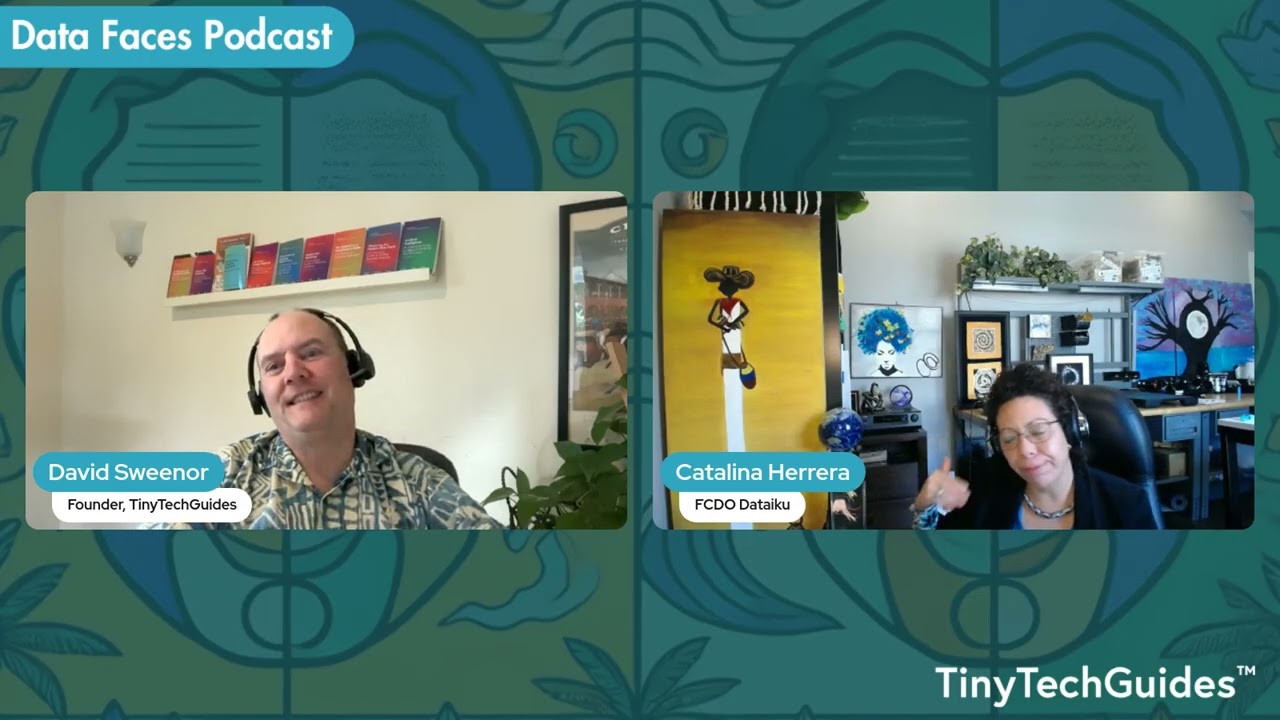
Listen: YouTube · Spotify · Apple Podcasts · Amazon Music
About Catalina Herrera
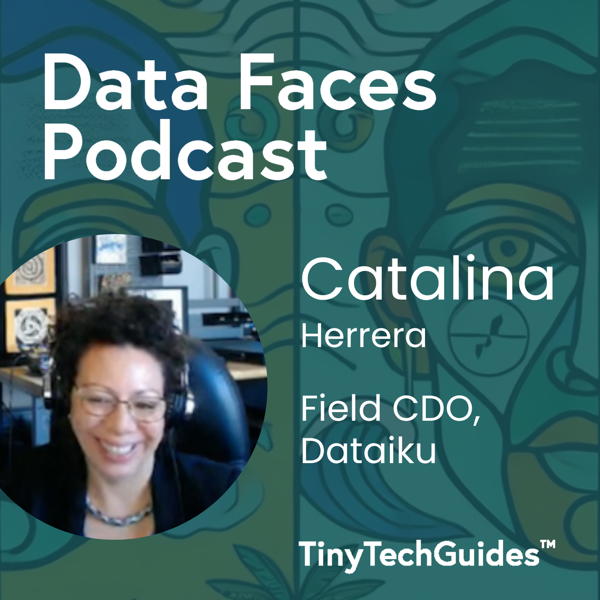
Catalina Herrera is the Field Chief Data Officer at Dataiku, a Colombian-born electronic engineer with 25+ years in the United States and multiple master’s degrees in computer science, engineering technology, and data science. With 20+ years in advanced analytics — from hands-on data science to enterprise consulting — she helps organizations deploy ML and AI that maximizes their data. In her spare time she’s a DJ who uses AI to create her own music.
In this episode
- What AI agents actually are — orchestrating descriptive, predictive, and generative AI
- Why most AI pilots fail
- The “agent sprawl” problem and how to govern it
- Balancing speed, governance, and reliability
- Why CIOs must act now — the Blockbuster vs. Netflix moment
→ Read the full article: Your Netflix moment: why CIOs must act now on AI agents
Full transcript
Catalina Herrera 0:00 David,
David Sweenor 0:05 Hello everyone, and welcome to the data faces Podcast. I’m David Sweenor, founder of TinyTechGuides, and your host for today’s show. This show, we’re gonna talk to the people actually making data analytics and AI work in the real world, what’s exciting, what’s messy, and what’s coming next. Today, I’m super excited to welcome Catalina Herrera. She’s field Chief Data Officer at data IKU. She brings deep experience helping organizations turn data and AI into real business value. Today we’re gonna talk a little bit about AI and agents. So let’s jump in, Catalina. Welcome to Data faces.
Catalina Herrera 0:37 Thank you, David, thanks for having me today. How are you doing?
David Sweenor 0:40 I’m living the dream. Can’t complain I got my my island shirt on. So can you just tell us a little bit about yourself, how you how you arrived at data IKU, maybe a little bit your background, and then tell us what you’re up to over at Dataiku.
Catalina Herrera 0:53 Yeah, absolutely. So I’m Colombian by for forever ago. I’ve been in the United States for over 25 years now. Wow, it sounds like a long time. I’m an electronic engineer by trade, and I have different master’s degrees in computer science and engineering technology and data science and so on. So I’ve been in the data science advanced analytics space for the last 20 plus years, and I’ve been very lucky because I’ve been, you know, from different roles. I’ve been exposed to different technologies and ways to do things. And I’m also being part from different teams. You have different perspectives. So sometimes they been there, done that. I was the hands on from that project or that process, and now it’s the other side of the spectrum. Now it’s like, Okay, how are we going to maximize the opportunity there and properly connect the dots between the technology plus everything else that needs to happen for that to be successful? And that’s kind of the last, what, 10 plus years, I’ve been consulting for the enterprise and basically deploying all of these use cases that are targeting machine learning, AI and generally, how to use better what we all have all over, which is data. Okay, that’s amazing.
David Sweenor 2:24 And can you tell us a little bit about data IKU, for people who may not be familiar with them, what does Dataiku do? Yeah.
Catalina Herrera 2:30 So we call it the everyday AI platform, or universal platform. And realistically, what it does is to smooth out the orchestration that needs to happen from all the different data assets and data outcomes that are part of these pipelines. So if you think about it from the most simple way, every time that you are using data, that data is coming from somewhere, and it needs to happen something to that data to actually be used. And that something can be very simple, descriptive, descriptive analytics, ETL, or it can be a little more complex where you start thinking about predictive analytics. Or it can be a little more complex when you add ledgers like generative AI on top of that, and it becomes agentic. So ultimately is the orchestration that needs to happen across all of those data sets and data outcomes, plus the people, plus the experts, plus the SMEs and everything else that needs to be part of that multi variable model for this to be successful at the enterprise now, and what is the meaning of that? So how do we deploy that in an enterprise environment? And how are gonna be making it successful? And how are we gonna measure that success that at the end, matters tremendously. Now it’s not just applying tech for the tech site is so what? What are we doing with this? We are maximizing the opportunities.
David Sweenor 4:08 Yeah, okay, I love that well, before we dive into AI agents, and we have some some, some interesting topics to discuss. I was stalking you on LinkedIn, and I noticed you were into AI music. And I like music as well. I’ve been tinkering around with it. What tell us a little bit about your your experience with AI generated music?
Catalina Herrera 4:28 Yeah, one of my favorite things to do, and one of my hobbies is I’m a DJ. I have a DJ station. I have a collection of drums. And again, I’m Colombian, and my Latin roots are very tangible in my musical aspect of it. So I have been, you know, enjoying the technology from every single angle. And one of the angles is the human empowered by AI. Right? And what that means is that that empowerment can come from the day to day enterprise deployment, or me as a human in my daily basis. And that’s one of the things that I like doing, is music. So I discovered a couple of llms that are very domain specific musically. Yep, I have been prompting my own musical snips that I am now mixing. So, oh, cool. Now I am a DJ empowered by AI. I am creating my own music, yes. So it’s been super fun, plus the album cover and the design of the album. All of that is Gen AI generated. So I talk about Gen AI. I need to test things and evaluate what really means and how we are, the humans in the middle of the loop, and what it means to be empowered by the technology, but at the same time maximizing the opportunity, which is very tangible right now for what’s going on in the market.
David Sweenor 6:05 Yeah, yeah, totally, I totally love AI. It allows pretty much anybody to unlock their creativity, you know, if you’re an artist or you’re in a music or what have you, and it really allows people to do a lot more and be creative now. So let’s talk about agents. There’s a lot of, I think, agents, AI and agentic AI and AI agents. They’re at, like, maximum hype cycle right now. And when, when a customer or prospect comes to you and say, Hey, we need some agents, how do you turn that? Where do you start? How do you turn that vision into ROI versus a, you know, a fancy demo?
Catalina Herrera 6:41 That’s a great question, David, and I think that’s one of the hardest things that are going on out there right now, the the hype and the boom of of agents, agents, agents. The reality of it is that I personally don’t think that a lot of people really understands what what it is and what it brings to the table. So I’m not going to be very specific into the definition of it, but we’re just going to think about it as a spectrum of capabilities and realistically, where the value comes because you ask something very important, which is and so what? How do we turn that into an ROI or ROI. How are we showing that this is moving any needle at all? Right? Sure. Couple of things back. If we think about the last 20 years or so, what has been going on in the industry is that we keep digitizing process, and we have data now coming from all over the place, structure and structures and structure. We keep asking questions to this data, and we keep growing within that analytics journey. So for the last three years or so, we have been producing together within the enterprise use cases, all of these assets that we can call intelligence, right? So the descriptive aspect of the data and the data story, the visualization, the dashboarding, then we grab that, and we actually kind of evolved a little bit into, oh, how this looks like when it’s predictive, for example, or sure, are we gonna operationalize that prediction and so on. Now the agentic layer happens when you combine all of these techniques that you are applying in terms of the question that you are asking to the data and the how you are asking that question. One machine learning algorithm versus the other one, one technique versus the other one. But at the end, everything goes within this umbrella, which is the eye umbrella, that is the collection of these data, outcomes, output outcomes. And then the agentic layer is using those assets to have intelligence to it. And that is the generative aspect of it, when you are orchestrating your descriptive assets, your predictive assets, your domain specific bots, for example, your retrieval and winter generation pipes and all of that, and all of that now gets combined into that agentic flow. But when you say, Okay, how do we start and how do we target this to be a successful project instead of another toy, right? And that’s going on a lot in the field. I will say that higher the level on the way that you think about it, the better number one and number two, the multi variable problem that you have to consider, right? So first of all, you have to classify that use case into them four main we call it the framework, which, at the end is kind of for these, delegation, description, assignment and diligence. You need to know, first of all, the what and the why. Yep, what is it that you are trying to do? Do, and who is going to be using these. What is the KPI that you are targeting to move, and how you’re going to connect the dots on the needle that you’re trying to move, the How to instruct, right? Who is going to be writing these prompts is, what are the data constraints? Are we using any specific policy tied to this. Is this going to be audited at some point? Do we have to follow 15 different steps here? What are we know? How are we going to stop this? Then you have to include the how to judge this. How are you going to evaluate that whatever is going on is going on within those guardrails, right? So the ground is the how you’re gonna know that, the latency, the cost, the safety, the where are you including your golden data sets? How are you evaluating this overall? No. And then the fourth one, which is extremely important is, how are you going to operate this now? How you’re going to run this responsibly? Who needs to approve this? Who needs to monitor this, and how, what it means for you monitoring these, and pretty much everything that you need as a feedback for this to improve? No, and that’s where we go back to this multi variable model. And I will say that the technology is not only there, but it has been there. So open AI released GPT two years ago, but we have open phase and open source LLM libraries available for for years and years and years, no, but what changed, no, is that acceleration and the housing is now demanded by the workforce, because now everybody’s in power by the gpts of the world, outside the enterprise now. So that demand is pretty obvious. So once you define your four days now, you have to be very aware that this is going to take some time, so you need to pretty much box it into your 3060, 90. What? What do I need to accomplish? Right? So 30, I need an executive sponsor. I need to ensure that I have that use case defined, and I know that is part of what I call my my critical use cases. Therefore is tied to a KPI. Therefore is tied to a team. I have a champion. I understand what it does. Do you have the data that you need to produce it? That’s another thing that sometimes we don’t think and hey, no, you are missing half of the day, who will approve the budget, and what is the timeline for that budget? Now, all of those are 30 days, early stage questions. Then, once you have that, you move to the 60 days, which is okay? Do I have risk attached to this? What are the resources, requirements and timelines, estimates, what is the change management plan like, how I’m going to follow some kind of a structure to ensure that we have a solid design going on and that we are following that process, and then you will have to deploy it so your 90 days can be what’s your deliverable? Who is going to be using it in the field? What kind of questions are you expecting there? Who will provide a final approval, and what kind of documentation has to be part of it, and how are you going to provide that? What is your plan to move from the pilot deployment to the operational deployment. So do you have a way internally to move from your sandbox and your dev instances to your production operationalization instance? And what that means? Are you going to train a user? Are you going to provide a set of prompts for these users to know how to start with? Are you going to ensure that you have a way to collect all of these lessons learned and feedback? No, so again, the technology is there, and it’s been there for for a while now, now is that the awareness of every single variable that needs to be orchestrated for this to be successful within a framework that is going to allow these teams to be deployed at a production infrastructure with a field asking questions, being empowered by it, by really moving a needle, which is at the end, how you tie this to the ROI that you ask at the beginning.
David Sweenor 14:38 Now, right, right. That’s that’s super interesting. I do like the framework one of them, you know, you mentioned data, and we’ve all heard it, bad data, bad agents, garbage in, garbage out, whatever phrase or you like to use. And you know, classically, when we created predictive models. Because you sort of controlled everything. You know, you you build the model yourself. You knew, sort of the data that went into the model. For the most part. You know, llms are really, in my mind, a totally different beast. So in terms of the data portion of it, you know, what practices or patterns, you know, make agents, you know, reliable and measurable. You know, what do you need to consider from a data perspective?
Catalina Herrera 15:24 Everything that you need to consider from the data perspective, from forever ago. So you’re right, garbage in, garbage out period. However, you have a layer there that is a very interesting layer, which is, now you are thinking about an AI system so you cannot come from your individuality, as in, I am building this one model and see how that one model is going to perform here. Now you have to think backwards. Now you have to think I have an AI system that I need to maintain as up to date as possible for my consumers, to ensure that they have access and insights to what matters for them. From the business aspect, through this interface that can be agentic, no, so it can be a conversational interface, and behind the scenes, you have an agent that is actually leveraging descriptive, predictive, generative assets, not which, at the end, is what really is happening, but every single data outcome that is part of what the agent is leveraging becomes like that one ingredient that has to be as good as possible by itself. So it goes back to your garbage in, garbage out, but at multiple levels, because now you have the super earliest stages, which is, Oh, I did this first joint, and I am bringing 15 silos, and I am doing ETL. And now this, I have this table that has all of these columns that become information that the agent can leverage. Well, what is the traceability, transparency of the process that you follow to clean that data, to ensure that you don’t have garbage coming into the agent? Right? So it goes back to the practices that we have been pitching for the last 20 years or so in the field, for everybody that works with data, which is the process that you are following to ensure that you have the cleanest possible data, has to be transparent. You have to have explainability. How do you decide between this model versus that model versus that model, and how do you tie that to your use case, but also to your own framework on responsible data outcome and what that means for you and for your tips. Now, so the agent is not an isolated event. The agent is actually using all the descriptive, predictive assets that everybody has been generating as part of these flows. So now make the most out of it, but now more than ever, the garbage in garbage out matters, and that’s how you focus on what matters for you. So goes back to techniques like retrieval, augmented generation being very popular right now in the field. And why is that? Because you can still apply the intelligence that generative AI brings to the table, but it’s very domain specific. No right you are ensuring that the agent is becoming an expert into what you think it should be an expert into so it becomes your helper. I see agents as digital interns. That’s the way, right, right? And the more you give them, and the more you organize and structure the way that they think and the way that they leverage the assets that you are providing, the more it will help you, and that is your ROI, right? So it’s how you are augmenting a lot of these enterprise processes and use cases and maintaining that lineage, transparency, explainability. Therefore you know where the data is coming from, therefore you have access to how the agent made that decision and how it actually landed at the output that it landed. But transparency it becomes key. Explainability becomes key, and the garbage out has to follow your internal processes and frameworks to ensure that you are cleaning the data and that you are involved in your domain experts on your SMEs as part of that so you are validating that, in fact, you are using the best data that you can be using as part of that agentic flow.
David Sweenor 19:53 Right, right? Okay, so that makes a lot of sense to me, and we’re going to talk about governance in a second. But for. We get there with these multi agent systems. You mentioned something early on that was quite important. You gotta pick the use case. It’s gotta be tied to a KPI. So I love that framework. But now, if my multi agent system has five steps, these things are probabilistic. And, you know, even just like one, you know, query to, like, a chat GPT, sometimes it makes up stuff. Makes up stuff quite frequently. So when I got five of these chained together, is there more of a risk that it’s going to go, you know, off the reservation, or, you know, go go haywire, like, like, the like, the butterfly effect, you know, flaps its wings over here and you have a tornado or hurricane on the other side of the world? Is that? Is that a real risk people should be thinking about? Yeah.
Catalina Herrera 20:44 I mean, these are non deterministic models. They hallucinate that. And that’s the aha moment where we can go both directions, right? So this can be very well defined. We can be from the beginning, very sure about what are the check boxes that we need to follow, and how we’re going to empower this team, and where is that feedback as part of the flow? Because what you are saying is fundamental, but it goes to everything. When we say, keep the human in the loop, is not a joke. So what it means to keep the human in the loop, and what it means to keep the human in the loop with an agentic flow that can be non deterministic and can hallucinate, and that goes back to your original goal. What is it that you are trying to accomplish? Who will be using this? Is this going to be a customer facing outcome? Who else needs to evaluate if that is an hallucination or not, and how you are going to maintain a feedback loop where you can do pretty much thumbs up, thumbs up, as you do with a Pandora model or Spotify model or with a Netflix model or so on. But the reality of it is that a lot of the initial pilots that we see successful in the field are defining that framework with internal use cases first before being customer facing. So there is a stage right, and there is also the, keep in mind that different llms can provide different answers to the same question exactly. So it becomes super, super important to being able to experiment and to have a stage during that process, when you are defining that 3060, 90 pilot within that agent, where you properly define the type of prompts that you are targeting, but also you are comparing one LLM versus the other one versus the other one, not only from the type of response that you are Getting, but also from the cost that you are getting, right? So what if you can have exactly the same response from this open source LLM that is not costing you all those tokens, and then you have the same answer here, but you have 100k bill every month. It’s like, okay, how do I define that? And that’s part of your 39 is 3069 you know? Sorry, great question. But human in the loop is more more important now than ever, with agentic and the opportunity of seeing behind the scenes so so they like who, for example, tracks every single log and interaction in terms of the agentic flows. So from the IT admin perspective, is very easy to see the behind the scenes, which teams are using, which llms. How much is this costing me overall, across the enterprise? Do I have anybody asking the question that they should not be asking, and we’re going to the governance central tower where you are overseeing everything that is happening behind the scenes, not only in cost, but also toxicity. Or do I have somebody asking questions that it should not be asking? Or how I am collecting the feedback from the field as part of this flow to allow the agent to get better and better at the answers that is generating now, and what that means for the flow,
David Sweenor 24:30 you know, this is really interesting to me, because, you know, if we think about, you know, the use case, and it sounds like, you know, potentially you might need to narrow the aperture so it’s going to be Like a very specific use case that you want to accomplish. So, you know, to keep it sort of in a line, it almost sounds like we’re getting to deterministic code at that point. Do I need agent? Like, like, how narrow is it? And, you know, what’s the value of an agent? You know, that has to be that that narrow. And then the other question I have is, when. You’re making these decisions at scale, right? That’s part of the value key. Is it possible to have a human in a loop all the time? Or do you sample like, how do you how do you think about that?
Catalina Herrera 25:13 Yeah, great questions. And we target. So what we see working in the field in terms of agentic deployments, is where we target what we call the mission critical process and across different verticals. So if you think about finance, for example, there are three or four use cases that historically have been proven, ROI and value, and those are the best ones to target for an augmented process, which is where it becomes agentic. So let’s think about a classic, classic, classic one, the predictive maintenance use case that everybody has been talking about for the last years, and that can go to different verticals. So it can be in manufacturing. Can be supply chain energy. So if I think about predictive maintenance, an example of how to augment that flow and make it agentic, I have wind turbines. So wind turbines, we know that they have to be maintained. You know that you can stop the engine and it stops production. You need to be as organized as possible, knowing what to maintain. First, classic predictive maintenance, what are the assets that you can use to augment the flow from the descriptive side, you have historical information, sensor information, all that comes from history, from sensor reads, it becomes an asset for the agent, the script. You can also have predictive models. It can be multiple onshore, offshore, big turbine, small turbine, different engines, multiple predictive models. All right. Now you have an additional data that you can use to augment that flow. Now add a little bit of generative AI on top and let the agent have access to everything that is historical sensor, read the statistics all of that intelligence. Then add the predictive intelligence, which is okay, higher probability for this engine to fail. If the sensors are within A, B or C or D, then the generative AI aspect of it can help you be one step ahead. So how do you augment that process? So instead of you digging into the data and trying to get your answers. Ask the agent in a conversational user interface. Hey, send the email to my maintenance crew and attach to the email the top three turbines they need to focus on next week period. How is that doing that? Well, it’s a micro automation job that can be sending the schedule automatically. It is intelligent, because it is using all the data that you provided to make a decision. And the decision is based on predictive, based on historical, based on the sensor reads I am defining. These are the higher probability failure engines. Therefore, that’s where we focus the crew that is ROI right there, how many hours you saved in between, in terms of all the data gathering assets, now you have a conversational interface that can be in the field for a crew that is right there, ready to do the maintenance and the email was received in that morning. So that is augmented that process. And then I have multiple examples across verticals, when you think about finance and anti money laundry and all the fraud detection, augmented be one step ahead. Make it conversational, make it automatic, micro. Automate a lot of those processes and make the flow even smoother, and focus on your SMEs and your feedback and your transparency. You know retail, you have demand forecasting and warehouse optimization. Same augmented healthcare, I have third party data coming from all over on clinical trials and operations and patient matching augmented so the value here, when we talk about our AI, it comes from your mission critical processes. It comes from your own flows that you have been smoothing out for the last 10 to 20 years, or whatever. Now is the time to optimize that and to kill it in terms of roai, when you augment those processes with the agentic layer, right, right? So, but defining that framework for the first time is the hard part. But once you have it, once copy, paste different That’s right. Copy Paste different use case, copy paste different use case, and then. Feel it right, and that is your ROI.
David Sweenor 30:01 I thank you for providing that example. It was, it was super, super helpful, and, you know, specific. So I appreciate that we’ve touched on, you know, governance a little bit. And so I want to talk a little bit about, maybe when people think about this, what guardrails need to be put in place. You know, from from day one, what kind like? What types of guardrails should people be thinking about?
Catalina Herrera 30:29 And there are so many. But overall, I think you can group it into four or five main categories. The first one is lineage has to exist from end to end. Where is this coming from? Basic guardrails are saying, I know I have 15 fabs, therefore I have to have 15 categories within this column. I know sensors cannot read below zero. If I have below zero. All of this is, is cut off like basic guard runs from the beginning, which is, is the data that I have aligned with what I think, right? So that’s kind of a station. Then you have to, then you have to be able to include all your golden data sets. So you’re going to focus on the evaluation before exposure. Aspect of it, right? So you have to be able to to have hallucination checks. You have to experiment one LLM versus the other one defining how much money are you going to spend in tokens per month if you have ridiculous queries, or if you can catch all of that to avoid that extra cost. So how are you going to include your golden data sets? Do you have ground truths? Do you have a history of answers that customer success has been replying for the last 20 years that you can use to train the agent? All of that has to be part of it. Then, do you have any internal process or a specific policy that you have to follow or to enforce in line as part of this deployment? No PII detections, toxicity, the permissions of the tool, the rate limits? Do you do? I have to cap somebody in the use of tokens for
David Sweenor 32:24 right? You don’t want that. Oops, oops, surprise bill at the end.
Catalina Herrera 32:30 You want to kill switch, automate that as much as possible, because you don’t want surprises. There are a lot of surprises so far in the field in terms of the bill from the tokens now on these llms, so it’s something serious to consider. And then how you keep that human in control? No, what is the hand off process to go from? And here is what I think about, kind of four quadrants? No, the first quadrants you have, usually the personas that are bringing the data from the silos and doing a little bit of ETL description cleaning, blah. Then you have the second quadrant that grabs that and push it maybe data scientists and analysts that are exploring the predictive aspect of it. And that’s usually the first two quadrants, but then you are ignoring completely the three and four, which is how I’m going to deploy this. Who needs to authorize it? Who needs to sign off? How we’re going to keep it precise? That is other thing. When you say which other guardrails? Well what it means to have machine learning deployed in production that is within a precision threshold. And what happens if the model is drifting? Do I need to notify somebody? Do we need to retrain the model? Do we need to redeploy the model? Who needs to sign that off? That has to be part of your guardrails as well. And then the fourth one is who cares about the precision of that model, or who cares about that hallucination, or who cares about the responsible AI aspect that we are deploying into a production environment, and that usually involves things that are from the legal side or from the other side that has nothing to do with the IT, data science, data analyst, or anybody else. So from the beginning, my advice is you have to think outside your bubble. And it goes back to whatever I am generating in terms of this data asset is going to be part of a bigger pipeline is going to be part of a bigger AI system that is feeding these agentic flows, where we need to ensure that the agent has the cleanest possible data it can have, and that we understand exactly where the data is coming from. Who did that? Who did what to the data, and who will be receiving this, how in the field, and how we are going to operationalize it now, so guardrails go from the super early concept of permissions, access to what and lineage and all of that all the way to who is signing off this deployment. How many business initiatives do we have deployed in production that are leveraging agentic AI? How many are using these five llms versus these two that are open source? Who are the owners of the projects, who are the stakeholders that care about drifting, accuracy, precision, so all of those are guide rails that you need to consider. And the more projects you deploy in production, the more important the way that you define those guardrails and that scalable framework becomes right. So once you do it right again, you do it right once, and then copy paste, and then you have other group of people working together towards the same goal. But the first time is crucial, right?
David Sweenor 36:15 Okay, well, we’re running short on time, so maybe just one more quick question for you. Okay, you mentioned copy paste. We have, you know, agents or agentic systems per use case. Do we run the risk of repeating what we did with bi, and have too many like agent sprawl is what I’m thinking about. Do we have in BI, and we all recognize everybody had their own report, and none of them matched. I couldn’t get it. Do we run that same risk with agents?
Catalina Herrera 36:45 Yes, yes, it is the same risk, but I think we have a couple of lessons learned from the previous decade. Oh, I hope we do as a community, because you are right. If you think about deploying one agent, is not that hard. I mean, you have the different pieces. Again, the technology is there, and you can quick and easy be up and running with a little pilot and call it it. But when you think about scaling this into production, you need to consider many, many, many, many other variables, and that includes your own culture, your own people, the way that your teams communicate to each other, the way that you are targeting being an innovation first group of people or a data driven company, Well, you need to define what that means for you, but usually, when you have social, diverse group of people trying to maximize what they can do with this data. Using this technology, you will need to organize them. It can be just assets all over the place, because that is not going to be scalable. So acknowledging that this is a multi variable problem, acknowledging that the technology is a piece of it, but it’s not the whole perspective, and that you also need to include that human intelligence in terms of the human in the loop and feedback and guaranteeing that you do have your SMEs and your domain experts injected as part of that flow, you need to be very aware that you don’t need to start from zero, like we have been working on Towards Data outcomes and analytics for the last 20 years. Sure, use those assets and don’t start from zero, but use them in a way now that you understand that this is a little more complex in terms of the who’s and the whys. So think outside your bubble, and that’s the conversation that I have with my fellow data scientists and with my IT directors and admins. Right? You care about your thing? Well, right now, we need to care about empowering your people with the technology that is available. It’s no longer in no longer democratized data. Now it’s a matter of democratizing technology, but democratized technology on a way that is going to not going to buy you back and in a way that your teams can continue to scale so it’s repeatable. So if you identify what are the valuables that need to be part of that framework, that is where you can make it repeatable. So you are spot on, and we are crossing that risk and group teams in the field will have to burn before coming back one step and rethink about the framework they will use to deploy this in production. But the reality of it is that from the multi variable model is getting more complex, because you have more variables to orchestrate,
David Sweenor 39:56 right, right? Okay, that’s this is. This is fascinating. I could talk. About this all day. I liked your your your message, your think outside of your your bubble, and empower the Empower, you know, people democratizing technology. So Catalina, I want to say thank you so much for this conversation. It’s been amazing. What’s the key message you want people to walk away with? And how can I get a hold of
Catalina Herrera 40:21 you? This is, this is the time. LinkedIn is a good place to get a hold of me. And I will say the message is, and this is the this is the moment we are this is the threshold. I mean, the time is now. The technology is there. The time is now. This is the opportunity for you to be the Netflix and not the blockbuster. How are you going to ensure that you are going to maximize the opportunity that this brings for you and for your teams and shift if you need to shift, change the ways that you are doing things if you have to. But this is the moment where if you do so, and if you do so right, is going to be a very clear differentiator in terms of your competitive landscape, so the time is now amazing.
David Sweenor 41:06 This is your moment. Seize the day. Well, thank you so much, Catalina, you’ve been an amazing guest, and I appreciate you sharing your you know, practical hands on experience with with the listener. So thank you absolutely David.
Catalina Herrera 41:19 Thanks for having me. Cheers. You.