

Data Faces · Episode 27 · December 16, 2025 · 36 min
In regulated industries, reliable software has to be verifiable. Bruno Trimouille on why code-first data science still wins.

Listen: YouTube · Spotify · Apple Podcasts · Amazon Music
About Bruno Trimouille
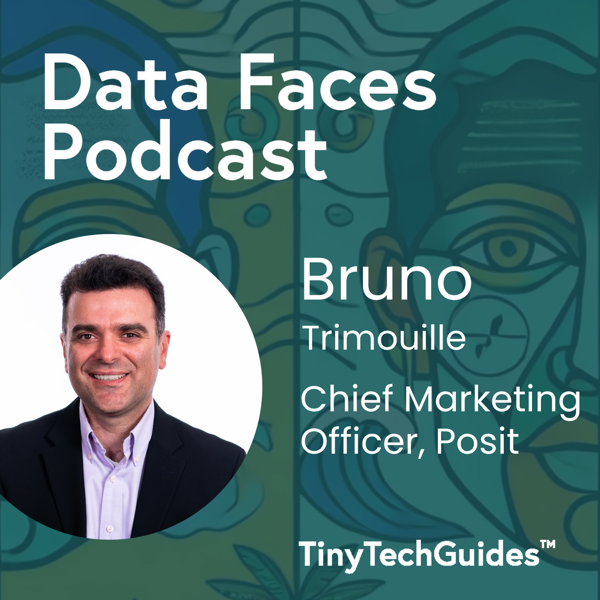
Bruno Trimouille is the Chief Marketing Officer at Posit (formerly RStudio), whose mission is open-source software for data science, scientific research, and technical communication. Posit serves 10,000 customers — including 1,800 of the largest firms in regulated industries — and supports millions of users worldwide. Bruno’s path to CMO ran through software engineering, presales, and consulting.
In this episode
- Posit’s rebrand from RStudio and its open-source mission
- The case for code-first data science — why reliable software must be verifiable
- Balancing speed with trust in regulated industries
- How AI fits an open-source, code-first data science workflow
- Bruno’s unconventional path from software engineer to CMO
→ Read the full article: Why code-first data science still wins in the age of AI
Full transcript
David Sweenor 0:05 Hello everyone, and welcome to the data faces Podcast. I’m David Sweenor, founder of TinyTechGuides, and your host for today’s show. In this show, I talk with the people are actually making data analytics, AI and marketing work in the real world. What’s exciting, what’s messy and what’s coming next. Today, I’m joined by Bruno trimoli, the Chief Marketing Officer at posit that’s a company built around open source and the data science community. BRUNO has had a fascinating career leading marketing in both tech and the analytics space, and he’s seen firsthand how open source and AI are changing how we work and innovate. So let’s dive in. Bruno, thanks for joining me on the databases podcast.
Bruno Trimouille 0:44 David, thank you so much for having me.
David Sweenor 0:46 Can you tell us a little bit about yourself and what you’re doing over at posit? And what does posit do?
Bruno Trimouille 0:52 Sure, so I am the Chief Marketing Officer at posit. I started that journey about 12 months ago, little longer than that, actually, and you may have heard about posit under a different name. Actually, we were formerly known as R Studio, which was the name of a IDE integrated development environment really dedicated to data scientists. We rebranded a few years back, and our name is now posit, and our mission is to create, as you said, open source software for data science, scientific research, but also technical communication. Today, we have about 10,000 customers amongst them, you know, 1800 of the largest firm, especially in regulated industries. And we can come back to that. And last but not least, every week we have millions, literally millions of users across the globe using open source tools.
David Sweenor 1:49 That is super cool. So what I want to maybe just start with the background. You know, what first drew you into the world of data and analytics is that what you wanted to be when you grew up the CMO of a public benefit corporation, or was it curiosity opportunity or just something else?
Bruno Trimouille 2:06 Great question. So I’m actually not marketeer by trade. I’m an engineer by trade. Software Engineer, actually, to be a little bit more precise, and I’ve always had an appetite being brought up in in France, to really look at data backing, you know, analysis and again, scientific research. So I always had a little bit of a passion for that that I carry through, not just in my engineering career, but also in my sales career. I was, you know, involved with pre sales engineering and also with consulting facing, you know, very demanding customers across many different industries and geographies too, and eventually winded up in marketing, because I thought that was the place where I could put my technology acumen, also my sales acumen at work, and sort of amplify the impact of good messaging, good storytelling, good actually, demonstration building, you know, throughout the world. So I was, again, pretty attracted by data and data science, but deposit opportunity really came on my desk, and I really dove in pretty quickly, because I was attracting first by the PBC model. So we are public benefit corporation. That is actually a thing in the US, where we really have some guidelines to do good, guidelines to commit back to the community. And foremost, we are in to create a company that will outlive you and I, David, our founder, JJ, really wants the company to be more than 100 years old, and by then, you and I won’t be here, which means that, you know, we need to recruit the next generation, empower them, groom them, coach them to, you know, pass the baton and for them to carry that through. We’re not here to be sold. We’re not here to be acquired. We’re not here to IPO. We’re here again, to do good work aligned with the mission statement that I gave you.
David Sweenor 4:18 You know, I love that, and that’s that’s pretty rare in this day and age. You know, most companies are, you know, I don’t these huge valuations that people are seeing out there. So, you know, kudos to posit and yourself and the team. So, you know, you’ve been in this data and analytics space quite a while, Bruno, and we’ve seen analyst firms and industry trends. You’re our monolithic platforms, best of breed. And sort of the pendulum swings, you know, depending on on the year. So how do you see this whole market, you know, evolve, as you know, open source tools, open source, you know, matures and adoption increases.
Bruno Trimouille 4:53 So on my end, one other thing that I was really sort of seduced by when it comes to posit is. Sort of really core belief that we need a code first approach. And we didn’t choose that randomly. We choose that based on some research that was done in the data analysis space, and it was found and also documented by somebody named John Chambers, not the, not the CEO, the ex CEO of Cisco, but renowned, I would say, scholar, also the creator of the s language, which was a precursor, and John Chambers said that, you know, for software to be reliable, things need to be verifiable and things need to be trustworthy. So for us, it means that the concept of, you know, data science being inspectable and reproducible, thus trustworthy is paramount. And today, the best approach to do that is a code first approach. So I was really very seduced by that. But then, when you sort of stratify the offering today, you can say, well, there is code first, you know, here, and it really speaks only to the developer, and there is, you know, low code approach is the data scientist. But what was interesting, and I saw that coming a little bit, is at the time I was discussing with with posit, I saw the advent of AI to sort of bridge the gap, frankly, because if you think about it, yes, there is power in empowering the business stakeholder to do things on their own. But why do we want to do that? We want to do that to kind of speed things up right and gain velocity. And I think AI sort of creates a middle ground approach, which is still code first base. It kind of bridge the gap, especially when it comes to speed and quick turnaround time, and bring this code first approach, really, frankly, much closer to business stakeholders.
David Sweenor 6:56 Yeah, that’s really interesting. You know, I think you’re right, because there’s been this, you know, chasm, I guess, between low code, no code, and code first and low code solutions are great, but if they don’t do what you want, you’re sort of stuck. And now with Gen AI, everybody can be a coder. The question is, do you want me writing the code for your business? I’m wondering, sort of, what trends you’re you’re seeing there. Is it bringing more business people there? You know, everybody has cursor or lovable or, you know, pick your your IDE. But is it? Is it increasing risk? Do you think to organizations?
Bruno Trimouille 7:32 Yes, I would. I would think so. So speed has to go with governance. When we talk to any of our customer, we see and feel the tension. Right? It’s almost like on the left side, you have your data scientists, and they want speed. They want to access data at speed. They want to quickly model and share, you know, outcomes with business stakeholders. Business stakeholder look, they want speed as well. You know the today, the, I would say, key reason why you would want to do data science is to help you have the power of data to make faster and smaller decisions. So decision have to be done at the speed of business. And then the business stakeholders, sometimes they see something and they want to quickly feedback, you know, with the data scientist, and that spinning will need to go really, really fast. So I think there’s a notion of governance that needs to be built in. And for us, it’s very intrinsic, I would say, to the product. And then coming to your comment on AI. I mean, for us, we just unveiled a number of AI driven capabilities. But for us, we call it responsible AI. It’s not a marketing term to it. It’s really, you know, ensuring that everything that AI generates is actually a piece of code, some SQL queries, you know, some technical artifact that, again, can be inspected and run for reproducibility.
David Sweenor 8:55 So, you know, I have heard on many occasion that this this balance and this need for governance. Does governance slow things down? I think it’s important. But, you know, you get this argument? Well, I don’t, I can’t deal with all the rules in my company. It’s just takes too long to deploy things. You know, what’s your perspective on that?
Bruno Trimouille 9:13 So look for for us, it’s actually very key and very central to how we design the offering. As you said, it’s central challenge in modern data science, but we have the strong belief that actually the most effective model for scalable and responsible data science, this is not a zero sum game between innovation and governance, but rather a framework where governance enables innovation. So again, it goes back to code first. If you adopt this code first philosophy, then it sits at the core. Around it, I will draw a first cycle circle, sorry, of centralized and secure data foundation. Obviously, data science has data. Data is at the core. And since one of the reason why we have. Great collaboration with some of the technology partners you would see us market with today, like Amazon, Databricks or snowflake, because security governance, data lineage access at the platform level, or at least at the data science level, is really, really key. Then you draw a layer of code first, data science, not just the data science modeling, but the whole workflow, right? And here you make sure that the workflow is again, repeatable, transparent, expectable. Everything is really well documented. Look, transparency is really non negotiable for a number of use case and a number of customers. And then the last layer is what you could call, you know, more like agile development, deployment and the feedback, right? If the data scientists can use a platform to instantly deploy model, expose that to business stakeholder, they can play with it, quickly, engage and give feedback, pretty much directly. Things can happen in real time, and that pretty much unlocks things. So for us, again, we see this tension speed governance. But we believe there are two side of a coin to actually foster innovation and overall, faster decision making. You know,
David Sweenor 11:12 it’s interesting. And you spoke about, you know, models and governance. And if I was looking at the website earlier, and you do a lot with apps too. So it’s more, more than just a model that feeds some other system there these data scientists are building applications. Is that? Did I understand that correctly?
Bruno Trimouille 11:29 Absolutely, absolutely. So when we talk about, you know, sharing assets, let’s call them data driven assets with business stakeholders. I mean those assets sometimes, by the way our API’s, we’re seeing, for instance, some credit agency or government agency, you know, sharing access to their model via API, and we facilitate that. Then, you know, the next thing could be some dashboards that can be produced on an IT basis. Kbra, for instance, is a credit agency that produces report, you know that have to get generated on schedule and pack some insights as well. It’s not just about the report, but it’s about the insights that are back to the report, and then we can go all the way to interactive application. I mean, if you look at the company or institution like NASA, I mean, they do have interactive application where they look at their staffing needs, staffing prediction and really complex mission like going back to Mars and interactively play different scenarios, drill into the data, do what ifs analysis, and really, I would say, interact the data with the data to again, drive better decision and report on resources, human resources, commitment, sure.
David Sweenor 12:43 Wow. That’s, that’s super cool. It sounds, you know, very, very impactful. I want to maybe switch gears a little bit on this notion of open source. And, you know, we’ve seen some of these large generative AI players switching their business models and things like that. So I’m curious, how do you approach this, this open, you know, maintain the spirit of open source, but you also are a business that needs to make money and serving enterprise companies. So what’s, what is that balance? And how do you, how do
Bruno Trimouille 13:13 you view that? Yes, so look, open source is actually in the mission statement. So for us, it’s a central part of the company’s identity. But actually, instead of being antagonizing, we have created what we call the virtuous cycle. So what is the virtuous cycle? Well, we started with open source roots. We delighted our community. We engaged with them, made them champion, listen to them, and act in a very transparent way that created great adoption, again, millions of users on a weekly basis. Then what happened is, you know, some of the data scientists in certain company, especially in the regulated industry, you know, think financial service, healthcare, life science, government agency, you know, started to make very meaningful applications and and data driven assets, I would say, with these capabilities. And as you know, when this thing bubbled up, you know it is going to want to drive some governance, right? We’re talking about, really, we’re talking about access, control, governance and all the capabilities that are required for enterprise deployment, and that’s how a commercial offering were created. Now I want to say that our commercial offering are not just open source with value add services. They are open source at the core, more code built around it, and that creates the commercial offering. Obviously, commercial offering drives revenue, and this revenue is then re injected in open source innovation to the tune of 40 to 50% and the rest goes to, you know, the commercial tool innovation and things of that nature. So. We call that the virtual cycle. It’s the flywheel, you know, that has propelled the company to where we are today, but it’s very central part of who we are. And again, we think about it as very symbiotic, right? Because the open source community helps us drive innovation, sure, and then the enterprise adoption, you know, allows us to create capability to drive adoption at the enterprise level, scale, and govern that innovation responsibly. Why do you think
David Sweenor 15:31 organizations are looking towards open source? You know, if I use an example like, I don’t know, like Microsoft, it’s pervasive. It’s not open source. It’s probably open source alternatives, say to the Office suite as an example, but write it for data analytics, specifically. Why do companies want open source?
Bruno Trimouille 15:53 So we’ve seen, frankly, we’ve seen sort of different scenarios. For instance, I can give you some scenarios in one of our top industry, which is the life science space E was an issue of, you know, not having technology that was open enough. So again, transparent, reproducible code. First, it was also an issue of skill set. You know, some of the skill set on specific languages and techniques were kind of vanishing, and so they wanted to tap that power of innovation, that power of transparency, that power of being able to open the aperture when it comes to sourcing talent in their domain. And so we are seeing today that the FDA, which is the Food Drug Administration here in the US does otherwise, some clinical trial submission in new languages and in new formats, which is open source space. So it’s a really quantum step, I would say, by a very established and very governed, you know, agencies, to really look at that as new pathways. So it doesn’t mean we forget about the old one. We could rent things in parallel. But I think the need for openness, innovation and the need to source new talent were key drivers behind the scenes.
David Sweenor 17:14 And they can start, you know, sort of, you know, future proofs, them, I guess, in a way, and that they can just sort of bring it with them. If you know, situation changes. They have it, they own it, and can sort of do whatever they want with it, right?
Bruno Trimouille 17:24 100% I mean, look, you know, open is sort of antagonizing to locked so, yes, if you think about vendor lock in, if you think about the parentity of the work that you do, I think open source definitely has some chops and some value to add.
David Sweenor 17:43 Yeah, the number of users that you quoted, you know, millions of users, or 10s of 1000s of users, you know, maybe it sort of creates this community, maybe, maybe a cult like community is it make it more sticky within organizations I’m trying to understand, like, what a B to B leaders? You know, what can they learn about open source models and building this really loyalty and long term engagement, you know, versus maybe more more of a transactional business, 100%
Bruno Trimouille 18:09 low community is at the center of what we do. So coming in from more of the traditional enterprise background, you know, I really had to shift my mindset. You know, as a marketeer, sometimes look, you see community as a marketing channel, right? Sure, if you are coming at it with, again, the open source mindset, you actually see community, how can I say as a almost a strategic extension of your own team, a strategic function that allows you to build almost a defensible moat around your business, frankly. And so the way we build this very vibrant community, and also the way we behave as a company, the PVC model actually empowers us to do that, is we need to build trust through very active transparency, right? I mean, look, open source projects are transparent. We’re transparent in how we invest in all those community projects, the one that we lead, and even beyond that, we are always number two, thinking with the end user first. Some people say, well, it’s bottom up adoption. Look, you can’t you can’t lose with that. If you have raving, which we do, they will really promote the technology within they will promote the technology when they change jobs. And that’s really, really key. So point number three, treat the community really as an extension of your team. They are part of the product development and support in a way I know for some of us, at the beginning, it’s kind of mind bending. It’s like, wait a minute, yeah, we need to keep control. Well. Point number four, you need to really empower, recognize and elevate your champion. And we have different program for that. Every Thursday, I’m going to do a little pre. Here, but every Thursday we have an amazing, what I call an amazing act of marketing. We have a community of data scientists, hundreds of them, logging online every Thursday, not to have positive pitch to them, but to share amongst one another. Presenters are amongst our customers. So customers presenting to customers and users and prospective users, and has been going on for years, and it’s a great marketplace, I would say, for exchanging ideas. We’re just here to facilitate. We’re not here to do, you know, hard pitch. We’re here to share authentic story. As you say, some stories are great successes. There’s also great learnings in failures, maybe in projects. So I think overall, you know, focus on education, not promotion, and sharing the value of what the tools can deliver. Yeah, I
David Sweenor 20:55 think that’s super cool. And, well, I’ll get the link from you, and we’ll put it in the show notes. So if people want to check that out, they can certainly, certainly do so. So maybe I’m going to shift gears a little bit. So we’ve been talking about open source governance, a lot of things in the data and analytics, machine learning market. I want to switch to your role as a CMO and how AI is used in marketing. So can you maybe just share with the audience, the listeners and viewers, how is AI changing how you do marketing as a function, you know, within posit
Bruno Trimouille 21:31 so as a, again, software developer by trade, I really, I think, have natural, you know, curiosity to tinker and play with things. And I really saw AI as a fantastic tool at the beginning to really drive, I would say, productivity, you know, productivity to remove the blank page syndrome and start to have, you know, content generated faster. Take a piece of content and change the tone, or get an email headline and have, you know, AB test done, you know, in seconds right in front of you. I think to me, that was sort of the level one. But then as I started to look around and also engaging with people like you, David, I really saw the power that this could deliver in not just being a bot sitting next to you, but literally a thinking partner, sure, and what I’m talking about here is really asking open ended question. Actually, last week, I was with one of our technology partner and we look at market trends and we look at how we could tackle some some of those challenges together. It’s crazy amazing how you could almost have market studies on tap. Obviously, you need to look at the citation and sort of configure the prompt, but the level of research that you have access on tap and can customize, really customize the research, not just to analytics in general, but just data science, maybe even in a specific industry, and really look at the trends and opportunity is just mind blowing. So I’m thinking about it as a thinking partner. I think we need to educate our team with the ABC, you know, automation, prompting, etc. But overall, I think we need to push everyone to think about AI as, again, a thinking partner, just not just about answering easy questions. Yeah, you
David Sweenor 23:26 know, one thing that always strikes me, and you know, pre AI has always been, hey, we need to define these segments. And you know, I may want to talk to a finance persona for this messaging and adapt it to life sciences or what have you. And now, to your point, you can do this in an instant. I’m curious, do you need a new set of marketing technology to operationalize something like this? Like, I mean, what’s the like in the past? I would say, hey, the capacity of an organization maybe is maybe two or three campaigns at once, or whatever. Pick your number doesn’t matter. But you see, there’s no tech needed for this as a marketing function, 100%
Bruno Trimouille 24:04 100% I’ve seen it manifested, you know, if you look at campaign as a spectrum, you know, on the left, you need to understand your buyer. Well, it’s fantastic to do that right. This will never replace talking to a lot of customers. And, you know, Frontline, however, this can really arm you with a very comprehensive view that then you can test and check, you know, with your own sales people, with your partner and obviously, with your customers. So I’ve seen a lot of good work being done on the, you know, messaging and creation of all the ICP profile, of all the messaging, positioning, value based, you know, selling tremendous you know, impact here. I’ve seen it also helping out with how you would almost script, you know, some of the initial pitch that you do, whether it’s some email copy or some, you know, phone message copy, or maybe even some talking point over slides. And then I. I have previously used, and we are currently deploying technology that put that in context. So this goes, you know, first, to tap intense signal and create models that combine those intense signals with your own, you know, engagement model, and sort of create an overall scoring and propensity model, which is great, but then allowing you to customize some of the content that you send. So think about it as you would fit it. You know, pretty cookie cutter email sequences based on persona, use case industry, those kind of things. But then you let the AI look at all the content that you have. You know, your ebooks, your demos, your customer success story, and you can do mass personalization at scale. And I’ve seen conversion rates on very targeted segment, let’s say 100 to 200 people that were previously hand raiser, also known as MQL. That’s sort of called, I’ve seen conversion rate to the tune of 10 to 12% meaning that those people were MQL in the past, dormant and silent in the nurture stream and sort of awaken through this. You know, AI driven mass personalization. Obviously, you have the guardrail right. Email Template has certain placeholders and things. It doesn’t write an email from A to Z or a pitch from A to Z, but the mass customization ability is just mind blowing.
David Sweenor 26:32 Yeah, and you know, you and I have worked together in previous lives, Bruno, and you’re like messaging, you know, you have some baseline messaging or corporate deck, and you want to get review from the CMO, the Chief Sales Officer, the Chief Product Officer, what have you. And your AI can behave as a role, and it’s uncanny the feedback you get act as a skeptical buyer. Review this, and then what comes out of these things is, well, I got four different opinions. Now, I still have the same problem. I still got to smush it together for one back, perhaps for a general deck, but it’s, it’s really cool on the role, I guess, role playing side of things,
Bruno Trimouille 27:09 absolutely, and even the even the tone. I mean, you can do some pretty funny thing and change the tone, you know, change the perspective, almost prepare people to, you know, better, handle objections.
David Sweenor 27:24 Frankly, sure. How about on the so we’ve been talking mostly about text based content. Have you experimented anything with sort of the audio or visual aspects of it? Or, you know, I always say, I always think, I think like it’s probably maybe different maturity level. Perhaps text is easiest to start with, and then as you want to add video or audio or images, it just takes a different level. Have you done any experimentation with those things?
Bruno Trimouille 27:51 So I would say we have two paths. The creative team at posit is very oriented to preserve, you know, integrity of sourcing, etc. So they’re currently looking at how to best leverage, AI, why keeping the integrity and, you know, the publishing rights, I would say in general. So they’re experimenting with that. They said they will come back, you know, before end of quarter. So I can’t wait to see what they have in store on the sort of sound and the other side of the house we want, and we are experimenting when it comes to training and creating some training content, literally based on script. You know, sometimes you have a written document and there’s a lot of great information, and you’re really happy, and you’re kind of scratching your head, and you say, my goodness, there are different kind of learners, right? Some people learn through reading, some people learn to actually hearing. And so how about being able to create, maybe, again, with a technology like notebook LM, we tested that, you know, the interactive podcast, for instance, on track that literally discuss to the key point and becomes great learning material. So we experimenting with that notebook. Lm is one of the technologies, and there’s a few others that are in the works, but enablement material is definitely in scope, and something we want to push the envelope on.
David Sweenor 29:17 Yeah, actually, the podcast that dropped today, a former guest, he specialized in sales enablement, and he talked about using AI for for role play, and it’s, he’s like the AES and the SES love it. So, yeah, definitely something there.
Bruno Trimouille 29:32 Yeah. And actually, since, since you talk about that, we have rolled out, you know, a new white posit deck, which is spread your your your first, you know, elevator pitch, that that you do any for Sales Team happen to record the call on Gong. We have some automated AI driven checks to make sure that they were on message and on target. It’s not really broader. They know. About this. It’s in the spirit of, again, proving and just making sure that you keep on message. But those things, you know, were unfathomable. You would have to spend 10s of hours, you know, screening all the calls from A to Z, and today you can do that at speed.
David Sweenor 30:16 Yeah, absolutely. So we’ve been talking mostly about, you know, using AI, as you know, it’s a productivity or efficiency play. Have you used it for, sort of, it’s great at Data Analytics as well. Have you used it in marketing, for for insights? Yes.
Bruno Trimouille 30:31 So for me, sort of two arenas that I’ve started to play with. One again, is sort of the market survey, market analysis, trend, you know. And I think it’s a fantastic research tool, especially when you do when you use the deep research function of whatever algorithm you know. And right, sure, GPT is your favorite. So that’s one arena, and then the other arena is, yes, some of the data analysis. So here we are also able to drink our own champagne, but we are starting to unlock some of that on our own data, on our own marketing data, and it’s pretty fun to watch so more innovation to be expected in the near future. There, yeah, do
David Sweenor 31:16 you see like roles shifting within a company like our people say that are doing campaigns or something like that, they’re able to do their own data analysis now, or maybe before you needed an analyst or an expert to help with that. Do you see like that, or other examples of that within within your marketing function?
Bruno Trimouille 31:36 Yeah, I think, I think on the campaign side is definitely more velocity. So it’s a matter of productivity, I think look on the product marketing side as well, it can make you very efficient to do, for instance, things like competitive analysis or win loss analysis and just speed things up. Now, I must say, and no fans to those people, but I think it really changes the game on sort of your content production line. I’m not saying we don’t need any content marketing. I’m really not saying that, but I think the content marketer role has definitely changed. I think it shifted from more editorial base, you know, kind of focus, to a focus of, how can we evolve those tools and all those contributor create a new kind of supply chain where content can be produced at more speed, can be mass, customized to specific persona, and really fuel this sort of digital demand generation engine that’s very content hungry, frankly. So again, I’m not saying content is gone. Actually, content is king, but the role of the people who used to be in the content marketing, I think is really shifted, and in my opinion, it’s a good thing, because they can act as a facilitator, tap More people within the company to be great content contributor and creators.
David Sweenor 32:54 Yeah, I think absolutely. And there is a risk, I think, you know, I’d warn any companies, you can create lots of content at scale, but it can be crappy content, more good content. So I don’t know if more is the answer, but maybe, maybe it can be of higher quality, because you can use it for the research and have a more informed tentpole asset, perhaps 100%
Bruno Trimouille 33:14 and I think here, you know, preserving sort of your own voice is really key. Maybe you can even use AI to make sure that the tone and voice is right a different model. I don’t know how we can. We can push it, but definitely, you know, I wouldn’t advocate to have aI generate something. And you press the publish button and it goes, you got to have the right guardrail. But, yeah, you need to keep your authentic tone and style, which is beyond graphics, actually, and goes into how you address your community, sure, sure.
David Sweenor 33:45 And so I think we’re running close to the end of time. So maybe one last question is staying on the marketing theme. So looking ahead, you know, what skills do you think define the next generation of data driven marketing leaders? Does the skills change? Do they need to be different types of people, generalists versus specialists, or, you know, I don’t know.
Bruno Trimouille 34:04 Yeah, I think, look, I think the, in my opinion, you got to be curious. You got to be a constant learner. You know, gone are the days where marketing is very static. And if you look at two years ago, five years ago, 10 years ago, marketing has become a greater mix between, you know, the art and the creative stuff, but science and data, as you put in your question. So in my opinion, you know, you need to have a more hybrid, you know, skill set again, think about AI as as a thinking partner. I think it’s really key. Marketing for me, is a team sport, so the cross functional collaboration needs to be there, and you may have even new teams you need to collaborate with. Today, I’m collaborating with our data science team, for instance, to really look at market and data insights, I think you need to think about your marketing stack as. Is as almost like a an architecture, and you really need to carefully groom that and make sure that you bring on the right tool and that things are connected, and that the data flows in and out. And I guess last but not least, especially at posit, you know, you need to be really grooming the community and being a very focused on, you know, keeping the brand tone and building the brand, that would be lots and lots of dividend, because, again, having raving fans beats all kind of marketing campaign you can put together
David Sweenor 35:36 that is perfectly said. Bruno, well, thank you for your time on the databases podcast. It was super informative. Where can, where can people find out more more information? Or how can they get a hold of you?
Bruno Trimouille 35:49 Well, thank you David for having me. If you want more information, you can go on pause. It, P, O, S, I T, dot, CEO, and from that point, you know the world is yours. The world of data science is yours.
David Sweenor 36:00 Well, perfect. Well, so Bruno, thank you so much for joining the databases podcast, and I’ll see you out there.
Bruno Trimouille 36:06 Thank you. David. Cheers, cheers. You.