

Data Faces · Episode 32 · February 24, 2026 · 35 min
The distance between a brilliant demo and a production system has little to do with the model. It’s a data context problem.

Listen: YouTube · Spotify · Apple Podcasts · Amazon Music
About Asa Whillock
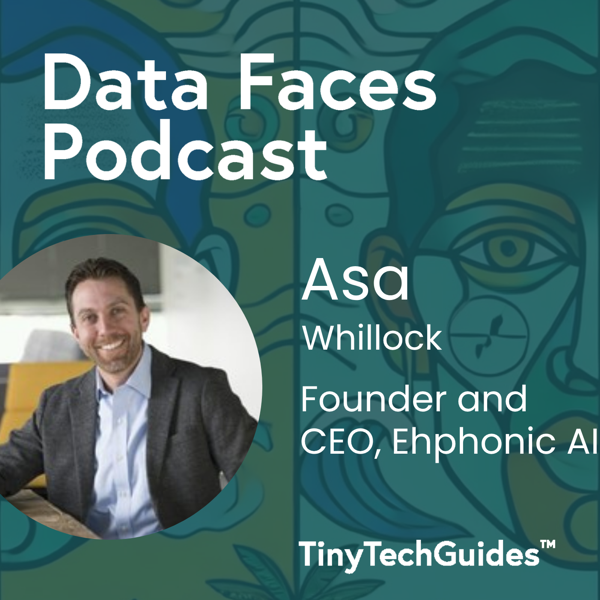
Asa Whillock is the founder and CEO of Euphonic AI. He has spent 35 years in software, living the pilot-to-production challenge from every angle — inside large enterprises like Adobe and Alteryx, and now at his own AI company. His focus is what it actually takes to move AI from a brilliant demo to a reliable production system.
In this episode
- Why AI pilots deceive leadership about production readiness
- The three categories of data context most organizations are missing
- Why chasing frontier models is a distraction from the real work
- How to connect AI investment to the metrics that actually drive your business
→ Read the full article: Your AI doesn’t have a model problem. It has a data context problem.
Full transcript
David Sweenor 0:05 Hello everyone, and welcome to the data faces Podcast. I’m David Sweenor, founder of TinyTechGuides, and your host for today’s show, the show I talk with the people are actually making data analytics, AI and marketing work in the real world. What’s exciting, what’s messy, what’s coming next. Today’s guest is ASA Willick, CEO and founder of euphonic AI. So in this episode, we’re going to talk about operation, operationalizing AI, moving beyond experimentation, pilots and demos to systems that deliver real business value. We’re going to dig into what gets in the way, what leaders often underestimate, and what it really takes to put AI into production. So Asa, welcome to the databases podcast.
Asa Whillock 0:42 Hey, thanks for having me. David, really excited to be here. Yeah, it’s gonna be great.
David Sweenor 0:46 Yeah, super excited to have you. So can you tell us a little bit about yourself and what you’re doing over at euphonic?
Asa Whillock 0:51 Ai, yeah, I’d love to, yeah, happy to so, so, as mentioned, my name is ASA Willock. I’m celebrating 35 years in software. Amazing sequence of careers I’ve been a part. Yeah, it’s been, it’s been a fun one through major corporations like Adobe alterics, even going back to Intel and AOL, believe it or not, start out with my career working for America Online, largely an analytical career, but spanned all sorts of different roles engaged in it. Yeah, recent venture that we just founded, euphonic. AI, excited to be able to service that we are a growth acceleration agent, and we serve those leaders like revenue operations and demands and who engineer the organization’s growth. And what we really saw the opportunity there is that every one of those organizations who’s trying to build and grow and plug in AI to accelerate their goals has really been challenged with the ability to say, Well, what? What actually makes that that possible, spanning all these different systems, they find that there are, frankly, gaps, and we’re going to talk about some of those gaps that exist right now in terms of being able to operationalize the growth of the org. And we’re super excited to be able to plug in and service that for every one of those right now, going super well so far,
David Sweenor 2:01 that’s amazing. Asa And so before we jump into the topic du jour, I saw a couple interesting LinkedIn posts for you from you. One was related to Voltron, maybe a couple of those in mice, hiding keys, and the other suggested you are stand up comedian past life. Tell us a little bit about those.
Asa Whillock 2:22 This is true well, so I’ll get them in reverse order. Yeah. So had lots of different things in my background, so it was to spend two years as a stand up comedian, and it was an amazing experience overall. I recommend it for for anybody, if you’ve got a kind of a fear of public speaking, it’s a great way to kind of break you of that. It’s a tough gig, though, right? It’s, it’s fun to be funny. And I would say that 80% of people, if you just take the time to learn how to write for comedy, and get up there and say, you, you can do it there too. There’s, there’s probably about 10% of people who will never be funny and 10% of people who would be funny if they read the phone book. But I had an amazing time making people laugh. It’s just a great experience overall. Okay, as for, as for Voltron, yeah, like, you know, I have a passion, and the passion is for getting into technical subjects and trying to graduate them out into something that that anybody can really find, you know, kind of resonates with them. And some it’s something that they understand day to day. And, you know, you get into the weeds of what makes enterprise AI, so challenging to really adopt something you and I have worked on over time, and you can get very quickly wrapped up in jargon and depth. And I like to graduate it out to what you remember how challenging it was to get get vulture on the robot together, to go beat that, that giant bad guy who showed up? Sure. Well, it turned out that a mouse was hiding the key to the black line, which was the whole subject of that episode. People are like, oh, yeah, okay, that can connect to that. And it’s just such a privilege to be able to write for audiences that can, that can group with something else like that and that that makes it fun. So yeah, thanks for that one.
David Sweenor 3:49 It’s all right, hey. Well, no problem. So, you know, you mentioned earlier, you have a pretty storied career across, you know, both early stage and large enterprises. You know, you mentioned Adobe and Alteryx. So let’s given that, you know, how is your definition of really operationally, operationalizing? Ai, you know, has it changed through those different experiences? And it doesn’t mean something different to different size companies? Yeah, yeah, 100%
Asa Whillock 4:16 and I think when you reflect on the large organizations, which, which you and I’ve been a privilege to be a part of. There is one thing that’s consistently true for them, which is that they are relentlessly vertical. And what do I mean by that? Well, if you imagine all the things that an enterprise has to do to sell software, I usually phrase it as well. There’s authentication, like get just getting people logged in. Well, there’s a whole team for that. You’re talking about the UI that they have, there’s a whole team for the connectors, a whole team for that engine. And the reason why that exists is start to be pretty up. They’re answering RFPs all day. Well, can you do this for a nine capability? Can you do that? They need that depth in order to win? So what that means is, you’ve got all these separate teams all trying to optimize their own little areas. Unfortunately, the. The flip side of that depth is that there’s one area where the friction always appears, and that’s cutting through it horizontally, which is, unfortunately, exactly what the customer has to do. And whatever the customer has to do is what AI has to do. So breaking through all those barriers to be like, hey, we need a great AI experience, going through authentication, through the UI, all the way into the engine and out into this other side. It’s just super, super difficult, and that’s the challenge, right? And you get across all these different orgs who have all their own different goals to put together an amazing experience, and that’s the challenge, right? And you got to run through walls there that Now on the flip, you know, go into something much smaller, right? You don’t get much smaller than founding your own enterprise, right? It’s a very different story, and I think, driven by the new capabilities that have come to light in AI with all the most recent advances that you’ve done in terms of Frontier models and where they’re going, there has never been a better time to be horizontal, because you’re talking about capabilities that can take a lot of the drudgery away from what, frankly, every worker has to deal with in terms of being able to present a delightful experience and cross over there, we have the rich capabilities now if you can arm them with the data that serves to actually enable that experience. So when we looked at that, we’re like, man, the future flipped overnight from being obsessively vertical, which is kind of the SaaS world, to being something that is for positioned and really just unlocking the key data to put that together, is the magic of this small organization. I like to read. Kimberly tanned a 16 z does a really nice job of pointing out that nine out of 10 automations that could exist don’t today, because it’s just too difficult, right? They stand back and they still do things manually. They’ll step through, you know, capabilities that they could otherwise orchestrate, because it’s just too hard to unlock the data to build the sequences of things together. And that’s $130 billion opportunity by their estimation. It’s just, it’s just huge. So it’s a really nice opportunity to take on something small and start to stand astride all of those different systems and say, let’s, let’s make this thing work really well. That’s, that’s what operationalizing AI is it’s a great time to be small.
David Sweenor 7:02 You know? It reminds me of advice I used to teach Agile software development, and we use this layer cake. Be like, you know, your point on verticalization? Be like, Well, don’t build each layer of the cake. Build a slice of the cake. Make sure it works and expand. That is, that’s kind of what you’re talking about here, right? Is just versus specializing, you know, build a slice of functionality and expand from there. Is that kind of the idea 100%
Asa Whillock 7:28 I think it’s a natural kind of ebb and flow that happens in software, right? Is that you rewind the clock 20 years ago, you were probably designing all this software, horizontal slices to do everything. You build it yourself from from beginning to end. And the natural momentum of the last decade and a half has been you don’t need to do that. Any platform movements start to take root. And then let’s be great at each one of these functions. We can do them all separately. That’s vertical case. And comes together. And then you’re like, Okay, well, we’re slicing this way instead, and good on it, but you’ve got to watch for them. Those shifts happen. And so now, yeah, you can take that slice of the cake that goes in a completely different direction and really do some amazing things with these new capabilities.
David Sweenor 8:06 Okay? And then, you know, when as a company thinks, thinks about this, and, you know, infusing AI within their enterprise. You know, we read all these articles about people are stuck in pilot purgatory, they can’t get to production for many, many, many reasons. Can you tell us, like, Are there signals that tell you when something is ready to go to production, versus it being another sort of prototype or an experiment that fails to launch?
Asa Whillock 8:39 Yeah, 100% right. And I read the same things, and I live it day in, day out, in orchestrating an AI driven company. And I’ll tell you what’s shown up there, which is that it is absolutely the case, that it’s when you think about what makes AI production ready, it is really not so much about the model in terms of what it can do. And that’s very deceptive, because when you talk about demos and pilots, you’re almost always talking about a cultivated set of data and a cultivated set of questions so that the result is just outstanding. You’re like, This is amazing. Like, why would we not just deploy this everywhere? Right? Because you’ve, you’ve really kind of handcrafted, well, it’s going to know this and have this information and give it which is the vision, right? It’s realistic to think that it can do that at scale if that data is available. But the problem is really that that data that you need is scattered like toys across a two year old’s bedroom, right? When you get into the enterprise and, you know, which is like you stand outside of enterprise, and you think they’ve got to have their data all ducks in a row there. There’s so many people. They’ve got so many things put together. Their data must be marshaled in all these different ways, and it unfortunately, could not be farther from the truth, right? The data is as messy and problematic as it’s ever been.
David Sweenor 9:51 Well, Asa, I’m surprised, you know? It just reminds me, I’m still amazed that most of the world’s companies run on spreadsheets. Those are ill formed.
Asa Whillock 9:59 Yeah. 100% right? And that so here that, here are the signals right, that really will tell you when you’re when you’re passing through that. And I usually break it down this way, the framework for having real, valuable context comes into three buckets, right? And bucket one for data. And this is usually the one that most people are aware is the machine driven data, the row and tabular level data that we’ve gotten used to in SaaS is when we’re talking about your CRM records or your HRM records, or your SKUs in your ERP system. Now these are, unfortunately, in about 350 systems per enterprise, so it’s not simple to be able to say, well, I got access to all of those together, but at least we’re aware of those where we’re like, hey, if we’re going to plug in an AI to address customer support issues. It’s going to be aware of the depth of support issues that exist right now in my existing support system. And while that’s known, I think it’s it’s often jumped over how difficult it is to plug into the collection of those because each one of them has an opinion about what data looks like. They don’t do a great job connecting dots into each other, but at least we’re aware of them. We’re saying, okay, that it needs access to those systems. The other two buckets are harder, though, which is, think about what actually routes all the data is the critical metadata that stands as tried it. I’m talking about things like, well, the configuration settings that exist within your CRM record, the workflow routing that happens there, the log files that go over the top of what actually happened. Most of those are not API level data. Some of them are in some of your richer systems. Others, it’s tucked away in a UI somewhere that what switch actually controls which way this data goes from the other Well, that’s the equivalent of saying this is the train control that determines if this train goes to Seattle or Albuquerque. It makes a huge difference. And that being only available in UI, or only tucked away in some backwater catalog, or worse, not available at all, means that AI is operating without context to how this system is really going to function. And that’s that’s absolutely critical, and to even layer it onto the third we’re talking about human decision data, and this is one that I think are really starting to wake up to in the depth of how valuable this is. Think back to any organization you’ve been a part of, right? And you almost always can name. I asked the question, Who is the institutional memory of that organization? And you everybody always comes comes to mind with the image of that person. I always went to this person when they need to under, sure. Well, why were we doing this? Why do we make this choice? Why Why don’t we go this way? Why don’t we go that? And they always have the like, Well, we tried that before that didn’t work, so we made this choice, and we’re living with that architecture from there on out. Imagine living your life without that person in every decision you ever made. You’d be like this uninformed AI position. You’d be guessing right? And so when you have that layer together saying, I’ve got the machine data, I’ve got the metadata, I’ve got the human decision context, now you’re going to have an amazing experience. Now your AI is ready for production, and you really need to unlock all three of those in order to have the depth to really be able to say, Okay, this is going to be amazing. Otherwise, you’re just kind of stabbing in the dark.
David Sweenor 12:48 That’s super interesting to me. And how about the the notion of, you know, you mentioned this, I’ll call it institutional knowledge, the non machine readable data. Talked about metadata and then, like rows and columns. What’s the role of unstructured data and all this, like PDFs and audio and visual? You know this, 80% of the data that a lot of organizations tend to forget about it is that, what role does that play in this new world?
Asa Whillock 13:17 That’s a very big part of it too, right? You talk about the data that allows you to really scale tends to that what I would refer to either structured or unstructured, has to be a strategy between that machine level data and that metadata, right? So I think we’ve done a decent job of saying, if you have a catalog of PDFs, you have a whole Wikipedia set. If you have a whole slack catalog, I think we’ve gotten into the idea of that context being loaded into AI based systems, and that’s a portion of it, right that that schedules, right along with saying, hey, I need this machine level data to be able to understand its scale. What are we really aware of? And it’s been more challenging in the past, you and I’ve dealt with worlds where it’s like, Hey, bring this pile of PDFs online. And there’s amazing richness that needs to be developed into that. But you need to even take a step beyond that and say, it’s not just about, you know, this mountain of previous documentation in there, I need to understand what really operationally drives the next step that happens for this customer or this employee, or this particular, you know, supplier in this world, and that’s usually operational, that’s living with an existing system of record somewhere, a system that may or may not have made it easy for a machine to be able to really access it. That’s one of the key gates that I think once we start to unlock those capabilities in the systems that we drive and rely upon every day, we’re going to start to see another level open up.
David Sweenor 14:28 Okay, that’s a good, good, good point there maybe, maybe switching, sort of to leaders and, you know, data or AI leaders and architects are there decisions that you see, that they’re that maybe they put off, you know, we always want to make decisions at the last moment, that you know, maybe you know, cost, time, budget, resource. What have you you know down the road. Are there things that you know, what the kicking of the can, I guess, is what I’m asking about. Do they. Anything come to mind there?
Asa Whillock 15:01 Yeah, I have maybe a controversial opinion on this one, depending on who you are, is that I go back to what a former boss of mine once said that really resonated with you, which is, you really need to think carefully about what you want to be great at. And maybe that question is not the one that people are even trying to make a decision but I think it’s the most vital one, because if you we talked about cycles a little bit earlier in this AI driven moment that you and I are privileged to be a part of, I think it’s natural to occasionally just kind of you see a company pause and say, You know what? We were an amazing travel and hospitality company. We’re an amazing healthcare company. We’re an amazing what have you company now, we’re an AI company, and, you know, I think history is replete with those circumstances where it’s worked out, where someone has pivoted. Well, Amazon used to sell books, and now they’re Amazon Web Services. And there’s genius in that sometimes, but I think you need to be really thoughtful about that, because I used to do this at Adobe. You would, you would occasionally have a customer do this, what I would call it crazy Ivan, where they would turn this whole submarine around and say, You know what? We’re not. We’re going to build our own CRM now. We’re going to build our own marketing automations. We’re going to build our own thing. And you could set your watch 99 times out of 100 where they would just come back five years later. Because what they had told themselves was, hey, we’re going to rebuild this thing from scratch. It’s going to be amazing. It’s going to do all the things that you David, everything that you David, everything that you’ve ever wanted your CRM, is we’re going to do it now, and we’re not going to have to worry about dealing with vendors anymore. And the same is true in the AI moment, where I think the desire to the perception that it’s relatively easy to plug in and roll with gives you a moment to say, we’re going to be an AI cup. We’re going to drive this thing ourselves. But I think if there’s anything we’ve learned in the past three four years that it’s still hard, like, still unlocking context is still difficult, and building something that is really outstanding is not super simple, where you just want to be able to grab it, run off with it, and then you can stay focused on what makes you matter. So think really carefully about like, what do you really want to be great at the lesson that kind of came out of that one that sticks with me is that when I moved into a new home, I was obsessed with doing everything myself. Because I was like, Hey, I’m gonna, you know, it’s more expensive. We’re gonna figure things out. So I got out into into my garden, and I started to, I bought a whole bunch of yard tools. I like it. Here’s a leaf blower and a hedge trim. They’re all like, brand new. They’re working on it, and I had the gardener, and my character is coming out there, and I’m, like, trimming the hedges and doing all the things right? He’s, he’s, he, like, turns to me, he’s, like, is this what you want to be great at? Like, you want to, you want to be like, the great gardener in terms of what you’re doing. And he, he was right, because I was just, it’s ridiculous, like, what I’m doing out here, and he’s doing a great job of doing all these things, but I really need to focus on was, was doing what I was already within my core strength. So if you’re a great travel and hospitality, if you’re a great retailer, if you’re great something else. Focus on that, right? You will find the AI driven capabilities that will support that. But don’t get distracted into doing something different from that, and ask yourself that question really carefully, is what I’m doing really driving what I’m
David Sweenor 18:01 great at? Yeah, that’s a great story. I always, I’ve, I’ve tried that too. I’m like, Hey, I’m going to try to do this myself, because it’s cheaper, or what have you. I’m not very good at it. And so now I’m like, Oh, you need a guy or girl for that girl, for that matter, to do it, because they’re specialized in whatever it is you’re looking for. They’re, they’re experts at it. They can do a lot better. Now, if you have a like it as a hobby, you know that’s a different thing. But you need a guy so you know that that’s you know mentioned, you mentioned that you know these organizations that you know want to build things from scratch and come back five years later. You know, it’s all a mess. I’m curious, does AI perpetuate this in this day and age and meaning, like everybody is now a developer. If I want to go prototype something or build something, I can do it now. I have, you know, I know enough about this. I have no illusion that I would put that in production, but it’s a pretty good working model to sort of articulate and visually, you know, it works that, you know what I’m trying to do. So do you think organizations risk having a bunch of these individual innovators, and you have all these sort of shiny objects, and are they going to get distracted by that?
Asa Whillock 19:16 It’s a it’s a great question. David, I think you raised kind of two of the big key points that are in contention with that, which is, hey, organizations are trying to navigate this moment, and you’ve got things like vibe coding coming to life. You’ve got, you’ve got these rich capabilities around AI driven code development coming to light. And the reason why I say this is controversial is you don’t want to be the guy out there saying, don’t, don’t even try vibe code like it’s never it’s never going to stack up to real world programmers. Well, in many cases, it is right. It’s it’s bridging that divide. It’s got those capabilities coming together. And how better to learn how to use these capabilities than investing in it? And you do it within your organization for the people that matter. So what’s not to love? Well, I think. There’s 1/3 piece that has to be merged into, and I touched on it just a second ago, which is, when you think about what is actually, really going to drive your ultimate success, like what’s going to make your organization great, you have to kind of take a pause and say, If I’m adding the capabilities that everyone is adding, right? If it’s, if it take, take your AI driven coding, which is amazing, right? Like you can do so many things in software development these days, it’s such a rapid clip that were previously only available to high level developers. You definitely want to explore that so, but here’s the here’s the key question, you dig into doing that for your organization. What about your competitor? What’s happening over there? They’re doing the same thing. They’re developing AI driven code capability, and everyone down the line is doing exactly the same thing. And I would be challenged to find somebody today who’s not, who’s not digging into that world, and so the outcome of that investment becomes nothing. And that’s that’s the crazy challenge is that you fast forward by a couple of years, and everybody’s now running at that new speed of business driven by that AI developed coding tool, and your investment in it, if you made it an organizational priority, netted to just keeping up. And that’s not sufficient. You can’t aim for just keeping up. You have to aim for the things that really make you special, right? And that’s kind of really where you want to focus. So do you want to experiment in those areas? Absolutely. Do you want to understand how that’s going to impact you? Yes, you do. Do you want to make it an organizational imperative to do that? That’s, that’s not going to lead to your success, that’s not going to lead to your victory. That’s, that’s one that I think is is a bit deceptive, and it’s really driven by the moment. So you need to have a plan to keep up with that, but don’t make that the center of what
David Sweenor 21:38 you want to do. Okay, okay, super interesting. And then, earlier, you mentioned, you know, you know the concept of, you know, what do you want to be great at? Yeah, and I love, I love that notion, how thoughtful Do you think companies are, and how sick if they are thoughtful, how successful do you think they can predict the future? I mean, AI, the technology is changing probably faster than any time in history. Right now, new business models, what have you I mean, we might have a completely different landscape next year. Like, how? Like, what’s your take on that? Like, is it? Is it that, you know, they need to have sort of a vision, and then you’ll adapt to the technology that comes along. Or, you know, how should, how should leaders think about that?
Asa Whillock 22:24 I think so. Yeah, it’s, it’s a really thoughtful question, which is, you know, you I love business, right? I think business is amazing, and one, and so it’s a grand system. You graduate out of the technology into staring at business, and you get to get a grasp for all of the moving parts that make business amazing, from, yes, from the technology layer, if that’s a component of what you do, down to the finance to all the way over to the marketing and sales component, every one of these is a delicate art that does key capabilities. But fundamental to all of this is, well, what’s your differentiation? What really made your business special? Are you a low cost retailer who really drove your your unique offering into market. Are you a logistics supplier? Are you a, you know, are you a fabulous foundry that put together what it is? There is something about the thesis of your business that ultimately makes it successful. Now, the amount of traction that you might get is is a debatable one, like, there are time periods where, you know, just Costco is killing it, and everybody wants to be a part of and there are time periods where that’s not periods where that’s not there, and it’s more nascent. And that is a flex of, you know, are you in the kind of the peak moment of where this, this capability and differentiation app resonates, or are you off cycle from that? But, you know, fundamental to all of that is you want to invest in the technologies that allow your differentiation to shine, right? And that is kind of that magic point of what you want to be great at. And I think there’s a flip side corollary to that too. If you want to go into the do a slightly more sarcastic statement too, which is, you got to pick what you want to be great at. You also have to understand what you want to be bad at, right? And I think that you’re going to make a choice that orients around that one overall, you don’t want to be bad in a technological moment that impacts you. You want to be aware of what that is. But I think what you really want to do is flip the narrative from, Hey, there’s this great technology. What is it good at? I’m going to go apply that to my business, and instead, you want to turn that over to, what is our business really about? For people, like, if we stand back and say that, we’re going to be, you know, a particular line of business where we offer people the most amazing, high quality travel and hospitality experience. Well, what are the metrics that really drive that? Like, what are the components that that’s really about people discovering our business and seeing an experience that matters so they hear about it from another human being, which matters more than ever these days? Well, when you identify those key pieces that drive your business, use your technology layer to serve that right. Find a way to drive the referrals that go between your customer and somebody else to a higher level based on the technology that just emerged for you. Try find a way to be able to promote your go to market voice in a way that supports exactly the story that you want to tell, that is just going to ultimately sharpen your differentiation, and that’s going to leave you in a spot. Not where your business starts to shine based on a technology that served it. Don’t turn that stack over and try and find what the technology is good at and just plug it in way and hope it’s going to result in something out the other side. I think, at best case, you’re going to be able to keep up with the Joneses. At worst, you’re going to get lost and forget what you were really doing in the
David Sweenor 25:15 first place. Oh, that’s that’s perfect, perfect advice there. So speaking of technology, Asa, you know, historically, we put a lot of emphasis on the model we got to have the perfect model we want to eat. You know, in predictive models, I’m talking about here with, with agentic and generative AI, has this shifted? You know, if we think we have we have data, we have models with purpose, probably an orchestration later, and security and a bunch of other stuff. But has this, this fundamental tension between, I got to have the perfect model versus the perfect data? Is that changed?
Asa Whillock 25:51 Oh, man, I love this one because, I mean to quote, like, the off, quote, like, models are so hot right now, right? It’s, it’s, you know, there we’ve we, you and I have operated in data science for a while, and the surge of interest around the performance and the evaluation of models, and what is this latest model capable of, and all of it do it. It’s such an amazing thing to talk about, and what an amazing thing to experience, what a great time to be a part of. That said, it is not what matters, right? It’s not where you want to be skating toward. It’s a total distraction from what you could be doing, because the wise bet is standing back and realizing that these models and their immense capabilities are really just heading in a couple of direct one of which is your ability to ask a model in that is informed with the right data in a single shot to give you an amazing experience, has started to hit some amazing strides, like It can do tremendous thing. There’s still limits to breach. There are capabilities to put into but man Afu has gotten amazing in terms of taking the sows here and turning it into a silk purse of information and categorizing that together, and what a great job those guys have done. But on the flip side to that, it is the access to that data that is killing every one of these deployments we talked about it earlier, which is like you’re going to throw something together that is uninformed of all of your systemic level, all of your human decision making context, and that’s when you end up with responses that just don’t make any freaking sense at all, right? And so we you, you set out to do this, and of course, you lose track of that. You hire data scientists, you talk about how you’re going to train this model to be the very best in the world at something, whether it’s health care records or legal decisions or something and good on you, but you forget that that’s really about making sure that that system is as hydrated with data as it possibly can be, and the links between that data are crystal clear, so that you don’t have to take the world’s most amazing model to be able to plug into that when you I mean, you get the benefit of it, but you think about if you’re going to choose a model that is just at the absolute frontier capability with poor data, or you’re going to take a model that is maybe half a step backwards in capability, but give it all of the context that you need to make an amazing outcome. I tell you which one I will choose every time. Invest in breaking down those barriers of permissions, access data, those unsexy things, frankly, that really give you all of that amazing experience. You will get it every time. But it is hard work, because that enterprise process has not changed, right? It is not sprinting at the speed of model development right now. It is as slow as it’s ever been. Of chugging your way through that, and we really as enterprise leaders, need to do the hard work to start to identify, how do we make that process much more effective, so that as we start to deploy AI capabilities which mirror what human beings do, we finally have to pay the bill for the fact that human beings have had to suffer through grinding through the sides of machines that have really not been optimized for them. It’s going to have to be a The future looks very bright for the horizontal experience of getting through all these things, but, man, there’s a lot of work left to do to make it a good experience for human beings.
David Sweenor 28:50 And AI, yeah, we are definitely in the experience economy here. And you know, something that you just said really struck me, and this is not meant to be, you know, Ill in any way. But you said, you know, you mentioned focus on, you know, the permissions and access to help with that seamless experience. It sounds like you’re saying you gotta somewhat focus on some of the boring stuff and remove those barriers. Is that?
Asa Whillock 29:15 Is that something? Yeah. I mean, a
David Sweenor 29:19 podcast that just came out was focused on some of the boring stuff, because that’s where, that’s what trips you up 1,000% right?
Asa Whillock 29:25 I’ll give you an example from my world and you fund, we serve growth leaders, revenue operators, demand gen leader. These are the folks that engineer organizations growth. When you set a target for your org that you’re a $200 million run rate business, you’re going to grow by 100 million this year. These are the dedicated individuals to set up the machine to make sure that happens, so that everybody gets paid, so that everything comes together, amazing stuff, and they have great technology that underlies them. But that said, you’re talking about standing back about five human beings, typically managing as many workflows as the company has employees, typically maybe 5000 right? And that scenario is. Not one that’s been set up for success, not because any one system isn’t great, not because Salesforce didn’t do a good job of sales forcing or HubSpot didn’t really good job within their system. It’s because standing astride between one step to the next is the path that nobody ever went on. Right? Because if I’m HubSpot, why am I out trying to make Salesforce better? I’m not. If I’m Salesforce, why am I off trying to make sales loss better? I’m not. I want everybody to come to me, and it’s the unfortunate bridges between those systems that absolutely have to exist. Nobody has one system that runs everything that really makes it work. But I think about maybe the most formative experience I ever had as a software person was maybe the first, which was, I was a I was a quality assurance person. I stepped into software. Let me just try what the user actually has to try. And I remember I felt like I was walking the plank, trying to walk between two different systems that were meant to operate at scale, because it’s where it always fell apart. Oh, you wanted a text field to go from this one to that one? Well, that one’s in multi byte and this one’s in ASCII, so good luck. Why don’t you bridge the gap between those two? Well, but that’s what the customer has to do. Oh yeah, but we we put a publication on our website that the customer should just change and convert this to ourselves. It is so tough to be able to bring those things together. And you talk about those revenue leaders that we serve, one of the number one things that we’re ever on top of is, how do I get these systems to harmonize to meet my goal? So I’m not surprised later after the fact where things just went awry and fell apart. I mean, that’s the gap that we’re standing. So I usually come back and say, if you’re standing astride systems of record right now, something that Janine ball clouded judgment said that really stood for me is that you look across those systems of record, you stand across them right now. You are now finding that opportunity that AI can make every level of impact for. And that’s what gets me up in the morning every single day.
David Sweenor 31:42 I love that, because you’re right. Every software provider, you know, they try to design it. It’s almost like a casino. So you stay within their ecosystem, right? And that’s great. But, you know, being able to make the connections across these different ecosystems, that’s that unlocks to that.
Asa Whillock 31:56 Try walking between Vegas casinos, right? You’re out in the desert
David Sweenor 31:59 sun, 25 minutes to the next one? Yeah, jumping across
Asa Whillock 32:03 Las Vegas Boulevard trying to get from one to the other. But you’ve got it. You have no choice. That’s that’s what you’ve got to do to make things work.
David Sweenor 32:09 With a yard of Margarita in your hand, I think, yeah, obviously. So, okay, we’re running. We’re running close on time here ASA. So you know, if you had one piece of advice for data or AI leader trying to ship their company to get this production or operationalization. You know, what is that?
Asa Whillock 32:29 I appreciate that one, David, if I had one thing to share with any leader, the thing, the question that I feel like you and I get asked all the time is, if, if, if AI is so transformative for enterprise, where is the ROI? Where is the fundamental thing that’s driving the return on this investment that we’re doing? And then I asked the question back to that leadership, and said, Okay, what are the five things that drive your ROI? What you know, what they are for your business? What are the what are they and they, they could be anything from it’s it’s our ability to serve and speed to lead. It’s our it’s our customer acquisition cost. It’s our time to value. It’s you know, what these numbers happen to be. Have you deployed an AI technological solution to tune for that? Have you looked in what actually impacts that particular metric? And almost every time, the answer is, well, well, no, I haven’t really dug into that. You rewind the clock, and one of the greatest experiences I got to be a part of when I was in my former career at Adobe is and they’ve talked about this extensively about their domain, data driven operating model that Sean Newton Ryan set up there along with his team. And fundamentally, what that came back to doing is they identified the five or six key metrics that drove their success in terms of customer adoption, retention, trying out new features. And they didn’t stop at one layer. They dug three to five layers deep to say, Yeah, but what really drives that and what really drives that component? If you ask yourself those questions and you drive into those key metrics that actually make your experience really work, you will find that transformative ROI returning to you, because with the amazing capabilities we have right now, I guarantee that you go one or two layers deep, you’re going to find amazing things to be unlocked. But ask yourself that question, because you can’t be standing back going, where’s the ROI? Oh, well, we just plugged in another coding agent, so maybe it’ll come online soon. You have to have visibility. You have to have headlights on how the metrics that really drive your business are really tuning up. So, so that’s the that’s the advice I would give, focus on what matters for you.
David Sweenor 34:19 All right. I love that advice. Well, Asa Willock, the CEO of euphonic, AI, how do people find you? Get a hold you. Hold of you if they want to learn more.
Asa Whillock 34:28 Yeah, you can find me on LinkedIn, or you can find us at euphonic. Ai.com that’s euphonic with ai.com really appreciate the opportunity. David, it’s
David Sweenor 34:36 been great. Well, thanks for being here, Asa, and I’ll see you on the flip side. Talk to you later. Cheers, thanks. Bye, you.