

Data Faces · Episode 41 · June 16, 2026 · 39 min
Everyone’s racing to do something with agentic AI. Almost nobody asks whether they should.

Listen: YouTube · Spotify · Apple Podcasts · Amazon Music
About Andreas Welsch
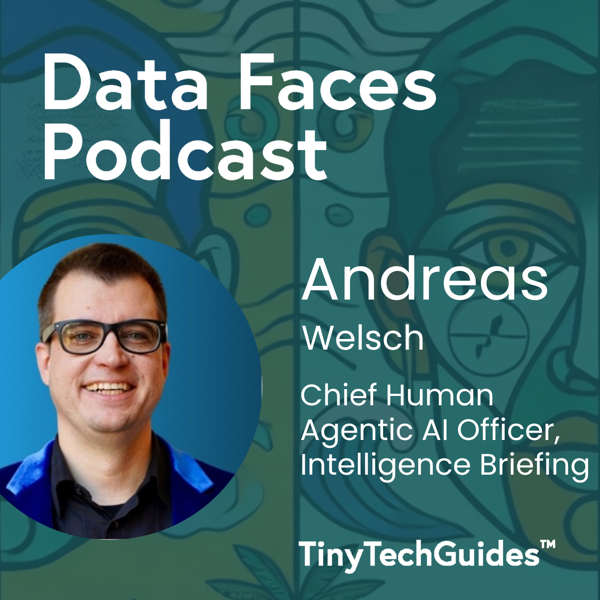
Andreas Welsch is the founder and Chief Human Agentic AI Officer at Intelligence Briefing, where he helps business leaders decide what to actually do with AI. He spent close to two decades at SAP, finishing as the vice president who ran the company’s AI Center of Excellence. He is the author of The AI Leadership Handbook and The Human Agentic AI Edge, an adjunct professor, a LinkedIn Top Voice, and host of the What’s the BUZZ? podcast.
In this episode
- The “should we?” test that separates real AI value from sunk cost
- Why the rush to cut headcount with AI spreads like a contagion — and the revenue question almost nobody asks
- Why so many teams are burned out doing the work of five people
- Pilots vs. production, and why people have gone quiet about what they’re actually building
- The truth about “SaaS is dead,” and why agent risk compounds as you add more agents
→ Read the full article: The question that separates AI value from sunk cost
Full transcript
David Sweenor 0:05 Hello, everyone, and welcome to the Data Faces Podcast. I’m David Sweenor, founder of TinyTechGuides and your host for today’s show. In this show, I talk with the people who are actually making data, analytics, AI work in the real world. What’s exciting, what’s messy, and what’s coming next? Today on the Data Faces Podcast, I’m joined by Andreas Welsch, founder of the intelligence briefing and author of not one, but two books, the AI Leadership Handbook and the Human Agentic AI Edge. He spent more than two decades at SAP building enterprise AI from the inside, and now he’s one of the most direct voices on what agentic AI actually demands from business leaders. So let’s dive in. Andreas, welcome to the Data Faces podcast.
Andreas Welsch 0:52 David, thank you so much for having me. It’s a pleasure being on the show.
David Sweenor 0:55 Super excited to have you. Can you just tell us a little bit about yourself and your company?
Andreas Welsch 1:01 Sure. I’m Andreas Welsch. I help business leaders figure out what do we do with AI? It’s as simple as that. After that, it usually gets pretty complex. From what should our strategy be? What should our roadmap look like? What are the right things to prioritize? Most of all, how do we bring our people on board and help and empower and encourage them to use AI and use AI well?
David Sweenor 1:23 Well, there’s a lot to that, Andrea. So before we jump into the topic du jour, the show is called Data Faces. So I like to get behind the faces. You know, what did you do before your professional career? So what did you want to be when you grew up? Did you know you’re going to have your own company or did you want to be something completely different?
Andreas Welsch 1:48 So I would say the first memory that I have of a profession or of a job that I wanted to pick up was probably becoming a pediatrician. Okay. And that’s as far as possible away now from what I’m doing now. I think I realized pretty quickly that I actually have more of an engineering mindset and curiosity. And there are pictures of me being probably anywhere between four and six years old, having like one of these bigger toy cars that you can sit on and a screwdriver and trying to take it apart. Taking stuff apart was easy. RC cars. they all came apart but then i ended up with these extra parts and springs and screws and so things have gotten better since then which is is the good news um but i’ve always been driven by by the curiosity of how how do things work how do they work underneath and how can we make them useful so now i get to do that in in the context of ai energetic ai super exciting
David Sweenor 2:50 I love that. Well, it’s probably a safer bet taking a car, taking apart, you know, RC cars is better than people. Oh, my gosh.
Andreas Welsch 3:00 All right.
David Sweenor 3:04 Hey, well, this is very interesting. So I did some research on you and you spent a lot of time at SAP, I think close to 20 years. You ended up as VP running their AI Center of Excellence. I spent 12 and a half years at IBM and ended up in their analytics center of competency. And now we both run our own businesses independent of these larger organizations. So what was the moment you’ve decided, hey, I’m done with these big technology companies? And what did you learn about running your own thing that maybe the 20 plus years of corporate did it prepare you for?
Andreas Welsch 3:45 How much time do we have on today’s show? We have 27 minutes. So let me at least give you the key nuggets here. I’ve been fortunate to work with a lot of Fortune 100s, Fortune 500s during this first cycle of machine learning and how is it different from traditional programming. And I saw that organizations were running into the same challenges. time and again that they’ve run into with cloud, that they’ve run into with mobile and other trends too. That, hey, we have this new shiny object. Let’s go figure out what we can do with this. Throw spaghetti at the ball and see what sticks. And sometimes things stuck. Sometimes they all came crashing down. And when generative AI came up, I realized that there’s the same cycle starting again of, hey, we need to figure out what we can do with this. Let’s throw spaghetti on the wall and see what sticks. And like, hey, I actually think I can help so many more organizations with what I’ve seen during that first wave. in how to do it and how not to do it, that I want to give this a shot. I want to see how I can help make a meaningful difference, specifically in mid-size, upper mid-market businesses that might not have access to this experience yet, that also don’t work with McKinsey’s and Bain’s and BCG’s, that don’t have the Accenture’s and Deloitte’s and so on. Nothing wrong there, but just in terms of getting access to the information, making it meaningful. So that’s what’s motivated me to go out on my own. And quite frankly, I mean, I’ve got so many people in my network, much like yourself and others too, who have built their own businesses that from the outset, I always wondered, well, what if? What if I was able to do that? What would it take? What would you learn? And one of the first things that I learned was you are the CXO of your business, literally X anything from revenue to legal, to finance, to marketing, from HR to, you know, whatever else you name it. So, so many learnings over the past two years since I’ve gone independent. that I can apply in any other situation. Being able to connect with a lot more people across different industries, having your own voice, your own identity, your own brand that’s not associated to somebody else’s brand, I think is hugely beneficial and exciting too. And so just being able to have a more holistic view and impact on what is happening, that’s what’s driving and motivating me.
David Sweenor 6:19 You know, I do like that. I feel the same. It is much more meaningful. Sometimes I found myself at very large companies, I’ll say doing a lot of busy work for the sake of keeping you busy and doing work because they were paying you. But like, if you didn’t do it, would anything happen to the company? Probably not, but I’ve seen too many instances in my career where people felt like they couldn’t take a vacation because the company was going to implode if they were not there. But guess what? They go on vacation and the company just runs perfectly fine.
Andreas Welsch 6:51 Exactly. And I think once you realize that, that’s already a big step towards getting you thinking and thinking about what else is out there.
David Sweenor 7:02 That’s right. And, you know, I followed your Substack for quite a while now. It’s the AI Memo, I think. Is that? Yeah, that’s right. We had the good chance to meet at the Gartner conference a couple of months ago in person. So that was that was amazing. But I realize you had two books. And so your newest book is the Human Agentic AI Edge. And you are your title, I think. And we’re going to look this at the Chief Human Agentic AI Officer. Now, it was a bit of an oxymoron for me in that people want to automate us away or automate lots of jobs away, but I think you’re proposing the opposite. Maybe we need more of humanity interacting and using the AI. Is that one of the ideas there?
Andreas Welsch 7:49 It’s definitely going in that direction. And I think with so much technology being available, step one is how do we make it useful in business? And step two is how do we make sure that we still capitalize on the experience, on the expertise that we have in our business and that we as humans bring to the table to bring these two together? I see still so many conversations about AI-driven layoffs, about AI replacing people, about a reduction in entry-level roles. I’m also an adjunct professor here in Pennsylvania. And my students are asking, do you think I still have a job once I graduate here? Those are questions that we haven’t had to deal with in a long time. But I believe that as leaders are looking at technology, they really should look at what does it mean if we were able to 10x our productivity, our capability? What if we were able to build new products and new services? Because there’s technology that takes care of this foundational menial layer. It doesn’t mean that you have to cut headcount, that you have to cut cost, because I think that means you’re sacrificing future growth. So part of the book is about how do we empower and encourage our team members and employees to use AI and use AI well so we don’t end up with a low-quality slop in our inboxes. Well, we got a lot of that. 40 of them this morning. So that’s where leaders are challenged. The top pushes down AI. The bottom says, I don’t want to use this or I’m going to be replaced by AI in three to six months. How do you manage that? How do you navigate that? And at the same time… um what are some you know some some thoughts and and some practical frameworks grounded in experience i talked more to more than 50 people in preparation of the book how do you do that how do you bring ai into your business how do you get people to use it well without neglecting that we still need to have humans and human judgment when we use these systems yeah you know what’s really interesting you have like an optimistic approach to this and and i wish i feel like a lot of businesses
David Sweenor 9:59 don’t write they’re motivated most of them they’re not altruistic in any sense by profit and efficiency and productivity and so maybe they’re not dreaming big enough you know you mentioned they could 10x what they’re doing or with the same head count but maybe they just wanted this incremental incremental improvements with less head count and what i see is everybody i work you know my clients is people are burnout. They’re doing like five jobs now because they have, you know, a quarter of the staff maybe they had, say, I don’t know, a year ago. Are you seeing something similar with your clients and folks you talk with?
Andreas Welsch 10:40 So the way I see it, it’s a bit of a vicious cycle. So somebody asks, or first of all, somebody says, we’re going to change the way that we do business. We need fewer people. We need more technology. They haven’t figured it out yet either. They’re betting and banking on the future and on this to pan out. But by one leader saying this and media picking it up, it paves the way for the next one to say it. And it paves the way for financial analysts and investors to say, well, your competitor over there, they seem to run leaner. What are you doing? How are you optimizing your margin? How are you optimizing your cost? Well, guess what? We can also slash costs. And then we look good, too, to investors. But the problem is, again, having layers that continue until the morale improves. isn’t really the way to success. And we know this, and leaders know this too. Yet this is happening because somebody over here said they’re doing it. Somebody over there wants to follow. Somebody over there needs to follow. And that creates this vicious cycle. I wish there were more people asking, so how are you making more money? Not how are you optimizing your costs? So how are you making more money by giving- Get more revenue. It’s that simple. So why is everybody so fixated on cost and not on revenue? Revenue is a lot harder to achieve in that sense and building products that people want to buy and offering services that people need. It’s a lot harder to do that than taking out cost.
David Sweenor 12:18 Well, you’re right about that. And that’s probably why they hit the easy button. Like, we’re going to get this short-term win. I’m using quotes for those people that are listening. But in the end, I have a theory that this is all going to crash. They’re going to start to see negative customer sentiment. Sales are going to go down. And they’re like, oh. We don’t have enough people, and they’re going to start to hire people back, whether they’ll be full-times or consultants, advisors. I don’t know. I think there’s a lot of different ways it could go. Just looking for something here, right? Easy button. Oh, you have one. I think I need one of those. Just AI it. I love it. Just AI it.
Andreas Welsch 12:59 It’s like the red telephone. Speed dial. That’s right. That’s how that works.
David Sweenor 13:06 So let’s talk about AI agents a couple of years ago and maybe to a degree now. It was on a slide and we were debating, is it AI agents or agentic AI and really just not being productive, talking about nomenclature and definitions and things like that. So from where you sit today, advising leaders, what separates companies that are getting real value from agents and those that are still running pilots? I personally have not seen a lot of in-production. agentic workflows or AI agents. I see a lot of prototyping and experimentation, but that putting it out and unleashing it to the world is, I think there’s still a long ways to go, but I’d be curious to hear your thoughts.
Andreas Welsch 13:58 so in a way i i can uh adapt what i just said about how how is this momentum created about layoffs we can adapt this to how is momentum created about agentic ai one company says we we’re now building agents whether or not that’s true the next one picks it up and everybody else says and and you so i think we’re we’re luckily a little further than than just the slide where They’re companies coming out with their agents. They’ve been building agents or agentic platforms for the past year, year and a half, roughly. Now the next phase is, like I said, getting value from these platforms, deciding what are the right use cases, the right features, the right things to put in place. So we derive meaningful value. And it doesn’t end up as a proof of concept that dies on the vine or that we forgot we started it at one point. Companies that are doing this well, they’re looking at value from the very beginning. What does our current workflow, our current process look like? Where are opportunities to fundamentally change it? And it’s not easy. It’s especially not easy if you’re in a large organization. If you’re… a large oil and gas, large retail, large life science company. This is really, really hard work. Processes have been established for the past 15, 20 years. And they work. And that’s why we have a process. We know what’s the input and we know what’s the output. So why change? Well, change because there’s opportunity to do it better, faster, cheaper with the help of AI. But those companies that do do the hard work of figuring out What is still needed? What can we eliminate in this process? Are these steps needed? They are, first of all, setting up their sales for success to rethink how they organize this. The second one I would say is just because we don’t hear so much about it doesn’t necessarily mean it’s not happening. i’m confident that that the work is happening what i’m just seeing is less and less people talking about how they’re doing it how they’re using it personally i i love going to practitioner conferences the uh generative ai week um that iq pc hosts has been an excellent conference where practitioners and leaders share what are they doing in their business how they address governance, evaluations, what they use agents for, how much autonomy they give the agents, things like that. The AI Summit in New York at the end of December was an excellent conference too, where I heard several leaders speak about building agents, agents for their leaders, agents being a second brain or being an avatar of their leader that you can ask questions to and things like that. And those are things that I’m not necessarily seeing in media or in mainstream media. So the work is happening. I’m confident, especially in large organizations that have built the muscle. I feel it’s just fewer people talking about it because either it’s the competitive moat. If I tell you what I’m doing, then you might adapt it or you might do that too. Or you might say, haha, they’re so far behind, we’re already doing this. So I’ll keep my cards close to my chest. And on the other hand, there’s a good amount of risk too. If I’m a leader and I’m sharing that we’re investing in AI, in a genetic AI, But my workforce might get concerned that, hey, there are more layoffs coming. There’s more risk to my role. So I’m not as open to using the tools and participating in the innovation. So all of these factors, I believe, are contributing to the fact that we’re not seeing too much yet publicly. But then when we hear the stories or when we are in person and people are a little more open to sharing, there are some good examples coming out.
David Sweenor 17:32 Yeah, you know, one thing I find that’s pretty interesting among my clients, I’d be curious to hear if you have similar experience, but there’s a lot of people. So there are these board level initiatives and that’s fine. Those will happen. You know, you pick a few of them, they’ll work on them. But the people within the companies. They are innovating like crazy, trying to figure out, should I use Clog, Gemini, pick your favorite service, GBT, doesn’t matter, to do this. And they are innovating like crazy, but I see… everybody has their own thing now. And so there’s, but there’s no like coordination among them. And so, you know, this was like, it’s like, it was like when everybody had self-service BI, Hey, I got a dashboard here. I have a dashboard here. I have a dashboard here. I’ve seen the same parallel there. Are you seeing this among your, your, your clients?
Andreas Welsch 18:22 So what I feel generative AI has done really, really well for enterprises and actually companies of all sizes is getting people to get hands-on with the technology, especially with AI. You don’t need to be a data scientist. You need to speak a language, your native language. It doesn’t even have to be English. It doesn’t have to be German or French or anything, whatever language, right?
David Sweenor 18:45 Wait, do you speak German to it or English?
Andreas Welsch 18:48 I speak English, dude.
David Sweenor 18:50 Okay.
Andreas Welsch 18:50 Yeah.
David Sweenor 18:51 I’m just curious. You can pick a different language if you want.
Andreas Welsch 18:55 It’s just my Alexa that sometimes responds in German for whatever reason, even if I speak English. That’s funny. Maybe that’s where the plus comes from. Okay. So the thing is that I lost my train of thought. Where did we start? so we’re talking about everybody is innovating oh innovative yes thank you so what generative ai helped us do was get into this area of personal productivity yes i can summarize meeting minutes i can draft notes i can draft emails all these things. Now people are starting to warm up to the fact that I can also use it to do more desk research, competitive research, find opportunities, messaging, what have you. Lots of great things. You can connect it to your other tools. IT and legal and risk get a little itchy then with all the MCP servers and who knows who’s building what and what they’re connecting to and sharing with the data, but be that as it may. And so what we need to get back to where we started before generative AI is actually how do we make this operational for our team? Think about operational excellence. Think about process improvements. That’s just the one email that you send every week or every day or something. But what are we doing as a team? How can we automate these processes? We were there already with machine learning. Then Jenny and I came and we said, okay, let’s go to the innermost layer, almost like the onion. And we started at the very core of how do I do transcriptions in minutes and things. We need to go back to the outer layer. And from there, again, to what I see as the third concentric circle, like strategic differentiation. With the data we have, with the unique knowledge, with the customer base and the products and services we offer, what can we do that’s new?
David Sweenor 20:44 where ai helps us you know deliver this better faster cheaper the usual three yeah yeah definitely so you’ve been pretty direct that organizations are racing to you know we talked about it earlier they’re they’re they’re trying to do something with with ai whatever agentic or not and We’re talking about these great set of capabilities. You mentioned, hey, we got MCP servers, so they’re pretty easy to connect to everything within their business. You don’t really need IT’s involvement. They should be involved, but you can kind of do it on your own if you want. But we’re not talking so much about the consequences. So what are you seeing out there that maybe things aren’t going as stellar as they should be?
Andreas Welsch 21:37 So let’s start with what I think is a common misconception. SaaS is dead. We’ve heard this for the past few months. Every LinkedIn post is about that and the death of software, right? Yeah. And I recently upgraded my cloud subscription to the second tier, $100 a month, because I was maxing out the $20 plan pretty, pretty quickly and waiting another five hours. for the next quota or window to open wasn’t something that I wanted to do. Okay, so now I have $100 a month, and I started thinking, well, what else can I do with it? So I used some pre-built agents that somebody posted on GitHub to optimize my generative engine optimization of my website and SEO and AEO and these kind of things. was super exciting. And I thought, well, what else could I do? I could wipe code, sure. I’ve never been a professional developer, but I started my career in IT. I did a good amount of scripting, and I have a solid understanding of programming and logic and things like that. So I’m confidently dangerous, I would say. um and so i started building clones of apps that i regularly use um there’s a there’s a clone that i built for for docusign e-signatures you wouldn’t believe how easy it was to build that you have a document you upload it there’s some bounding boxes you add people or people’s information that you want to send this to there’s an email workflow once they go in and they say i want to sign The thing is locked and it’s saved in an object storage. I pay $20 a month for this. Not anymore. I do a lot of workshops and trainings. I use a tool called Mentimeter or Poll Everywhere. that let you do the live polls in your PowerPoint presentation. Oh, sure.
David Sweenor 23:33 Yeah.
Andreas Welsch 23:33 Great. It’s another $20 per month. So I thought, what about that? Can I rebuild this? In about two or three days, I rebuilt it. So once the subscription is up for renewal, I’m not going to renew. And there are four or five others. Mural for the digital post-its, a tool similar to Credly for credentialing. a microlearning platform. I’ve built all of these things over the past three weeks, roughly. Now I’m bringing them onto one common architecture. But the things that I learned, and that’s the big point I want to get across, is you’re actually paying for convenience and for peace of mind when you get a SaaS subscription. There’s somebody else that is maintaining that thing for you. For $20 a month? That’s actually a pretty good deal. You don’t need to worry about dependencies and the latest modules and regression testing and cybersecurity and data privacy. And what about the US and having people from Europe and the right to be forgotten type of thing? So you don’t need to worry about all of this. So all of a sudden, $20 for a DocuSign, it’s actually not that bad. Because I know it works and I can connect it to all these other things. Incredibly, sure, pretty expensive, but I don’t need to worry about the fonts and the alignment and does this work here and does it work there. And those are just the, what I would call, non-essential SaaS apps. Sorry if anybody takes offense here.
David Sweenor 25:00 No, no, but you can use them on your own for your personal, whatever you need to do.
Andreas Welsch 25:05 So where I think it’s a lot harder, though, to rebuild and replace is when you get to core enterprise software, whether that’s your ERP or CRM, your HR software, your finance applications, because there you need to have auditability. And again, there you want to defer some of the risk to the vendor. If this thing doesn’t work at Sunday at 2 a.m., who do you call? Not Joe, who’s vibe-coded the thing last weekend, but he called it the support hotline. And they’re on the hook fixing this. That’s why you pay the money. And it’s probably why you pay them the big bucks. So things like that is why I’m thinking, yes, there’s a shift happening from seed-based pricing per user, per seed, to value-based pricing, to maybe more consumption pricing, as we’re seeing this with Anthropic and their approach in the enterprise or token-based pricing. But at the end of the day, you need to decide what’s my core skill set. Comes back to core business strategy. What’s my core skill set? Am I good at building this? Should I be building this just because I can? And what is all the rest of the maintenance of the work that I end up doing now too just because I wanted to save $20 a month?
David Sweenor 26:25 That’s a good point. I’ve actually never… thought of that. It is fun to tinker. Can I replicate this thing? And you do it. You’re like, oh, it was working yesterday and something happened. It’s not quite working right today. So there’s definitely a balance of being an independent solopreneur or entrepreneur. It’s a little bit different than running any company with more than one employee. I don’t know if I’d want to… automate payroll for 10 people if I had 10 employees. I would pay somebody to do that, probably.
Andreas Welsch 27:00 Right. But if you have the development teams, if you have the IT developers doing this kind of work anyways, if you can replace a $5 million subscription with a $200,000 investment, Sure. Sure, right? That’s a different calculation than me being the CXO of my business, including the CTO.
David Sweenor 27:25 Yeah. I do like the CXO. Like, oh, today I’m an accountant. I hate it.
Andreas Welsch 27:31 Yes.
David Sweenor 27:33 Oh, my gosh. So, hey, we both have podcasts. You got What’s the Buzz?
Andreas Welsch 27:37 Yes.
David Sweenor 27:38 And I have this show. So we’ve all had lots of different conversations on both of our shows. So what is the one question you think more practitioners maybe should be asking or be asked by AI leaders that maybe you’re not hearing enough of?
Andreas Welsch 27:57 So to me, it comes back to what I was just sharing. And I think that the question is, should we really do this?
David Sweenor 28:06 Just because you can doesn’t mean you should.
Andreas Welsch 28:08 Yes, absolutely. So there are lots of good quotes like that. With great power comes great responsibility, for example. But one of the responsibilities is figuring out and making a decision, should we actually do this? Just because we can doesn’t mean that we should. And I think if you start there and approach many of these AI projects with that mindset of just because we can doesn’t mean we should, you will save yourself a lot of headache, a lot of sunk cost, a lot of trouble, a lot of politics. And ideally, you focus your investments on the things that do move the needle.
David Sweenor 28:47 Yes, interesting. I’d love to hear your thoughts on this. So you mentioned running out of tokens, and I think you and I are on the same cloud plan. And I’ve run out.
Andreas Welsch 28:55 I think I’ve gotten away to management a little better.
David Sweenor 29:00 But I said, oh, I want to future proof myself so I can run my same system with Gemini. It behaves, Gemini CLI, it behaves a bit differently and that behaves differently than Codex. I’m curious your thought on this idea of future proofing because five months ago it was GBT, then it was Gemini, now it’s Claude. A month from now it’s going to be something else. How do you, how do you, and they all work a little bit quirky.
Andreas Welsch 29:30 So I’m a little embarrassed to say this, but I’ll say it anyways. I’ve worked with a number of large enterprise clients and specifically around leadership training. And I saw a number of them use an open source front end called LibreChat. There’s another one that’s pretty popular in Europe that’s called LangDoc, but the idea is that you have this UI that kind of looks like any of your AI assistants, and it has a range of models that you can use. So from your Anthropic to Mistral to OpenAI and Gemini and what have you, anything, whatever your IT department… unlocks for you. You can build agents. You can do RAC. You can do web search and all the kind of things. So I spend more time than I’d like to admit setting up my own LibreChat because I wanted to see, again, can I get rid of my $20 subscription of ChatGPT and Cloud and Perplexity and just use this one front end? I haven’t used that little amount of AI in a long time because it’s clunky. I need to copy things from here to there. And then something doesn’t work. And I’m wondering, well, Am I running out of tokens for the re-ranker or for the web search thing? And how long is this going to last me? And so I feel like the idea of having this one front end where I can flexibly choose whatever model I want at the end turned out to be something that I didn’t really need. And again, paying for convenience, something that works, would have been perfectly fine. And not getting locked into a virtual server for the next year or two because it looked like a good deal. So here is my honest assessment. Because many people are asking, like you too, should I diversify? Should I build some things here and there and there? Or should I take them from here and move them there? And typically, my recommendation is if you have something that’s working, keep it there. Don’t touch it. Use it. Especially if you’re a business of one, how much time do we have to adapt from one to the next to the next? You spend a lot of time for very little gain. But as you’re finding a tool that works even better, see if you can sign up for that one and build something new there. And then you can still migrate it at some point. Tool hopping, I think there’s too much happening, too much innovation happening in the industry that it’s not necessarily worth using multiple or using this for here and then moving everything over.
David Sweenor 31:59 All right. Well, that’s a hot take for sure. And I do feel like you mentioned $20 a month. I feel like… It’s like my streaming subscriptions on TV. There’s like $20, $20. The next thing you know, I’m like, what am I spending all this on? I use half of it. So everybody out there, go audit your subscriptions and just cancel the ones you don’t need right now.
Andreas Welsch 32:19 Oh, yeah.
David Sweenor 32:20 Yes. Oh, my God.
Andreas Welsch 32:21 Unpopular opinion. Yes.
David Sweenor 32:23 That’s right. I have maybe just two questions before we run out of time. One is about your book. What did you find about the writing process? that maybe you underestimated. I know this is your second, but I’ve read some books and I’ve co-authored books and people are like, oh, I didn’t know that. Is there anything about the writing process that surprised you?
Andreas Welsch 32:47 so i i had planned to to work with a copy editor and with the line editor a human person um because i typically like the the interaction i like the experience the coaching the feedback and i talked to you to a few friends in my network and said why AI can do all of this. AI can do the editing. Shouldn’t you be using AI in testing? I’m like, yeah, I think there’s a point to this, so let me try. So I built three custom GPTs at the time, one as a developmental editor that usually helps you frame the idea and the thesis of the book. The second one is the copy editor, structural, consistency, coherence, syntax, these kind of things in the line editor, like going through it with a really fine-grained, fine-combed tooth. to see are there any spelling mistakes and things. What I found was that AI, or in this case ChatGPT, was a helpful assistant that really didn’t know when to shut up. So it was always helpful. So two things here. I wrote the manuscript myself, no AI involved, and then I uploaded it to ChatGPT and said, now look at this as a developmental editor, as a copy editor, as a line editor. OK, hey, I have these 10 suggestions. So I tweak my prompt and give me the top five that are really urgent and that I need to fix. Otherwise, this is going to be really bad, and people will find inconsistencies. And they’ll say, what did you do here? Then the next one, important but not as urgent. And then the last ones, yeah, you could do them if you want to. OK, so I go through this process. Here are the top five things you absolutely need to fix. I was blown away that it found it. that it found some inconsistencies that it found some factual inaccuracies super good at that right yeah so so things that i had remembered differently from news stories it said no no you’re incorrect actually this and and that happened okay well great My human editor probably would not have found that. But then came the part of it not being able to shut up or wanting to shut up. So I uploaded the next revision. It’s like, hey, and here are the next five things that are urgent and important. Here are the ones that you should do, and here are the ones that you can do. And I’m like, okay, well, I guess there’s a point. Okay, let me fix those other five and those. And then I uploaded the third revision, and it was still giving me feedback to the point where I’m like… i think if i implement that i’m actually seeing diminishing returns it’s actually getting worse than what it was before so what this taught me was i need to be very clear up until which point i do accept suggestions and recommendations from ai whether that is in the writing process or in the coding process or in anything else in research And I need to have enough expertise to say, until this point, and no further. That’s where I draw the line in the sand. Because otherwise, you depend too much on it, and you have no idea if it’s getting better or if it’s actually getting worse.
David Sweenor 35:46 That’s a great point. It is like some asymptotic approach to this netherworld. And then the quality goes way down. You do got to know when to stop. So maybe last question. And thank you for sharing that story. I had a lot of similar experiences. But the last question here. So maybe what’s the one piece of agentic AI conventional wisdom that you think is wrong?
Andreas Welsch 36:12 you hear all the time i’d love to end on a hot take here hot take would be it does everything for you and it does it perfectly all the time um i think there there’s a lot of potential let’s be honest but we’re still relying on a probabilistic system that can be confidently wrong. And even with governance, guardrails, harnesses, evaluation, and whatnot, we’re trying to fit this into a box. But there’s still so much wiggle room that even within the box, it could do something that is totally wrong or undesired. So to me, that is the big thing that we’re not talking enough about yet. When we put these systems into businesses, into processes, what if? How does that risk compound? Compounds exponentially, not linearly. And one agent is fine. Two agents is a little more complex. Three is even more complex. But we’re talking about these big visions of the future, of autonomous enterprises, of agentic enterprises. And all this stuff. But we’re really at the point where many are just building their first agent or maybe their second. And then, yeah, that’s the part for me. Lots of potential, but we’ll add lots of complexity and a good amount of risk, too.
David Sweenor 37:38 All right. Well, Andreas Welsch, the founder and chief human agentic AI officer at Intelligence Briefing. Where can people find you? Where can they find your book, your podcasts? Where do we go?
Andreas Welsch 37:52 Awesome. Wonderful. So first of all, go to intelligence-briefing.com. That’s where you find out all about me. Connect with me on LinkedIn. I’m a top voice. I’m a LinkedIn learning instructor. I’ve been incredibly busy since leaving corporate and I’m loving it. You’ll find both books on Amazon. Actually, Amazon now has AI generated translations. So you find both books in German, in French, and in Spanish by now. They were just released automatically the other day. um let me know what do you think there’s also the audiobook of it that’s ai generated all in on ai but uh as with anything in life everything in moderation so all right well a super fascinating discussion thank you for joining the dave faces podcast and i will see you out there thank you so much for having me bye